September 15, 2005
latimes.com
Gay Issues Split American Baptist Church
Congregations in the Southland and West Virginia prepare to leave the relatively liberal national denomination.
By Larry B. Stammer, Times Staff Writer
Leaders representing 300 American Baptist churches in Southern California and parts of other Western states announced Wednesday that they have taken the first steps to break with their national denomination because they said it had failed to declare homosexual practice incompatible with Christian Scripture.
Citing irreconcilable differences over homosexuality and Scriptural authority with their comparatively liberal denomination, American Baptist Churches USA, the board of directors of the denomination's Pacific Southwest Region on Friday approved a resolution to begin withdrawing from the 1.5-million member national denomination. The board also announced its intention to cut off its contributions to national headquarters as of Dec. 31.
At the same time, a theologically conservative lay leader in the West Virginia Baptist Convention, the largest in the national denomination, said Wednesday that he and his allies were preparing to follow suit. They said they would propose a secession resolution at next month's regional meeting in Clarksburg, W.Va.
If the two regions pulled out, their withdrawal could mark the largest single exodus of member congregations from any Christian denomination in the nation over the volatile issue of homosexuality. There are more than 5,800 local congregations in the denomination.The debates over homosexuality, including such issues as the blessing of same-sex unions and the ordination of openly gay and lesbian ministers, has engulfed the worldwide Anglican Communion and it's U.S. member, the Episcopal Church, as well as the United Methodist Church and Presbyterian Church, U.S.A.
American Baptist Churches USA is based in Valley Forge, Pa. It is far smaller and has been more theologically liberal on issues such as homosexuality than the separate and better known Southern Baptist Convention, which claims 16 million members.There was no immediate comment from national church headquarters in Valley Forge, despite repeated telephone calls.
Several steps must be taken before the Pacific Southwest resolution can take effect. The region's executive committee has until Dec. 8 to report back to its board of directors on various issues raised by a breakup, including the ownership of church property. If the board of directors approves the executive committee's recommendations, the region's 300 congregations would then be asked to vote on whether to leave American Baptist Churches USA.
Details are under review of how the vote and decision would be carried out.
The Rev. Glenn E. Layne, pastor of First Baptist Church in Temple City, estimated that 275 of the 300 churches would vote to part. "This is not a happy day," said Layne, who favors secession. "But I have to believe that God is preparing us for something better."He stressed that the move "is not a gay-bashing issue. This is an authority-of-Scripture issue."
The Pacific Southwest Region issued a statement confirming its intention to leave the denomination. Its executive minister, the Rev. Dale V. Salico, said Wednesday he wouldn't comment further.Salico's office also posted open letters to pastors and congregations on its website, http://www.abcpsw.com , Wednesday explaining its decision. Brian Scrivens, president of the regional board, spoke in one letter of "deep differences of theological convictions and values" with the national church. Scrivens wrote that the matter began coming to a head in November when the denomination would not implement a previously passed resolution that stated, "The practice of homosexuality is incompatible with Christian teaching."Other opportunities to implement the resolution failed during meetings in April and July, he said.
Another issue involved a practice of the national church of allowing local congregations that had been "disfellowshipped," or expelled from a regional group because of their liberal stands on homosexuality, to join another region. In one case, the liberal First Baptist Church in Berkeley was allowed to affiliate with the church's Wisconsin region.
Scrivens said the Pacific Southwest board was "deeply grieved" over its decision and continued to recognize colleagues in the national denomination as "beloved friends and co-workers."In Madison, Wis., the national executive director of the Assn. of Welcoming & Affirming Baptists, which supports gay and lesbian rights in the church, said that withdrawal by the Pacific Southwest and West Virginia regions — the two largest regions in the denomination — would be a major setback."It's hitting us very hard and heavily," said the Rev. Kenneth Pennings. "We're saddened by this move, but we're going to be stronger than ever on the other side of this move."
Baptists have long been known for jealously guarding the autonomy of local congregations, which hire their own pastors and elect their own governing lay Board of Deacons.
In the case of homosexual issues, national leaders have respected local congregations' decisions.
I have to hand it to Larry Stammers at the Times: the story is even handed and accurate.
Note this as well: the only reason I'm cited is this Blog. Hugh Hewitt (see www.hughhewitt.com), the author of BLOG, would be so happy.
Thursday, September 15, 2005

Wednesday, September 14, 2005
THE ELITE ARROGANCE OF WILLIAM HERZOG
If you want to know how the other side thinks, read this example of naked liberal arrogance.
Baked Clay Pots:
A Reflection on the Crisis Facing
American Baptists
William R. Herzog II
http://rogerwilliamsfellowship.squarespace.com/rwf-biennial-address-2005/
It is probably just a sign of aging. You know how our minds can play tricks on us. Or I could be deluding myself into thinking that I am seeing something that really isn’t there. I suppose that could happen easily enough. But the more I study the first century, the more it begins to look like the 21st century. Oh, not in the particulars, of course. The distance between then and now is immense, and I wouldn’t want to diminish the distance except for this nagging doubt that won’t let me go. I know that our technology is far superior, and our cultural mores are not the same. Still, in other ways, we are much more alike than different.
So it didn’t surprise me – although it probably should have had I been more alert to my environment – that, as I was reading the April 2005 issue of the ABE Connections,i I said to myself, “so, the Judaizers that once haunted Paul and the fledgling house churches in Galatia have returned but this time they are calling themselves `American Baptist Evangelicals (with a capital E).’” As Yogi Berra would have said, “it was deja-vu all over again.”
But I’m getting ahead of myself. Consider this slip of the tongue a preview of coming attractions, or distractions if you prefer. It is much more important for you to learn how I came to this conclusion than to hear the conclusion itself, although it is – I have to admit even to myself – a bit unexpected, to say nothing of being a bit startling. So let me step back from the precipice I have created and explain myself to you. I certainly owe you that much, at the very least. So here we go.
Most of you are familiar with the conflict between Paul and the so-called Judaizers in Galatia. Paul argued that the gentiles did not need to keep Torah, although it was just fine with him if the Judeans voluntarily chose to do so. After all, for Paul the Torah was simply one cultural way to live out faith, and if Judeans wished to express their faith through Torah obedience, then let them do so. But gentiles could not be forced to keep Torah because, to do so would imply that Torah was more than a cultural way of living out one’s faith. It would imply that keeping Torah was a prerequisite to living by faith. To obligate gentiles to keep Torah would mean that all peoples had to become Judeans first before they could become Christians, and Paul rejected that argument lock, stock and barrel (see especially Galatians 3).
With regards to salvation, one thing was essential for Paul – the righteousness of God, revealed apart from the law could now be appropriated by faith in Christ Jesus. Christ alone was sufficient for salvation; everything else (and I mean everything else, even one’s stand on controversial issues) was secondary. Just as the Judeans had the Torah to guide them, so the gentiles had the Spirit to guide them (see Gal. 5:16-26). But, once they were “in Christ” (by which Paul meant (1) spiritually in Christ and (2) in the body of Christ, the house church) both groups faced a similar task of spiritual discernment. Both Judeans and gentiles had to sort out what in their culture was compatible with their faith in Christ and conducive to it, and what cultural trends clashed with faith and undermined it. But it was the same task for each group. Talk about culture wars. They are nothing new.
The Judaizers took a dim view of Paul’s “gospel,” especially its exclusive emphasis on the sufficiency of faith in Christ. What isn’t always noted is that their disagreements with Paul and other early church leaders (see Acts15:1-35) were rooted in a particular – some might even say a peculiar – view of Scripture, and this is where they begin to look like American Baptist Evangelicals (with a capital E). Like their ancient counterparts, the ABEs are certain that they have the real Scripture, the whole Scripture, and nothing but the Scripture, unadulterated and uninterpreted, and like their contemporary counterparts, the Judaizers believed that the authority of their Scripture was so complete that believers should sacrifice their freedom in Christ for obedience to their Scripture, which meant their view of Scripture. More insidiously, the ancient Judaizers, like their contemporary counterparts, had imported a humanly devised theory of inspiration to elevate their interpretation of Torah/Scripture and to press its demands.
Just exactly what did that look like. The Pharisees who appear to be the primary group among the so-called Judaizers held to an “oral Torah” whose authority was equal to that of the written Torah itself. They even devised a story to authenticate its elevated position. The first time Moses ascended Mount Sinai and came down from the mountain (so the story goes) , he brought the Torah, but when he saw the people worshiping the golden bull, he dashed the tablets on the ground (or if you follow Mel Brooks’ version of the event, he was a klutz who dropped one of the tablets on the ground). The second time Moses ascended the mountain, he remained long enough to have a conversation with Yahweh about the meaning of the Torah, so when he descended Sinai the second time, he brought not only the tablets of the Torah, the written Scripture, but also the conversation with Yahweh, the basis of the oral Torah. On his second ascent of the mountain, Moses received not only the tablets of the law but a set of clarifying interpretations, the Torah and the oral Torah, which the Pharisees/Judaizers packaged as one.
Of course, the oral Torah provided a convenient way for Pharisees to pass off their own interpretation of Scripture as Scripture itself, a practice continued down to the present day, and one to which (you will be shocked toknow) I am not immune. Now the Pharisees could claim that they were just reciting the meaning of the Torah when they were, in fact, passing off their interpretation of Torah (their oral Torah) as Scripture itself.
To catch the significance of this tale, take the recent statement by Bill
Nicoson entitled, “A Clarion Call,” in the April issue of ABE Connections.ii We have become, he argues, a denomination with two different religions:
(1) one that follows the belief and understanding of biblical authority in the evangelical tradition and (2) another that believes in superceding biblical authority with the American Baptist practice of soul liberty.iii
Notice the difference between the two statements. The first religion propagates a view of biblical authority (Torah) in the evangelical tradition (oral Torah), but in the second statement the two are collapsed into one, soul liberty versus biblical authority (used without qualification). Even more disturbing is the authoritarian agenda implied in Nicoson’s statements. He issues a dire warning that “soul liberty and Baptist polity are being used to usurp biblical theology and authority,”iv though, curiously enough, he defines neither biblical authority nor biblical theology. This omission reflects a regrettable tendency among so-called evangelicals to invoke biblical authority, rather than to define it, to talk about Scripture rather than engaging Scripture.
Notice again the unqualified use of biblical authority which suggests that there is a single view of biblical authority that happens to be the one assumed by the ABEs, though what this means is never spelled out. What frustrates Nicoson about soul liberty and Baptist polity is that, if followed, they mean that “you cannot tell an ABCUSA church what to do.”v Hello! Is anybody home? [I want you all to know that, though I was sorely tempted, I did not say, “duh!”] That is the glory of soul liberty and Baptist congregational polity! And its significance has never been clearer than at moments such as this when a group of Baptists, who have lost their way and their identity as baptists, attempts to impose their cultural agenda on everyone else. You don’t have to be a brain surgeon to imagine what kind of polity Nicoson and his ilk would impose on every church in this denomination while hiding behind a thoroughly humanly
constructed view of biblical authority that justifies their every move.
Nicoson evidently fails to see the irony of his own position, and his entire clarion call suffers from an absence of doubt. He is frustrated because Baptist polity prevents him from forcing his agenda on local churches who do not share his view of the issues dividing our denomination. This is the complaint of a fundamentalist Southern Baptist, not an American Baptist. What troubles him is what makes Baptist polity and soul liberty indispensable to our Baptist principles. They are intended to protect the minority from the tyranny of a majority.
But let’s be clear about this much: The issue is not, as Nicoson puts it, “when biblical authority is replaced by `soul liberty’ or any other man-made invention, unity is sacrificed.”vi The doctrine of biblical authority implied but never spelled out in this article leads directly to making less than 10 verses of Scripture into the sole issue that preoccupies the denomination. This is what happens when fundamentalists talk so much about the Bible that they don’t bother to deal with its great themes of judgment, justice and justification, righteousness and redemption, forgiveness and empowerment. Since theology abhors a vacuum, when the great themes of Scripture are ignored, any nuisance can fill the vacuum that should have belonged to the living core of Scripture.
The fundamental issue and question is this: What happens when a malignant view of biblical authority replaces a healthy one? Just what is this malignant view of biblical authority? It is a view of the Bible as an inerrant document whose every word must be as authoritative as every other word. This is why the zealots in ABE can focus on less than ten verses or so and hold them up as a litmus test for every church in the denomination. If Scripture is inerrant, then it doesn’t matter whether the Bible treats an issue in a dozen verses or a hundred chapters. This undifferentiated view of the Bible takes the Bible as a completed product requiring no interpretation except the culturally constructed interpretation that the American Baptist evangelicals have passed off as the Scripture itself. It is as though each verse was chiseled in stone, like the decalogue, and only needs to be invoked and repeated. The so-called position paper from the First Baptist Church of Keokuk, Iowa, is an example of this view of biblical authority in action.vii The framers of the document write:
As deacons of our congregation we have spent much time in prayer and Bible Study of God’s Holy Word and based on the following scriptures – Lev 18:12; Lev 20:13; I Cor 6:9-10; Rom 1:26-27; I Tim 1:10; II Peter 2:1-2, we are taking the following position:
The First Baptist Church unequivocally rejects homosexuality as an acceptable lifestyle, ordination of homosexual pastoral leadership, and same-sex marriage being contrary to scriptural teaching. (Just what teaching is not mentioned, a regrettable omission since Scripture knows nothing of same-sex marriage or ordination or homosexual lifestyles.)
Seldom has so much been condemned based on so little! (With apologies to Winston Churchill!) The non-engagement with the Scriptures is stunning, even more, it is insulting to Scripture. And this from people who presumably view themselves as clothed in biblical authority. The Position Paper (non-position paper would be a more apt description) says not a word about the language used in the passages, their contexts in Scripture or the practices to which they are addressed. They are simply invoked to set up a blanket condemnation of what the deacons have already decided to condemn. This sounds something like the Jesus Seminar in action. Surely, we can do better than this!
In light of this misuse of Scripture, it is refreshing to read the latest
“Resolution of West Virginia Baptist Churches For Biblical Truth in the ABC/USA.”viii At least, they make no pretense about engaging biblical texts. They have decided that threats should replace Bible Study and denominational discussions. The only reference in the document to the Bible is this:
Whereas, God’s Holy Word I Cor 5:11 says that we should not “... keep company with anyone named a brother who is sexually immoral ...” etc.
This is exactly what Simon the Pharisee said to Jesus after the woman anointed Jesus’s feet with her tears and alabaster ointment. (Luke 7:36-50) Jesus kept table companionship with toll collectors, prostitutes and sinners. Of course, to make a point, I have done the very same thing that the “biblical truth” folk are doing, citing proof text for proof text. What point am I making? Just this: the principle of Paul and the practice of Jesus conflict. One does what the other condemns. If we take a flat, so-called literal reading of Scripture, we will either have a psychotic break or figure out some scheme to make the contradiction go away. The solution of many of the ABEs would, no doubt, be to invoke a pre-millenial, dispensational approach to the Bible. This view of Scripture relegates Jesus’s teachings to the dispensation of the kingdom. They are irrelevant to the dispensation of the church which is covered by Paul’s letters and the other non-Gospel material in the New Testament. How is that for a “literal” reading of Scripture?
By contrast with this approach, it would be possible to place each text in its context so that we may ask why Paul said what he did and what he meant to accomplish by issuing the warning. When we do, we discover that Paul is addressing a case in which “a man is living with his step mother” and having sexual intercourse with her. This violates sexual taboos, including Torah, and Paul condemns this perverted heterosexual behavior. Now we come to the verse from which the “West Virginia Baptist Churches For Biblical Truth” took their snippet of Paul. The whole verse reads as follows,
But now I am writing you not to associate with anyone who bears the name of brother [or sister] who is sexually immoral or insatiably greedy, or is an idolater, an abuser, drunkard or swindler. Do not even eat with such a one. (I Cor 5:11, author’s trans.)
It is clear that the West Virginians for Biblical Truth have provided their own abridged, Readers’ Digest version of the text, conveniently omitting the behaviors that we hallow in our capitalist society, such as cultivating insatiable greed through tax breaks and swindling workers out of their retirement funds. Nowhere does the passage refer to homosexuals. This isn’t biblical interpretation! It isn’t even a responsible use of proof texting. It abuses Scripture and beats it into submission to a previously set agenda. No wonder these West Virginia churches are reduced to threatening to get their way. If this is the best they can do, they haven’t got a biblical leg to stand on. So much for biblical truth, West Virginia style.
Respecting the context of the passage from I Corinthians helps us to see that Jesus’s behavior of eating with toll collectors, prostitutes and sinners serves a different agenda. Jesus sits at table with the poor and the outcast who have been forced into demeaning behavior (prostitution) or swindling others (toll collectors). They are the last, the lost and the least. He includes them in this dramatic gesture of table companionship to indicate the covenant love of God who gathers the outcasts of Israel (see Isa 56:1-8). Jesus goes to the outsiders, not the insiders, whereas Paul addresses the corrupt insiders who continue to practice exploitive and abusive behaviors, taking advantage of others or making a mockery of the life of discipleship. Paul is trying to protect the boundaries around the house church, whereas Jesus is extending the boundaries of God’s covenant love. So, using a context sensitive approach to the biblical texts helps us to understand the Word they speak to us. On closer scrutiny, what appears to be a contradiction disappears.
Before we finish with I Cor 5:11, I want to return to the way that the West Virginians for Biblical Truth used the text. When Paul condemned the heterosexual behavior of the man and his step mother, was he condemning all expressions of heterosexuality? Of course not. But suppose, by analogy, that the only contexts in which Paul did see heterosexual relations were temple prostitution, porneia (screwing around or indiscriminate heterosexualrelations) or the sexual abuse of adolescent girls by older heterosexual men. Under these circumstances, what would he have said about heterosexuality? He probably would have condemned it as unnatural, exploitive and abusive. This is, in fact, what was the case for homosexual relations in the ancient world. The only contexts in which Paul saw same gender sexual relations were temple prostitution, pederasty (the sexual abuse of pre-pubescent boys by their tutors), porneia or screwing around, and crossing over (constitutional heterosexuals crossing over into homosexual behavior in Roman orgies; see Rom 1:26-27). We would expect Paul to condemn such expressions of same gender sexuality, and he did. All the passages cited by the First Baptist Church of Keokuk, Iowa, refer to these kinds of sexual abuse. This is what Paul condemned – sexual abuse, not same gender relations. So, in an ironic way, the West Virginians and the Keokuk Iowans have shown the way to undermining their own position, and I thank them for their assistance.
All of this means that the issue is not soul liberty versus biblical authority, as the American Baptist Evangelicals would have it, but two views of biblical authority and interpretation. One view sacrifices the soul liberty of the biblical interpreter on the altar of biblical authority, an authoritarian view of the Bible as a static book in which every word (in what language is never clear) is inerrant. This leads to so many quandaries and contradictions that the biblical authoritarians must devise schemas for interpreting Scripture (like pre-millenial dispensationalism) while they deny what they are doing Their purpose seems to be to present their positions on controversial issues as divinely inspired truth and to force others to adhere to their position. In fact, these positions on issues represent the “oral Torah” of this contemporary version of the Judaizers who are trying to pass it off as the Torah itself.
To this approach, the adherents to soul liberty say, with the apostle Paul, “for freedom Christ has set us free. Stand firm, therefore, and do not submit to a yoke of slavery” (Gal 5:1) even when that yoke of slavery is presented as an inerrant Bible. Those committed to soul liberty acknowledge that Scripture requires interpretation. Indeed the very character of Scripture as Torah (God’‘s instruction in the meaning of covenant) invites us into this very task. God encourages us to join this lively and liberating conversation, even respecting our interpretations, partial and incomplete though they be. Because our interpretations are partial and incomplete, they are always arguable and subject to dialogue and debate.
When we acknowledge that soul liberty invites us to become biblical interpreters, we can understand the statement of John Robinson, “God hath yet more light to break forth from His holy Word.” That light breaks through as the result of our interpretive work. Soul liberty opens up the Scriptures as surely as biblical authoritarians close Scripture to inquiry and exploration.
But here is the heart of the matter. Just like the Judaizers before them, the ABEs are arguing that something more than faith in Christ is required. The Judaizers saw that something more as circumcision and Torah obedience. The ABEs believe we must condemn and purge gays and lesbians from denominational life to purify American Baptists. But, as Luther knew so well, the equation of faith that begins with Christ + (fill in the blank) = salvation, is doomed to failure. Just now, the formula seems to be Christ plus homophobia equals saving faith, that is, the ABEs are arguing that faith in Christ is inadequate for salvation and maintaining koinonia. To John 3:16 we must add the sentence, “the practice of homosexuality is incompatible with Christian faith.” It is no longer enough to say “I have been crucified with Christ; and it is no longer I who live but Christ who lives in me,” we must add to that sublime truth the sentence, “the practice of homosexuality is incompatible with Christian faith.” We cannot affirm as the bond of our unity “so if anyone is in Christ, he or she is a new creation; behold, the old has passed away, the new has come” without adding, as a statement of faith as important as Paul’s writings (what happened to the authority of the Bible here), “the practice of homosexuality is incompatible with Christian faith.”
The issue of biblical authority is little more than a presenting problem that masks a larger agenda. The attempt to force Welcome and Affirming churches out of the denomination is the most visible part of a larger picture. Dr. Larry F. Johnston’s advice to the General Board (as reported inConnectionsix) was to rid the denomination of these menaces. Nicoson comments that “it is becoming increasingly clear that we cannot keep everyone on the bus.” So the consultant’s clarion call was to throw the GLTBs under the bus. Sacrifice them for the good of the denomination. Just what kind of denomination we would be if we followed this sage counsel and pursued the purge, no one seems willing to discuss. Make no mistake about it. If the ABEs win, this purge will be a prelude to a full-blown pogrom against women in ministry and other undesirables and persona non grata, like the members of the Roger Williams Fellowship.
The purpose of these remarks was to say of the American Baptist Evangelicals (with a capital E) and their view of biblical authority – “the emperor has no clothes.”
But more than that, I want to suggest that the time may well have come for a denominational split. Do we want to spend the next decade arguing with zealots who believe their cultural theology is an inerrant word from God? Do we really believe that we can begin any serious conversation with thepremise: “I’m right and you’re wrong,” or is it, “I’m OK but you’re no damn good. Let’s discuss it!” Do we want to spend the next decade deconstructing the work of the Judaizers or would we prefer to engage in more constructive tasks, like proclaiming the gospel of God’s justice and justification revealed in Christ Jesus our Lord? Jesus once said,
No one puts new wine in old wineskins; otherwise the wine will burst the skins, and the wine is lost, and so are the skins; but one puts new wine in fresh wineskins. (Mark 2:22)
Perhaps we are feeling the levels of frustration we are because we sense that the new wine fermenting in our midst is about to rupture the boda bags in which we have, to this point at least, kept our wine.
We were once foolish enough to accept a one sentence resolution, “the practice of homosexuality is incompatible with Christian faith,” even though it violated American Baptist Resolution 8175 that had stood since December of 1988. The resolution explicitly identifies sexual orientation as one of the areas where prejudice manifests itself. That resolution stood on a policy base, the American Baptist Policy Statement on Human Rights, adopted in December of 1976. Through our own carelessness, we have admitted a statement that reeks of prejudice and bigotry and, in some quarters, is already being used in efforts to deny basic human rights to the GLTB community. We are in danger of moving from a denomination that values liberation to one that is becoming oppression. Once we have abandoned our own policy statements, we endanger our policy statement on racial justice and anti-semitism. What is next?
As Paul learned in the house churches of Galatia, the price of a liberating gospel is eternal vigilance. So he engaged the Judaizers and refused to let them redefine the gospel so that it included Christ + other stipulations. Christ plus homophobia is no gospel at all. Christ alone is good news. The time has come to make clear that we are following Paul’s lead, and we will not turn the Bible over to modern Judaizers.
Finally, what image shall we use to describe our ministry. I like the way Paul puts is in II Cor 4:7-12.
But we have this treasure in baked clay pots to show that the
extraordinary excess of power is God’s and not from us. In all things, hard-pressed but not depressed, at a loss but not at wit’s end, hounded but not deserted, knocked down but not shattered, at all times carrying in our bodies the dying of Jesus so that the life of Jesus might show more clearly in our bodies. (author’s trans.)
Not bad for baked clay pots. This is worth exploring. This is what we are called to do and to become. The boda bags may burst, but the baked clay pots will see us through this change.
Thank you for your time, your patience and your attention.
TEXT OF PSW NEWS RELEASE
American Baptist Churches of the Pacific Southwest
News Release September 14, 2005
The American Baptist Churches of the Pacific Southwest Board of Directors has decided to begin the process of withdrawing from the Covenant of Relationships of the American Baptist Churches in the USA. The resolution approved by the PSW Board September 8, 2005, states:
“Because the deep differences of theological convictions and values between the American Baptist Churches of the Pacific Southwest (ABCPSW) and the American Baptist Churches in the USA (ABCUSA) are understood by the Board of Directors of the ABCPSW as irreconcilable, the Board of Directors of the . . . effective September 9, 2005 . . . [will] initiate the process to withdraw from the Covenant of Relationships of the ABCUSA. . .”
According to Dr. Dale V. Salico, Executive Minister of the ABCPSW, “The Region Board has . . . determined that the time has come to create distance between the ABCPSW and the ABCUSA so that both may move ahead in the mission God has given them without continual conflict.”
While conflict between the Pacific Southwest Region and the ABCUSA has centered on issues relating to homosexuality, the underlying tensions reflect different values of the two organizations regarding Biblical authority and accountability. According to Brian Scrivens, President of the Region Board of Directors, the decision to begin the process for withdrawal from the ABC covenant came “in response to the inability of the ABCUSA to adopt meaningful implementation of the Resolution on Homosexuality.”
The Board of Directors of the ABCPSW expressed its grief over this decision . “We continue to recognize our brothers and sisters in Christ in the ABCUSA as beloved friends and co-workers in the Body of Christ,” President Scrivens stated. “Because of our long history and many common concerns in gospel ministry, we will have opportunities for continued fellowship and partnership. Our decision to withdraw from the Covenant of Relationship is made without animosity or malice. We will continue to pray for God’s blessing on the ABCUSA, its leadership, agencies and congregations.”
The effect of the decision will be to create some distance between the ABCPSW and the ABCUSA in order to clarify the distinctiveness of their values and ministries. Leaders from the ABCPSW anticipate conversations with leaders of the ABCUSA concerning areas of mission that remain important to the congregations of the Pacific Southwest Region.
The Executive Committee of the ABCPSW, after studying issues related to this decision will make final recommendations to the Region Board of Directors on December 8. Upon the ABCPSW Board of Directors approval, recommendations will be sent to the churches for a vote at a specially called meeting of the Region. The final decision regarding withdrawing from the Covenant of Relationships will rest in the hands of the churches of the Region.
This was emailed to me today; time stamp is 4:39 PM.
News Release September 14, 2005
The American Baptist Churches of the Pacific Southwest Board of Directors has decided to begin the process of withdrawing from the Covenant of Relationships of the American Baptist Churches in the USA. The resolution approved by the PSW Board September 8, 2005, states:
“Because the deep differences of theological convictions and values between the American Baptist Churches of the Pacific Southwest (ABCPSW) and the American Baptist Churches in the USA (ABCUSA) are understood by the Board of Directors of the ABCPSW as irreconcilable, the Board of Directors of the . . . effective September 9, 2005 . . . [will] initiate the process to withdraw from the Covenant of Relationships of the ABCUSA. . .”
According to Dr. Dale V. Salico, Executive Minister of the ABCPSW, “The Region Board has . . . determined that the time has come to create distance between the ABCPSW and the ABCUSA so that both may move ahead in the mission God has given them without continual conflict.”
While conflict between the Pacific Southwest Region and the ABCUSA has centered on issues relating to homosexuality, the underlying tensions reflect different values of the two organizations regarding Biblical authority and accountability. According to Brian Scrivens, President of the Region Board of Directors, the decision to begin the process for withdrawal from the ABC covenant came “in response to the inability of the ABCUSA to adopt meaningful implementation of the Resolution on Homosexuality.”
The Board of Directors of the ABCPSW expressed its grief over this decision . “We continue to recognize our brothers and sisters in Christ in the ABCUSA as beloved friends and co-workers in the Body of Christ,” President Scrivens stated. “Because of our long history and many common concerns in gospel ministry, we will have opportunities for continued fellowship and partnership. Our decision to withdraw from the Covenant of Relationship is made without animosity or malice. We will continue to pray for God’s blessing on the ABCUSA, its leadership, agencies and congregations.”
The effect of the decision will be to create some distance between the ABCPSW and the ABCUSA in order to clarify the distinctiveness of their values and ministries. Leaders from the ABCPSW anticipate conversations with leaders of the ABCUSA concerning areas of mission that remain important to the congregations of the Pacific Southwest Region.
The Executive Committee of the ABCPSW, after studying issues related to this decision will make final recommendations to the Region Board of Directors on December 8. Upon the ABCPSW Board of Directors approval, recommendations will be sent to the churches for a vote at a specially called meeting of the Region. The final decision regarding withdrawing from the Covenant of Relationships will rest in the hands of the churches of the Region.
This was emailed to me today; time stamp is 4:39 PM.
LA TIMES ON ABC/PSW ISSUE
2:50 PM PDT, September 14, 2005
latimes.com
Gay Issue Divides American Baptist Leaders
By Larry B. Stammer, Times Staff Writer
American Baptist leaders of 300 local churches in Southern California and other Western states said today they intend to break with their national denomination because of its failure to declare that homosexual practice is incompatible with Christian Scripture.
A resolution to withdraw from the 1.5-million member American Baptist Churches USA was made by the Pacific Southwest region's board of directors at its Covina headquarters.
The resolution cited "deep differences" over homosexuality that were "irreconcilable."The resolution, approved Sept. 8, comes at a time when other American Baptist regions in the U.S. were also poised to consider breaking with their denomination. Several steps must be taken before the Pacific Southwest resolution can take effect. The region's executive committee must report to the region's board of directors by Dec. 8 on property ownership and other issues related to the break. If the board approves, a recommendation that the region leave the 5,000 church national denomination would be sent to the region's 300 local congregations for a vote.If the local congregations concurred, the break would constitute the single largest withdrawal from a national denomination by its member churches. The protracted and wrenching debate over homosexuality has previously engulfed the worldwide Anglican Communion and it's U.S. member, the Episcopal Church. The issue has also threatened the unity of the United Methodist Church and Presbyterian Church, U.S.A..
While American Baptists have debated homosexuality for years, the issue was brought to a head in July when conservatives said that the national denomination failed to take a decisive stand against homosexual practice.
American Baptists are a smaller denomination than the better known Southern Baptists.
Source: http://www.latimes.com/news/nationworld/nation/la-091405baptist_lat,0,3402520.story?coll=la-story-footer&track=morenews
latimes.com
Gay Issue Divides American Baptist Leaders
By Larry B. Stammer, Times Staff Writer
American Baptist leaders of 300 local churches in Southern California and other Western states said today they intend to break with their national denomination because of its failure to declare that homosexual practice is incompatible with Christian Scripture.
A resolution to withdraw from the 1.5-million member American Baptist Churches USA was made by the Pacific Southwest region's board of directors at its Covina headquarters.
The resolution cited "deep differences" over homosexuality that were "irreconcilable."The resolution, approved Sept. 8, comes at a time when other American Baptist regions in the U.S. were also poised to consider breaking with their denomination. Several steps must be taken before the Pacific Southwest resolution can take effect. The region's executive committee must report to the region's board of directors by Dec. 8 on property ownership and other issues related to the break. If the board approves, a recommendation that the region leave the 5,000 church national denomination would be sent to the region's 300 local congregations for a vote.If the local congregations concurred, the break would constitute the single largest withdrawal from a national denomination by its member churches. The protracted and wrenching debate over homosexuality has previously engulfed the worldwide Anglican Communion and it's U.S. member, the Episcopal Church. The issue has also threatened the unity of the United Methodist Church and Presbyterian Church, U.S.A..
While American Baptists have debated homosexuality for years, the issue was brought to a head in July when conservatives said that the national denomination failed to take a decisive stand against homosexual practice.
American Baptists are a smaller denomination than the better known Southern Baptists.
Source: http://www.latimes.com/news/nationworld/nation/la-091405baptist_lat,0,3402520.story?coll=la-story-footer&track=morenews
WEST VIRGINIA FOLLOWING IN WAKE OF PACIFIC SOUTHWEST; VALLEY FORGE REACTS TO PSW ACTION

Wednesday, September 14, 2005
News Release
West Virginia Baptists To Deal With Homosexual Issue
9-12-05
CLARKSBURG – Because of the practice and affirmation of homosexuality among some American Baptist clergy, delegates to the West Virginia Baptist Convention (WVBC) annual meeting in Clarksburg next month will be asked to vote on whether or not to withdraw from their national denomination, the American Baptist Church, USA (ABC-USA).
In a letter dated 9-9-05 and sent to all WVBC churches, the West Virginia Baptists for Biblical Truth (WVBBT) announced their intentions to submit, for a vote of the convention delegates, an amendment to the WVBC constitution that would remove the WVBC from association with the ABC-USA.WVBBT is a coalition of 65 West Virginia Baptist churches organized to address the issue of sexual immorality in the churches of the ABC-USA. Their letter claims that the ordination of practicing homosexuals and the affirmation of the homosexual lifestyle by some ABC-USA churches is contrary to biblical teaching. According to Jay Wolfe, chairman of the WVBBT, WVBC churches represent the largest region out of the 35 ABC-USA regions across the United States. “West Virginia Baptists have been fighting the homosexuality issue within the church since 1991 – and the acceptance of it by the ABC-USA leadership has only gotten worse. It is time to stand on God’s word and break fellowship with those who condone flagrant sin in the church,” Wolfe said. When asked if he thought God would exclude homosexuals from the church, Wolfe replied, “The attributes of God revealed in His word show Him to be forgiving and merciful, unwilling that anyone should perish. But once we become a Christian by accepting His grace and are born again into His family, He calls us to a higher level of accountability in regard to sin. Like the woman in John chapter 8 that was caught in the act of adultery, Jesus said to her, ‘neither do I condemn you: go and sin no more.’”
There are approximately 460 West Virginia Baptist churches scattered throughout West Virginia. Usually, these are the oldest and largest Baptist churches in West Virginia cities. WVBC offices are located in Parkersburg. Dr. David Carrico is the WVBC Executive Minister.
For more information call: Jay Wolfe 304-844-0906WVBBT, RR 4 Box 56, Salem, WV 26426
Wednesday, September 14, 2005
ABC Newservice Reports: September 14, 2005
NEC EXPRESSES ‘DEEP REGRET’ OVER PACIFIC SOUTHWEST MOVEMENT TOWARD WITHDRAWAL FROM COVENANT
VALLEY FORGE, PA (ABNS)—The National Executive Council of American Baptist Churches USA today expressed “deep regret” over the action this week by the Board of Directors of the American Baptist Churches of the Pacific Southwest to move toward initiating withdrawal from the denomination’s Covenant of Relationships.
The NEC statement reads as follows: “We deeply regret the action taken by the ABC of the Pacific Southwest, whom we love in Christ, to begin movement toward withdrawal from the Covenant of Relationships. Our denomination has been blessed by the historic commitment by our regions to interdependent dialog and action for mission in the name of Christ. We grieve when partners in ministry move away from that covenantal relationship."
To read the rest of the news release go to www.abc-usa.org
Source: abeonline.org news section today.
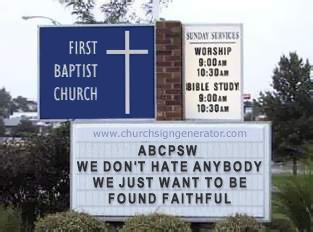
National Media Interview

A reporter from a national media source interviewed me a few hours ago. That source may appear in the next day or so, and I have been asked not to divulge the source. I will also be out of town Thursday and Friday, so it may be a few says before I have anymore to say on this. Stay tuned...
THE OFFICIAL WORD FROM THE PSW OFFICE
From the PSW website...
ABCPSW Board Decision...
We are writing to inform you of an important decision by the Board of Directors of the American Baptist Churches of the Pacific Southwest (ABCPSW). On September 8, 2005, following months of discussion and prayer, the following resolution was approved:
Because the deep differences of theological convictions and values between the American Baptist Churches of the Pacific Southwest (ABCPSW) and the American Baptist Churches in the USA (ABCUSA) are understood by the Board of Directors of the ABCPSW as irreconcilable, the Board of Directors of the ABCPSW takes the following action effective September 9, 2005:
Initiate the process to withdraw from the Covenant of Relationships of the ABCUSA. The Executive Committee of the ABCPSW will report to the ABCPSW Board of Directors regarding issues related to this action by December 8, 2005.
Upon approval by the Board of Directors of the ABCPSW recommendations will be sent to the churches for a vote at a specially called meeting of the Region.
Authorize the Executive Committee of the ABCPSW to consult with necessary professionals regarding issues related to this action.
Withdraw from the Budget Covenant of the ABCUSA effective 12/31/05.
Letter from PSW President:
September 12, 2005
Dear Pastor and Congregation,
Greetings in the name of our Lord Jesus Christ,
We are writing to inform you of an important decision by the Board of Directors of the American Baptist Churches of the Pacific Southwest (ABCPSW). On September 8, 2005, following months of discussion and prayer, the following resolution was approved:
Because the deep differences of theological convictions and values between the American Baptist Churches of the Pacific Southwest (ABCPSW) and the American Baptist Churches in the USA (ABCUSA) are understood by the Board of Directors of the ABCPSW as irreconcilable, the Board of Directors of the ABCPSW takes the following action effective September 9, 2005:
1. Initiate the process to withdraw from the Covenant of Relationships of the ABCUSA. The Executive Committee of the ABCPSW will report to the ABCPSW Board of Directors regarding issues related to this action by December 8, 2005. Upon approval by the Board of Directors of the ABCPSW recommendations will be sent to the churches for a vote at a specially called meeting of the Region.
2. Authorize the Executive Committee of the ABCPSW to consult with necessary professionals regarding issues related to this action.
3. Withdraw from the Budget Covenant of the ABCUSA effective 12/31/05.
While disagreements relating to Biblical Authority, accountability, and human sexuality have caused tension between the Region and the ABCUSA for many years, it became apparent at meetings in Green Lake, in November 2004 that these issues threatened to splinter the ABCUSA. Dissension centered on the lack of implementation by the ABCUSA of its Resolution on Homosexuality, which states, “The practice of homosexuality is incompatible with Christian teaching.” The Regional Executive Ministers Council (REMC) committed itself to make recommendations to the General Board of the ABCUSA before June 2005 to implement the Resolution in ways that would preserve the unity of the denomination. However at meetings in April, 2005 the REMC and the General Executive Council were unable to reach agreement on any proposed implementation, despite the fact that several Regions of the ABCUSA indicated that their constituencies were finding it increasingly difficult to remain aligned with a denomination whose policy on this issue of national importance was contradicted by its actions.
In response to the inability of the ABCUSA to adopt meaningful implementation of the Resolution on Homosexuality, the ABCPSW Board committed itself to distance the Region from the ABCUSA if the ABCUSA did not deal with these issues in a Biblical manner by the end of the Biennial Meetings on July 3, 2005. At those meetings no action was taken to implement the Resolution.
On August 22, 2005 the ABCPSW Board of Directors approved two resolutions:
1. That the ABCPSW endorse a coalition with like-minded regions and American Baptist institutions to work in concert to bring Biblical renewal to the ABCUSA;
2. That the ABCPSW join other Regions in endorsing the Indiana/Kentucky proposal for implementing the Resolution on Homosexuality for approval by the General Board at the November 2005 meeting.
During the Summer of 2005 ABCPSW Executive Minister, Dr. Dale V. Salico, communicated with ABCUSA General Secretary, Dr. A. Roy Medley several times regarding these issues, exploring possible ways to avert the crisis that was building.
On September 7, 2005, Dr. Medley and ABCUSA President Peggy Johnson met with Pastors and Church leaders of the Region in the morning (A DVD of this discussion is available for $5.00. Contact Debbie Gentry- dgentry@abcpsw.com). In the afternoon Dr. Medley and President Johnson met with the Region Board. After these meetings the Board of Directors concluded that theological convictions and values of the ABCUSA and the ABCPSW were irreconcilable, and that it was in the best interest of both for the ABCPSW to withdraw from its present standing in the denomination.
The Board of Directors of the ABCPSW is deeply grieved over this decision. We continue to recognize our brothers and sisters in Christ in the ABCUSA as beloved friends and co-workers in the Body of Christ. Because of our long history and many common concerns in gospel ministry, we will have opportunities for continued fellowship and partnership. Our decision to withdraw from the Covenant of Relationship is made without animosity or malice. We will continue to pray for God’s blessing on the ABCUSA, its leadership, agencies and congregations.
Those with questions regarding the decision of the ABCPSW Board of Directors are requested to contact Executive Minister, Dr. Dale V. Salico at the Church Resource Center in Covina or at pswexec@abcpsw.com.
Your servant in Christ.
Brian Scrivens, President,
ABCPSW Board of Directors
Letter from Dale Salico, PSW Executive:
ABCPSW Board Decision...
We are writing to inform you of an important decision by the Board of Directors of the American Baptist Churches of the Pacific Southwest (ABCPSW). On September 8, 2005, following months of discussion and prayer, the following resolution was approved:
Because the deep differences of theological convictions and values between the American Baptist Churches of the Pacific Southwest (ABCPSW) and the American Baptist Churches in the USA (ABCUSA) are understood by the Board of Directors of the ABCPSW as irreconcilable, the Board of Directors of the ABCPSW takes the following action effective September 9, 2005:
Initiate the process to withdraw from the Covenant of Relationships of the ABCUSA. The Executive Committee of the ABCPSW will report to the ABCPSW Board of Directors regarding issues related to this action by December 8, 2005.
Upon approval by the Board of Directors of the ABCPSW recommendations will be sent to the churches for a vote at a specially called meeting of the Region.
Authorize the Executive Committee of the ABCPSW to consult with necessary professionals regarding issues related to this action.
Withdraw from the Budget Covenant of the ABCUSA effective 12/31/05.
Letter from PSW President:
September 12, 2005
Dear Pastor and Congregation,
Greetings in the name of our Lord Jesus Christ,
We are writing to inform you of an important decision by the Board of Directors of the American Baptist Churches of the Pacific Southwest (ABCPSW). On September 8, 2005, following months of discussion and prayer, the following resolution was approved:
Because the deep differences of theological convictions and values between the American Baptist Churches of the Pacific Southwest (ABCPSW) and the American Baptist Churches in the USA (ABCUSA) are understood by the Board of Directors of the ABCPSW as irreconcilable, the Board of Directors of the ABCPSW takes the following action effective September 9, 2005:
1. Initiate the process to withdraw from the Covenant of Relationships of the ABCUSA. The Executive Committee of the ABCPSW will report to the ABCPSW Board of Directors regarding issues related to this action by December 8, 2005. Upon approval by the Board of Directors of the ABCPSW recommendations will be sent to the churches for a vote at a specially called meeting of the Region.
2. Authorize the Executive Committee of the ABCPSW to consult with necessary professionals regarding issues related to this action.
3. Withdraw from the Budget Covenant of the ABCUSA effective 12/31/05.
While disagreements relating to Biblical Authority, accountability, and human sexuality have caused tension between the Region and the ABCUSA for many years, it became apparent at meetings in Green Lake, in November 2004 that these issues threatened to splinter the ABCUSA. Dissension centered on the lack of implementation by the ABCUSA of its Resolution on Homosexuality, which states, “The practice of homosexuality is incompatible with Christian teaching.” The Regional Executive Ministers Council (REMC) committed itself to make recommendations to the General Board of the ABCUSA before June 2005 to implement the Resolution in ways that would preserve the unity of the denomination. However at meetings in April, 2005 the REMC and the General Executive Council were unable to reach agreement on any proposed implementation, despite the fact that several Regions of the ABCUSA indicated that their constituencies were finding it increasingly difficult to remain aligned with a denomination whose policy on this issue of national importance was contradicted by its actions.
In response to the inability of the ABCUSA to adopt meaningful implementation of the Resolution on Homosexuality, the ABCPSW Board committed itself to distance the Region from the ABCUSA if the ABCUSA did not deal with these issues in a Biblical manner by the end of the Biennial Meetings on July 3, 2005. At those meetings no action was taken to implement the Resolution.
On August 22, 2005 the ABCPSW Board of Directors approved two resolutions:
1. That the ABCPSW endorse a coalition with like-minded regions and American Baptist institutions to work in concert to bring Biblical renewal to the ABCUSA;
2. That the ABCPSW join other Regions in endorsing the Indiana/Kentucky proposal for implementing the Resolution on Homosexuality for approval by the General Board at the November 2005 meeting.
During the Summer of 2005 ABCPSW Executive Minister, Dr. Dale V. Salico, communicated with ABCUSA General Secretary, Dr. A. Roy Medley several times regarding these issues, exploring possible ways to avert the crisis that was building.
On September 7, 2005, Dr. Medley and ABCUSA President Peggy Johnson met with Pastors and Church leaders of the Region in the morning (A DVD of this discussion is available for $5.00. Contact Debbie Gentry- dgentry@abcpsw.com). In the afternoon Dr. Medley and President Johnson met with the Region Board. After these meetings the Board of Directors concluded that theological convictions and values of the ABCUSA and the ABCPSW were irreconcilable, and that it was in the best interest of both for the ABCPSW to withdraw from its present standing in the denomination.
The Board of Directors of the ABCPSW is deeply grieved over this decision. We continue to recognize our brothers and sisters in Christ in the ABCUSA as beloved friends and co-workers in the Body of Christ. Because of our long history and many common concerns in gospel ministry, we will have opportunities for continued fellowship and partnership. Our decision to withdraw from the Covenant of Relationship is made without animosity or malice. We will continue to pray for God’s blessing on the ABCUSA, its leadership, agencies and congregations.
Those with questions regarding the decision of the ABCPSW Board of Directors are requested to contact Executive Minister, Dr. Dale V. Salico at the Church Resource Center in Covina or at pswexec@abcpsw.com.
Your servant in Christ.
Brian Scrivens, President,
ABCPSW Board of Directors
Letter from Dale Salico, PSW Executive:
- September 12, 2005
Dear Co-worker in Christ’s Kingdom,
I greet you in the name that is above every name, Jesus Christ our Lord. I want to share with you my perspective on the decision by the Board of Directors of the American Baptist Churches of the Pacific Southwest (ABCPSW) to initiate the process to withdraw from the Covenant of relationships with the American Baptist Churches in the USA (ABCUSA).
For many years I have worked diligently to maintain unity within the American Baptist Churches. Before coming to the ABCPSW as Executive Minister in 1997, I served on numerous regional and national boards and commissions, including the General Board of the ABCUSA and the Board of International Ministries. I was a member of the ABCUSA Commission on Denominational Unity and led Common Ground Conferences in several Regions, in which pastors on different sides of the issues regarding homosexuality discussed their convictions in a format to maximize communication while minimizing conflict. I have consistently encouraged pastors and congregations to be active participants in the life of the American Baptist Churches, including positions of leadership.
When I accepted the call of the ABCPSW to become Executive Minister, I made a commitment to lift a compelling vision for the Region, to maintain the integrity of the Region’s Biblical and theological convictions, and to strengthen its relationship with the ABCUSA. Despite underlying tensions between the Region and the ABCUSA, our American Baptist Mission Support and involvement have grown.
As your Executive Minister I have advocated for the Biblical convictions and values of our Region in the General Board and Councils of the ABCUSA, striving to do so with clarity, tact and grace. At the critical meetings of the Regional Executive Ministers Council (REMC) and the General Executive Council (GEC) of the ABCUSA in April 2005, I, along with other Executive Ministers, placed numerous proposals to implement the ABCUSA Resolution on Homosexuality on the floor for discussion. Each proposal was defeated, including a proposal to appoint a committee to recommend minimal implementation steps with which we could all live. The members of the GEC understood that several Regions, including the ABCPSW, would find it difficult to remain in the Covenant of Relationships if we reported no progress to our Region Boards. Yet the majority of the GEC insisted that there would be no accountability for implementing the Resolution on Homosexuality.
Following the ABCUSA Biennial in July, I continued to seek an understanding with General Secretary, Dr. A. Roy Medley that would avert a separation between the ABCPSW and the ABCUSA. In three lengthy, cordial yet direct conversations I shared with Dr. Medley the convictions and core values of the ABCPSW, and the kind of steps that the ABCUSA could take to satisfy the leaders of our Region. On September 7, when Dr. Medley and ABCUSA President Peggy Johnson met with PSW pastors, church leaders and our Region Board it was clear that they felt unable or unwilling to consider such steps. I continue to hold General Secretary Medley in high regard as a Christian leader and brother. I commend his willingness to meet with us, and the loving way in which he communicated with pastors and church leaders as well as with the Region Board.
The Region Board has therefore determined that the time has come to create distance between the ABCPSW and the ABCUSA so that both may move ahead in the mission God has given them without continual conflict. With President Scrivens, I say “We continue to recognize our brothers and sisters in Christ in the ABCUSA as beloved friends and co-workers in the Body of Christ. Because of our long history and many common concerns in gospel ministry, we will have opportunities for continued fellowship and partnership. Our decision to withdraw from the Covenant of Relationship is made without animosity or malice.”
What are the implications of this decision? If the churches of the Region approve the recommendation of the ABCPSW Board of Directors:
· The Region would no longer be a member of the ABCUSA and would have no representation on the General Board or Program Boards of the denomination.
· Churches desiring to remain members of the ABCUSA would be able to do so while continuing affiliation with the ABCPSW.
· ABCPSW churches would still be able to support American Baptist missionaries, institutions and projects.
· The ABCPSW would seek to negotiate agreements with the ABCUSA and its related organizations to cooperate in areas of mission important to our congregations.
· The Executive Director of the Ministers and Missionaries Benefit Board (MMBB) has assured me that pastors and churches in this Region will be able to continue active participation in MMBB’s Retirement, Disability and Life Insurance plans.
As the Executive Committee studies issues relating to withdrawing from the Covenant of Relationships, I will continue in dialogue with leaders of the ABCUSA, praying that if it is the Lord’s will, He will help us resolve the difficulties between us. If, as we believe, our differences prevent us from remaining in the Covenant of Relationships, I will work to establish healthy distance and distinctiveness between our ministries in a way that is honoring to Christ. I ask you to join me in working through our present difficulties in such a way that the world will see that even when Christians cannot resolve their differences, they continue to love, honor and respect each other.
The ABCPSW remains committed to our vision:
Strengthening churches to change their worlds for Christ,
and our core values: - Biblical Authority
- Local Church Integrity
- Leader Development
- Kingdom Multiplication
I feel honored to serve along side of the pastors, leaders, staff and Board of Directors of this Region. This is a new day. As leaders accountable to the Lord, let us be salt and light in this world. I remain committed as your Executive Minister to work with you, empowered by Christ’s love to build:
Healthy Congregations that are
- Biblically and theologically sound,
Passionately reaching and discipling lost people,
Guided by visionary spiritual leaders, - Working together for maximum global Kingdom impact,
Changing their worlds for Christ.
Sincerely,
Dr. Dale V. Salico
Tuesday, September 13, 2005
DURABLE DATA CITED IN NATIONAL NEWS RELEASE
American Baptist region withdraws, may trigger split in denomination
Date: 09/13/2005 Source: 05-90
By Robert Marus
COVINA, Calif. (ABP) -- In what may be the beginnings of a national split over homosexuality, leaders in a regional group of the American Baptist Churches USA voted Sept. 8 to begin leaving the denomination.
Directors of the American Baptist Churches of the Pacific Southwest have initiated the process of disassociating from the Pennsylvania-based denomination by the end of the year. Although the vote was taken Sept. 8, the news was not made public until Sept. 13, when a pastor in the region posted Internet versions of the letters he received announcing the news.
In a Sept. 12 letter to the region's pastors and churches, Dale Salico, the region's executive minister, said the Pacific Southwest board "has determined that the time has come to create distance between the ABCPSW and the ABCUSA so that both may move ahead in the mission God has given them without continued conflict."
In an accompanying letter, Brian Scrivens, president of the region's board of directors, said his board took the action "[b]ecause the deep differences of theological convictions and values between the American Baptist Churches of the Pacific Southwest and the American Baptist Churches in the USA are understood by the Board of Directors of the ABCPSW as irreconcilable."
The letters were made public by Glenn Layne, pastor of First Baptist Church in Temple City, Calif., on a weblog he runs, called Durable Data. American Baptist officials, contacted for comment Sept. 13, said they were still in the process of preparing a formal response. It was not ready by press time for this story.
Tensions over the issue of homosexuality have come to a head in recent months in the ABC, which counts 1.5 million members in 5,836 churches. Although the group adopted a resolution opposing homosexual conduct in 1992, many conservatives in the denomination have complained ABC leaders have done little to "enforce" it on the denomination's agencies or congregations.
Regional fellowships are the channel through which local congregations relate to the national body. In recent years, several gay-friendly churches have been expelled from some of those regional bodies. The ABC General Board changed the denomination's rules in 1999 to allow churches to join regions outside of their geographical area if the region is willing to accept them.
As a result, many pro-gay ABC churches have joined more progressive regions outside their geographical area. However, some American Baptist conservatives have sought to get rid of that option, thus effectively expelling gay-friendly churches from the ABC.
Several ABC regional bodies issued calls to the national denomination to deal decisively with the issue during its biennial meeting, which took place in July. Some of their leaders said they were left unsatisfied with what they perceived as a lack of sufficient action on the issue.
"I don't think the biennial solved anything, in terms of the future of the denomination," Mike Williams, executive minister for the American Baptist Churches of Michigan, said in July.
In addition, the governing board of the ABC Ministers' Council rebuffed an anti-homosexuality measure Aug. 22. It would have required members in good standing to be ministers who believe sexual intimacy is only appropriate in the context of heterosexual marriage.
Most national leaders of the ABC have cited support for traditional Baptist principles of local-church autonomy and the priesthood of every believer, rather than theological support for homosexuality, in opposing such moves.
"We stand at a crossroads," ABC General Secretary Roy Medley told delegates at the biennial meeting, according to the American Baptist News Service. "In our world, the path of radical discipleship -- the path of radical love -- is the road less taken. We dare not choose another. We dare not choose the wrong road ... the road that leads to separation. That choice will certainly unite you with like-minded people but will give you small souls and make you comfortable Christians."
Medley and ABC's national president, Peggy Johnson, met with regional leaders from the Pacific Southwest just prior to their vote to leave the denomination.
"After these meetings the [ABCPSW] board of directors concluded the theological convictions and values of the ABCUSA and the ABCPSW were irreconcilable, and that it was in the best interest of both for the ABCPSW to withdraw from its present standing in the denomination," Scrivens said in his letter.
Ken Pennings, executive director of the pro-gay Association of Welcoming and Affirming Baptists, also was not immediately available for comment Sept. 13.
Dear reader: I posted the letters aware of the intense interest in the matter by American Baptists across the nation. I sincerely regret any complications they may have introduced to the PSW staff, especially my friend, Dale Salico. May God bless and guide us all in this difficult time.--Glenn Layne
Date: 09/13/2005 Source: 05-90
By Robert Marus
COVINA, Calif. (ABP) -- In what may be the beginnings of a national split over homosexuality, leaders in a regional group of the American Baptist Churches USA voted Sept. 8 to begin leaving the denomination.
Directors of the American Baptist Churches of the Pacific Southwest have initiated the process of disassociating from the Pennsylvania-based denomination by the end of the year. Although the vote was taken Sept. 8, the news was not made public until Sept. 13, when a pastor in the region posted Internet versions of the letters he received announcing the news.
In a Sept. 12 letter to the region's pastors and churches, Dale Salico, the region's executive minister, said the Pacific Southwest board "has determined that the time has come to create distance between the ABCPSW and the ABCUSA so that both may move ahead in the mission God has given them without continued conflict."
In an accompanying letter, Brian Scrivens, president of the region's board of directors, said his board took the action "[b]ecause the deep differences of theological convictions and values between the American Baptist Churches of the Pacific Southwest and the American Baptist Churches in the USA are understood by the Board of Directors of the ABCPSW as irreconcilable."
The letters were made public by Glenn Layne, pastor of First Baptist Church in Temple City, Calif., on a weblog he runs, called Durable Data. American Baptist officials, contacted for comment Sept. 13, said they were still in the process of preparing a formal response. It was not ready by press time for this story.
Tensions over the issue of homosexuality have come to a head in recent months in the ABC, which counts 1.5 million members in 5,836 churches. Although the group adopted a resolution opposing homosexual conduct in 1992, many conservatives in the denomination have complained ABC leaders have done little to "enforce" it on the denomination's agencies or congregations.
Regional fellowships are the channel through which local congregations relate to the national body. In recent years, several gay-friendly churches have been expelled from some of those regional bodies. The ABC General Board changed the denomination's rules in 1999 to allow churches to join regions outside of their geographical area if the region is willing to accept them.
As a result, many pro-gay ABC churches have joined more progressive regions outside their geographical area. However, some American Baptist conservatives have sought to get rid of that option, thus effectively expelling gay-friendly churches from the ABC.
Several ABC regional bodies issued calls to the national denomination to deal decisively with the issue during its biennial meeting, which took place in July. Some of their leaders said they were left unsatisfied with what they perceived as a lack of sufficient action on the issue.
"I don't think the biennial solved anything, in terms of the future of the denomination," Mike Williams, executive minister for the American Baptist Churches of Michigan, said in July.
In addition, the governing board of the ABC Ministers' Council rebuffed an anti-homosexuality measure Aug. 22. It would have required members in good standing to be ministers who believe sexual intimacy is only appropriate in the context of heterosexual marriage.
Most national leaders of the ABC have cited support for traditional Baptist principles of local-church autonomy and the priesthood of every believer, rather than theological support for homosexuality, in opposing such moves.
"We stand at a crossroads," ABC General Secretary Roy Medley told delegates at the biennial meeting, according to the American Baptist News Service. "In our world, the path of radical discipleship -- the path of radical love -- is the road less taken. We dare not choose another. We dare not choose the wrong road ... the road that leads to separation. That choice will certainly unite you with like-minded people but will give you small souls and make you comfortable Christians."
Medley and ABC's national president, Peggy Johnson, met with regional leaders from the Pacific Southwest just prior to their vote to leave the denomination.
"After these meetings the [ABCPSW] board of directors concluded the theological convictions and values of the ABCUSA and the ABCPSW were irreconcilable, and that it was in the best interest of both for the ABCPSW to withdraw from its present standing in the denomination," Scrivens said in his letter.
Ken Pennings, executive director of the pro-gay Association of Welcoming and Affirming Baptists, also was not immediately available for comment Sept. 13.
Dear reader: I posted the letters aware of the intense interest in the matter by American Baptists across the nation. I sincerely regret any complications they may have introduced to the PSW staff, especially my friend, Dale Salico. May God bless and guide us all in this difficult time.--Glenn Layne
CHRISTIAN CENTURY GETS IT ALL WRONG
Defeated in votes, American Bapist conservatives organize
by John Dart
Rebuffed at national meetings of American Baptists that declined to adopt tough stances against homosexuality, some conservative leaders will meet this month near Chicago to expand an alternate missionary organization. A leader of the fledgling Great Commission Network calls it a coalition of churches "committed to biblical integrity" and contends that they "are not trying to start another denomination."
Critics say the campaign would divert funds from the American Baptist Churches in the USA.
Other mainline denominations have struggled to stay together while debating homosexuality under the glare of national media. The 1.4-million-member ABCUSA may be facing greater fracture despite the low national profile of its disputes.
Conservative evangelicals have been frustrated by their failure to obtain strongly worded policies against same-sex blessings and gay pastors. Liberal-to-moderate American Baptists, who acknowledge that a 1992 resolution says "the practice of homosexuality is incompatible with Christian teaching," say they have been defending traditional Baptist stances on congregational autonomy and individual conscience.
Delegates to the denomination's July convention supported top ABCUSA executives in approving a statement that, in effect, permits gay-welcoming congregations to join another regional church association if they are kicked out of their own geographical association.
Last month, the senate of the ABCUSA Ministers Council defeated a proposed membership amendment to its bylaws which declared that scripture teaches "sexual intimacy is to be experienced between a man and a woman committed to each other in marriage."
The proposal, debated August 22 at the annual senate meeting in Green Lake, Wisconsin, needed a two-thirds majority to pass. The vote was 32 no, 30 yes, according to American Baptist News Service.
The debate made it clear that the issue was "multifaceted rather than . . . merely a referendum on the rightness or wrongness of the practice of homosexuality," said C. Jeff Woods, associate general secretary for regional ministries. Woods cited issues such as local autonomy, discipline versus exclusion, love versus holiness, varied biblical interpretations and "the amount of time spent on this single issue."
The latter theme was echoed the next day by the Ministers Council executive director, Kate Harvey, who said that "we are back on mission" after a yearlong series of discussions on homosexuality at locations around the country. The discussions were arduous but respectful "as we wrestled with scriptures and with persons from the other side," she said. "None of us fully knows the mind of God and it is together that we discern more completely the fullness of God's truth."
The bylaws change had been proposed by the ABC's Pacific Southwest region, whose board was already on record as intending to withhold funds from national headquarters if steps were not taken in July on issues of homosexuality.
The rejection of the bylaws change "didn't surprise me," said Bill Nicoson, executive secretary of American Baptist Evangelicals, an advocacy group that claimed 559 affiliated congregations in late August.
The ABE Web site in July invited like-minded conservatives who are disappointed that they are "still left with a denomination that lacks a biblical worldview" to attend a meeting September 23-24 on the campus of Northern Baptist Theological Seminary in Lombard, Illinois. A spokesperson for the seminary said the ABC-related school is not sponsoring the conference but is merely renting the facility to organizers.
Nicoson described the gathering as a "moment to help create a coalition of Baptist churches committed to a solid, compassionate, intelligent orthodoxy."
Paul D. Borden, executive minister of the ABC of the West, based in northern California, said that he and 70 other Baptists created the Great Commission Network with the goal of attracting 1,000 ABC congregations and even becoming interdenominational. "When we call sin 'sin' and not try to redefine it as a 'life-style choice' that has God's blessing," Borden wrote, "then we offer people hope, forgiveness and reconciliation to God."
However, the meeting and new network appear as "wolves in sheep's clothing" to Susan Johnson, a Chicago pastor and former member of the ABC general board. "They are veiled attempts to stay under the radar and within the legal limits and either break up the denomination or take over major assets," Johnson said.
Johnson said that the Great Commission Network "has IRD fingerprints all over it," referring to the conservative Institute on Religion and Democracy and its Association for Church Renewal (ACR), which links conservative activists in mainline denominations.
Nicoson scoffed at the claim. He said he attends two ACR meetings a year, and called ACR an "information-sharing group, a fellowship, not something to lay out strategy." As for accusations that the conservatives want to take over the denomination, Nicoson said, "We have no desire to take over the Titanic."
Larry Greenfield, interim executive minister of ABC's Metro Chicago region and former president of Colgate-Rochester Divinity School, said that the network started last winter "is trying to develop momentum" around homosexual issues.
"I think the larger part of the denomination believes that the new law in Christ is love," said Greenfield. "About 25 percent make up the hard right, and probably 25 percent are pretty much to the left," he continued. "For the other 50 percent, the tradition of individual conscience and local church autonomy are critical to whom we are as people." John Dart is news editor at the Century.
From Christian Century. Portions indictaing utter cluelessness have been bolded--Glenn Layne.
by John Dart
Rebuffed at national meetings of American Baptists that declined to adopt tough stances against homosexuality, some conservative leaders will meet this month near Chicago to expand an alternate missionary organization. A leader of the fledgling Great Commission Network calls it a coalition of churches "committed to biblical integrity" and contends that they "are not trying to start another denomination."
Critics say the campaign would divert funds from the American Baptist Churches in the USA.
Other mainline denominations have struggled to stay together while debating homosexuality under the glare of national media. The 1.4-million-member ABCUSA may be facing greater fracture despite the low national profile of its disputes.
Conservative evangelicals have been frustrated by their failure to obtain strongly worded policies against same-sex blessings and gay pastors. Liberal-to-moderate American Baptists, who acknowledge that a 1992 resolution says "the practice of homosexuality is incompatible with Christian teaching," say they have been defending traditional Baptist stances on congregational autonomy and individual conscience.
Delegates to the denomination's July convention supported top ABCUSA executives in approving a statement that, in effect, permits gay-welcoming congregations to join another regional church association if they are kicked out of their own geographical association.
Last month, the senate of the ABCUSA Ministers Council defeated a proposed membership amendment to its bylaws which declared that scripture teaches "sexual intimacy is to be experienced between a man and a woman committed to each other in marriage."
The proposal, debated August 22 at the annual senate meeting in Green Lake, Wisconsin, needed a two-thirds majority to pass. The vote was 32 no, 30 yes, according to American Baptist News Service.
The debate made it clear that the issue was "multifaceted rather than . . . merely a referendum on the rightness or wrongness of the practice of homosexuality," said C. Jeff Woods, associate general secretary for regional ministries. Woods cited issues such as local autonomy, discipline versus exclusion, love versus holiness, varied biblical interpretations and "the amount of time spent on this single issue."
The latter theme was echoed the next day by the Ministers Council executive director, Kate Harvey, who said that "we are back on mission" after a yearlong series of discussions on homosexuality at locations around the country. The discussions were arduous but respectful "as we wrestled with scriptures and with persons from the other side," she said. "None of us fully knows the mind of God and it is together that we discern more completely the fullness of God's truth."
The bylaws change had been proposed by the ABC's Pacific Southwest region, whose board was already on record as intending to withhold funds from national headquarters if steps were not taken in July on issues of homosexuality.
The rejection of the bylaws change "didn't surprise me," said Bill Nicoson, executive secretary of American Baptist Evangelicals, an advocacy group that claimed 559 affiliated congregations in late August.
The ABE Web site in July invited like-minded conservatives who are disappointed that they are "still left with a denomination that lacks a biblical worldview" to attend a meeting September 23-24 on the campus of Northern Baptist Theological Seminary in Lombard, Illinois. A spokesperson for the seminary said the ABC-related school is not sponsoring the conference but is merely renting the facility to organizers.
Nicoson described the gathering as a "moment to help create a coalition of Baptist churches committed to a solid, compassionate, intelligent orthodoxy."
Paul D. Borden, executive minister of the ABC of the West, based in northern California, said that he and 70 other Baptists created the Great Commission Network with the goal of attracting 1,000 ABC congregations and even becoming interdenominational. "When we call sin 'sin' and not try to redefine it as a 'life-style choice' that has God's blessing," Borden wrote, "then we offer people hope, forgiveness and reconciliation to God."
However, the meeting and new network appear as "wolves in sheep's clothing" to Susan Johnson, a Chicago pastor and former member of the ABC general board. "They are veiled attempts to stay under the radar and within the legal limits and either break up the denomination or take over major assets," Johnson said.
Johnson said that the Great Commission Network "has IRD fingerprints all over it," referring to the conservative Institute on Religion and Democracy and its Association for Church Renewal (ACR), which links conservative activists in mainline denominations.
Nicoson scoffed at the claim. He said he attends two ACR meetings a year, and called ACR an "information-sharing group, a fellowship, not something to lay out strategy." As for accusations that the conservatives want to take over the denomination, Nicoson said, "We have no desire to take over the Titanic."
Larry Greenfield, interim executive minister of ABC's Metro Chicago region and former president of Colgate-Rochester Divinity School, said that the network started last winter "is trying to develop momentum" around homosexual issues.
"I think the larger part of the denomination believes that the new law in Christ is love," said Greenfield. "About 25 percent make up the hard right, and probably 25 percent are pretty much to the left," he continued. "For the other 50 percent, the tradition of individual conscience and local church autonomy are critical to whom we are as people." John Dart is news editor at the Century.
From Christian Century. Portions indictaing utter cluelessness have been bolded--Glenn Layne.
PSW: WE ARE OUT OF HERE
Please note in my haste the LAST scan should be read FIRST. (That sounds Biblical.) Then #2, #1 and #3.
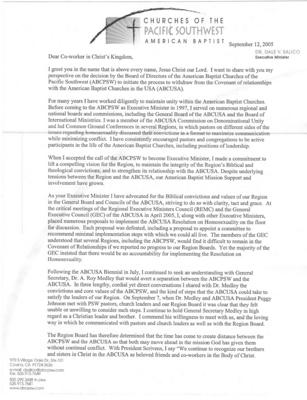
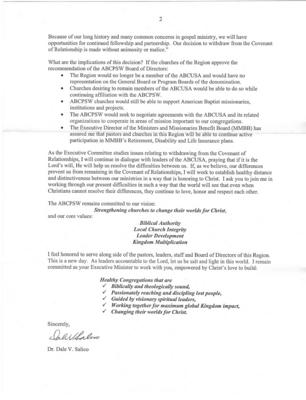


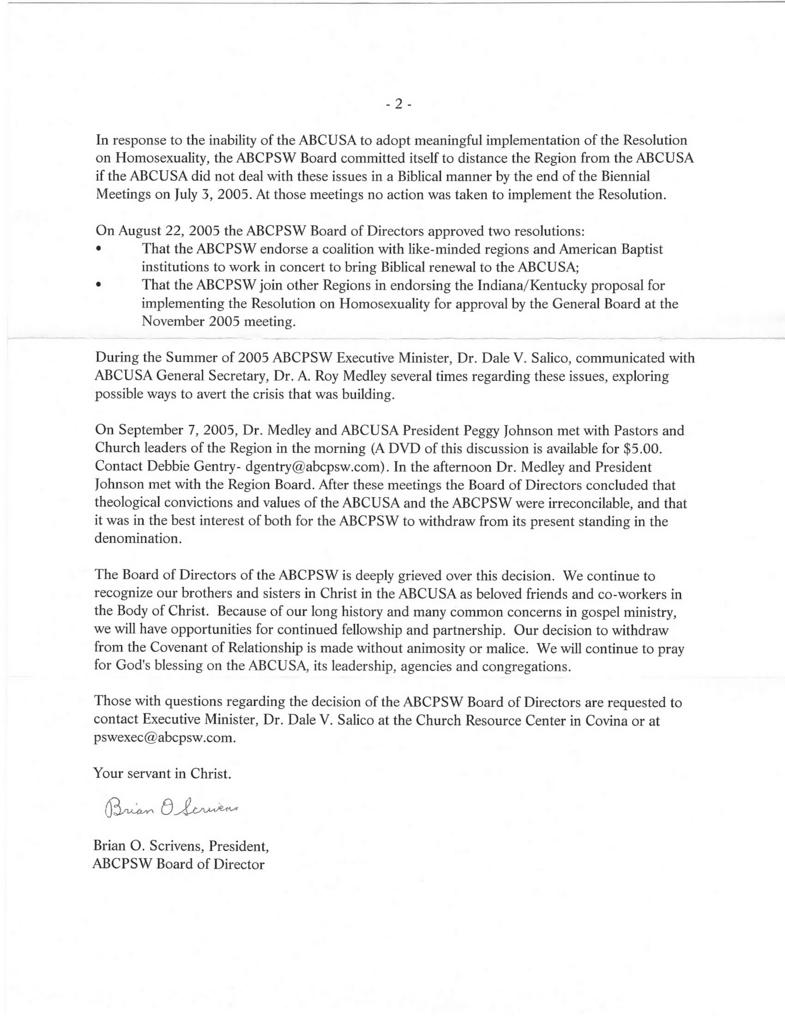
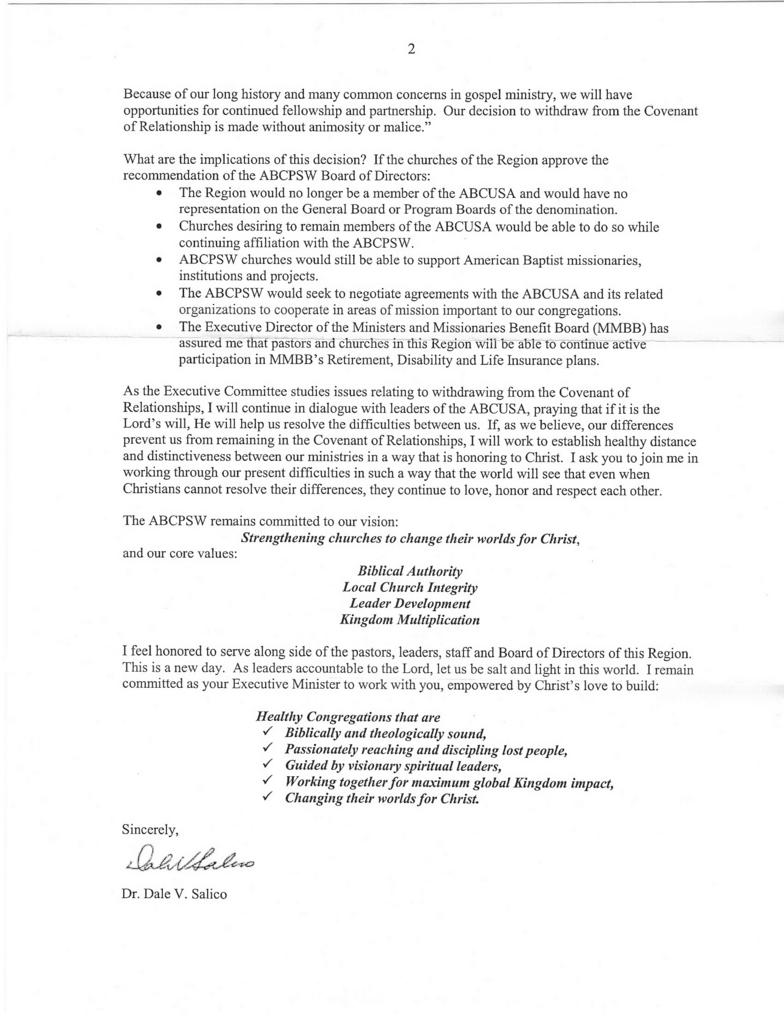
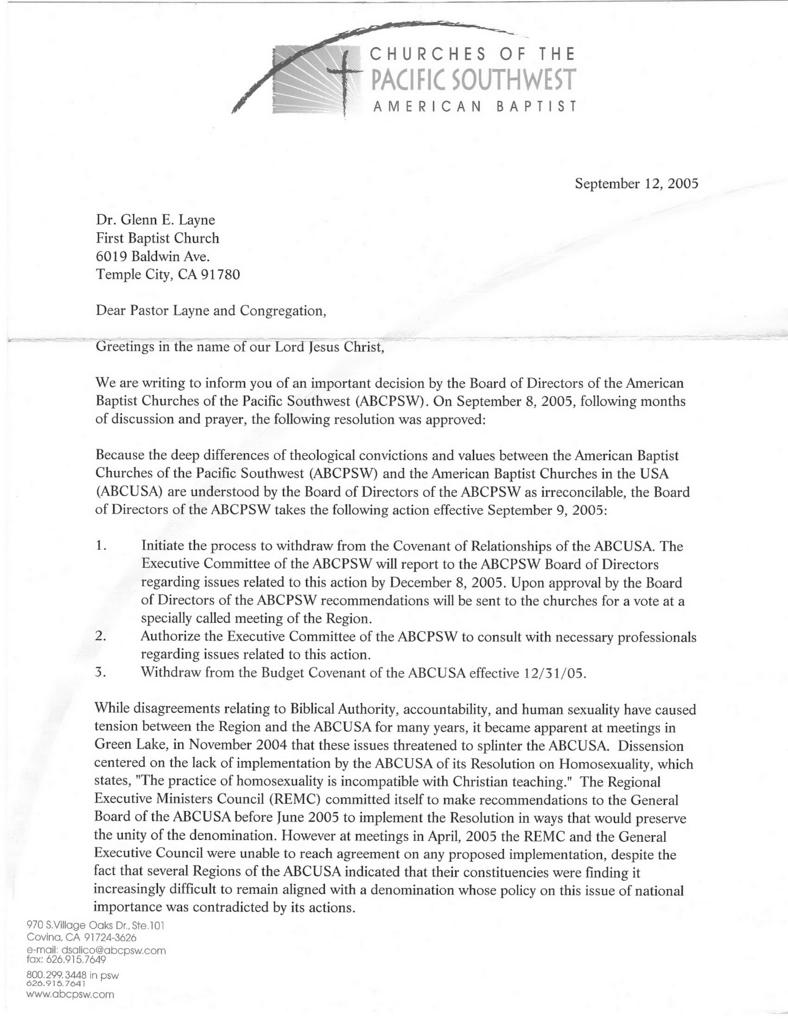
Monday, September 12, 2005
Mum's the Word

Dr. Salico of ABC/PSW met with the region staff today, and ordered them to be silent regarding the actions of the PSW Board until a letter arrives at ABC/PSW churches, Wednesday. An email will also go out that day. Stay tuned...
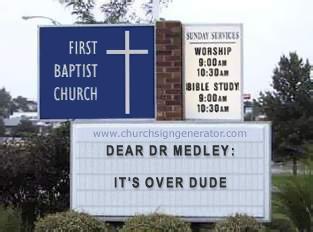
The Ecstatic Heresy
The Ecstatic Heresy
This article appeared last fall in Christianity Today, and is must reading for understanding our present situation--Glenn Layne
Seeking a superficial unity, some denominational leaders opt for feelings over facts.
By Robert Sanders posted 10/08/2004 9:00 a.m.
The conflict in the mainline churches is ostensibly about sexuality—specifically, homosexuality. But more than sexuality is at stake. The faith itself, the Christian faith, is being invaded by false teaching. Theologically, this heresy is rarely articulated. Rather, it works by feeling, an ecstatic sense that transcends petty verbal differences. Consider these three quotations:
The Dammann case does reveal continuing differences in the United Methodist Church concerning the issue of homosexuality. The Council of Bishops is painfully aware of this disagreement. In such moments as this, we remember that our unity in Christ does not depend on unanimity of opinion. Rather, in Jesus Christ we are bound together by love that transcends our differences and calls us to stay at the table with one another.
When they finished, all of us stood up and applauded, with a lump in our throats and a tear in our eyes, as we watched them embrace one another. Convictions were not reconciled that day, but two people who held different convictions were reconciled in Christ.
How we all fit together, how our singularities are made sense of, how our divergent views and different understandings of God's intent are reconciled, passes all understanding. All that we can do is to travel on in faith and trust, knowing that all contradictions and paradoxes and seemingly irreconcilable truths—which seem both consistent and inconsistent with Scripture—are brought together in the larger and all- embracing truth of Christ, which, by Christ's own words, has yet to be fully drawn forth and known.
The first quotation is from a March 25, 2004, statement by the Council of Bishops of the United Methodist Church in response to the trial of a lesbian Methodist minister. This trial reflected the deep divisions within that church. The bishops are "painfully aware" of these disagreements. Nevertheless, they feel that these differences are a matter of "opinion." These opinions, however, cannot negate our "unity in Christ" because "in Jesus Christ we are bound together by love that transcends our differences and calls us to stay at the table with one another." In other words, we can be in verbal disagreement, yet be unified at a higher level in Christ.
The second quotation is from an address by Douglas W. Oldenburg, moderator of the 1998 Presbyterian Church (U.S.A.) General Assembly. In the climax of his speech, he portrayed two men who also addressed the assembly. The first was a homosexual Presbyterian pastor who passionately affirmed his sexuality, his call to ministry, and his understanding of Scripture. His speech was followed by an equally passionate address by a man who held utterly contrary views. Once these two speeches had been delivered, the two men embraced each other. At that point, the assembly applauded with tears in their eyes and lumps in their throats. Although these two men held different convictions, convictions resulting in starkly different behaviors, they "were reconciled in Christ."
The third quotation is from Frank Griswold, presiding bishop of the Episcopal Church. Like the others, he believes that verbal disagreements, different conceptions of truth—even truths inconsistent with Scripture—are unified in the "larger and all-embracing truth of Christ."
These men do not speak in a vacuum. They are influenced by a tradition, a powerful theological perspective that resonates in our culture and is taught in our universities, graduate schools of religion, and seminaries. I call this the "ecstatic" perspective, a term taken from theologian Paul Tillich. Essentially, this perspective claims that God can only be known in feeling, in ways that transcend the language of God or about God.
Friedrich Schleiermacher (1768-1834) is the grandfather of the ecstatic tradition. For Schleiermacher, the essence of the Christian faith is a mystical sense of the Divine. This feeling is beyond language since language refers to objects in space and time. God is not an object like other objects. He cannot be described as if he were an electron, a tree, or a cat. To do so would be to profane God.
Compare and Contrast
Let me give three examples of the ecstatic perspective, contrasting it with what I consider to be an orthodox understanding of Christianity. (I am speaking, of course, of theological tendencies, as rarely do people fall consistently into one group or another; the contrast is meant to illustrate two theological trajectories that are found in the mainline churches.)
Consider Isaiah 6. According to orthodoxy, Isaiah literally heard God say the words, "Whom shall I send?" Isaiah replied, "Send me." God spoke again, in language accessible to Isaiah, giving him a message that he then proclaimed to the people. In this event, some things were beyond Isaiah's understanding. He could not, for example, comprehend the intense holiness of God, so holy that the Seraphim hid their eyes and Isaiah cried out, "Woe is me! For I am lost." Yet even though God remained a deep mystery, Isaiah nonetheless heard the transcendent God speak.
According to the ecstatic perspective, the divine utterance "Whom shall I send?" is a poetic metaphor. Rather than literally hearing a particular message from God, Isaiah merely had a profound sense of God the transcendent Holy One. As a result, his imagination created a dialogue between God and himself. The mystical feeling that gave rise to the dialogue came from God, but Isaiah—as formed by his psychological, social, and historical context—created its verbal expression.
Both views, orthodox and ecstatic, understand that God is transcendent. But for the orthodox, the transcendent God speaks actual words. The supreme example of God's speech is the Incarnation of the Word, who reveals God in concrete deeds and words. These two ways of being God, transcendent and holy yet present and speaking, correspond to God the Father and God the Word (or Son), while God the Holy Spirit enables human beings to hear and obey God's spoken words. This view requires the doctrines of Trinity and Incarnation. John 1:18 (RSV) states it this way: "No one has ever seen God; the only Son, who is in the bosom of the Father, he has made him known."
The ecstatic view robs the Incarnation of its objective, concrete character by making the revelation in Jesus ineffable. From there, the Trinity is debased since ultimately there is no God the Word who comes from God to verbally reveal the Father.
Consider a further example, the Resurrection. If Jesus was bodily raised by God, then God acted physically at a specific time and place. This would make God an agent, as if God—like an electron, a tree, or a cat—was literally affecting matter. Ecstatics would not understand God in such a "crude" fashion. As a result, many ecstatics deny the bodily Resurrection. Many also deny biblical miracles, which they consider creations of primitive peoples who took felt experiences of the Holy and clothed them in language normally used for objects.
By contrast, an orthodox perspective would trust in the biblical miracles, especially that God raised Jesus bodily from the dead, that the tomb was indeed empty.
Finally, consider ethics. Ecstatics do not believe that specific biblical commands were literally uttered by God. Rather, biblical people had a mystical sense of divine obligation that they expressed in the thought forms of their day. Since these thought forms are constantly changing, the ethical sense takes new forms under new circumstances. As a result, ethics changes as culture changes. From an orthodox perspective, however, God literally spoke biblical commands. Some of them were specific to the time and situation of the original hearers, but many of them, certainly the words of Jesus, are eternally valid.
Ten Differences
These two ways of understanding God—the ecstatic and the orthodox—underlie the theological division in mainline Protestant churches. These differences are not always clearly articulated, and many persons have vaguely adapted portions of each. When the matter is thought through, however, these two views differ in virtually every dimension of the Christian faith.
In addition to the examples given above, let me list ten principal differences.
Ecstatic: God in himself, or in his revelation as Word and words, is never really verbal. He always transcends language.
Orthodox: God is transcendent in his essence, but God can speak to human beings who can actually understand him. Above all, God is known in the words and deeds of Jesus Christ, the Word made flesh.
Ecstatic: Theological statements use language, but literal language refers only to objective realities. Language applied to God is always symbolic since God is ineffable.
Orthodox: Theological statements can accurately, albeit not exhaustively, describe God and his will. Theology also employs symbolic language since the spoken Word reveals God the Father, who is holy and transcendent.
Ecstatic: Scripture is the history of ecstatic experiences given verbal content according to the social context of the biblical peoples. We live in a different social context. Consequently, one must first hear the "Word within the biblical words" in order to sense the Divine that transcends all historical contexts. Then, once sensed, the Word within the biblical words is expressed in contemporary categories. The concept of "contemporary categories" allows experience to transform Scripture.
Orthodox: The biblical Word has verbal content in union with the specific cultural context in which the Word is spoken. There is no "Word within the biblical words," but the biblical words—including their cultural forms—are the Word written. As such, they directly address and redeem all cultural contexts as God's living Word. Experience lies under Scripture.
Ecstatic: The task of theology is to reinterpret the faith as relevant to new cultural contexts. The content of faith evolves since culture evolves.
Orthodox: The task of theology is first and foremost to clarify and preserve the faith once delivered to the saints and to transfer it intact to each succeeding generation. Certain aspects of revelation never evolve.
Ecstatic: Since personhood requires objectivity—that is, a person over against us who can speak to us—God is not personal so much as he is an energy to be experienced.
Orthodox: God is personal, revealing himself as God the Son who became objectively incarnate in the man Jesus, with whom one can have a relationship.
Ecstatic: Doctrines do not literally refer to God but to feeling, the depth of reality, or the horizon of being. Therefore doctrines can be radically reinterpreted in terms of ecstatic categories, and pastoral experience can carry more weight than doctrine.
Orthodox: Doctrines teach truths about God—his moral will and his saving acts. They can be variously understood. They deal with mysteries, but they cannot be reinterpreted in categories that have no literal reference to a God who speaks.
Ecstatic: Sacraments or ordinances express the identity and unity of the ongoing life of the church.
Orthodox: In liturgical traditions, sacraments are concrete means of supernatural grace by which God transforms his people. In the free churches, ordinances are the God-ordained means by which believers show their faith in God's saving acts. Both focus on God's action.
Ecstatic: All religions are ultimately one since the faith of each is an expression of the Holy or Ineffable in the concrete forms of a particular culture.
Orthodox: The particulars of a religion matter, and therefore, the religions are divided by their specific content.
Ecstatic: The ascent to God is a mystical union beyond the objective boundary of self and God. At this highest level, dialogue, give and take with God, disappears. All is bliss. Humanity has ascended to God.
Orthodox: Spirituality is an encounter with God, mediated by Word and sacrament, in which God and the person know each other as distinct selves. God truly speaks to us and listens to us. God condescends to speak to humanity on our terms.
Ecstatic: Those who affirm a particular piety or religious preference constitute the church. Heresy is not as troublesome as schism, to claim ultimacy for one's own verbal beliefs while denying that the differing beliefs of others are equally expressive of the Infinite.
Orthodox: Those who have been called by the incarnate Jesus Christ and conformed to that Word by the Spirit constitute the church. Schism is not as much a concern as heresy, the denial of an objectively revealed tradition.
A Church of Both/And
Ecstatics do not deny Scripture, the creeds, or the great documents of their traditions. They consider the Scriptures to be the foundation of faith, their liturgies resonate with the Ineffable, and the various confessions are a cultural treasure. They simply revise these sources along ecstatic lines. That is why it is appropriate to call them "revisionists." They revise Scripture, creeds, and the faith in terms of a non-Trinitarian perspective that has no real sense of the Incarnation.
Since the revisionists "honor" Scripture and tradition, they can worship, study, pray, teach, and promote their agenda shoulder to shoulder with the orthodox while holding utterly different conceptions of the faith. Conflict only arises when the church must deal with concrete issues such as revision of our language for God, sexual norms, evangelism to those of other faiths, or who is welcome to take Communion. At that point, real differences emerge.
As a result, it is not enough for orthodox Christians to simply say that Jesus called God "Father," or that Scripture condemns homosexuality, or that Jesus commands us to evangelize, or that the universal tradition of the church requires baptism prior to Eucharist. Ecstatics know all this. They relativize these claims by viewing them as outmoded expressions of an evolving faith that progressively expresses the Indescribable.
The ecstatic approach is ideal for denominational leaders seeking to maintain institutional harmony in the face of profound theological and moral divisions. It allows them to affirm a transcendent unity while affirming the contradictory beliefs and actions of their constituents. Such leaders may or may not have studied Schleiermacher, but their theology articulates the deepest values of our pluralistic culture—diversity, tolerance, and unity. Once these values assume theological expression and legitimacy, they function perfectly in the North American religious context.
But for the orthodox, it isn't feeling that brings life. It is a God who spoke his living words to them in Jesus Christ. "Heaven and earth will pass away, but my words will never pass away." (Mt. 24:35)
Robert Sanders is associate rector of St. Mark's Episcopal Church in Jacksonville, Florida. He received his Ph.D. in theology from the Graduate Theological Union and the University of California Graduate School in Berkeley, California. More of his writings can be found at http://users.iglide.net/rjsanders.Copyright © 2004 Christianity Today. October 2004, Vol. 48, No. 10, Page 55
This article appeared last fall in Christianity Today, and is must reading for understanding our present situation--Glenn Layne
Seeking a superficial unity, some denominational leaders opt for
 feelings over facts.
By Robert Sanders posted 10/08/2004 9:00 a.m.
The conflict in the mainline churches is ostensibly about sexuality—specifically, homosexuality. But more than sexuality is at stake. The faith itself, the Christian faith, is being invaded by false teaching. Theologically, this heresy is rarely articulated. Rather, it works by feeling, an ecstatic sense that transcends petty verbal differences. Consider these three quotations:
The Dammann case does reveal continuing differences in the United Methodist Church concerning the issue of homosexuality. The Council of Bishops is painfully aware of this disagreement. In such moments as this, we remember that our unity in Christ does not depend on unanimity of opinion. Rather, in Jesus Christ we are bound together by love that transcends our differences and calls us to stay at the table with one another.
When they finished, all of us stood up and applauded, with a lump in our throats and a tear in our eyes, as we watched them embrace one another. Convictions were not reconciled that day, but two people who held different convictions were reconciled in Christ.
How we all fit together, how our singularities are made sense of, how our divergent views and different understandings of God's intent are reconciled, passes all understanding. All that we can do is to travel on in faith and trust, knowing that all contradictions and paradoxes and seemingly irreconcilable truths—which seem both consistent and inconsistent with Scripture—are brought together in the larger and all- embracing truth of Christ, which, by Christ's own words, has yet to be fully drawn forth and known.
The first quotation is from a March 25, 2004, statement by the Council of Bishops of the United Methodist Church in response to the trial of a lesbian Methodist minister. This trial reflected the deep divisions within that church. The bishops are "painfully aware" of these disagreements. Nevertheless, they feel that these differences are a matter of "opinion." These opinions, however, cannot negate our "unity in Christ" because "in Jesus Christ we are bound together by love that transcends our differences and calls us to stay at the table with one another." In other words, we can be in verbal disagreement, yet be unified at a higher level in Christ.
The second quotation is from an address by Douglas W. Oldenburg, moderator of the 1998 Presbyterian Church (U.S.A.) General Assembly. In the climax of his speech, he portrayed two men who also addressed the assembly. The first was a homosexual Presbyterian pastor who passionately affirmed his sexuality, his call to ministry, and his understanding of Scripture. His speech was followed by an equally passionate address by a man who held utterly contrary views. Once these two speeches had been delivered, the two men embraced each other. At that point, the assembly applauded with tears in their eyes and lumps in their throats. Although these two men held different convictions, convictions resulting in starkly different behaviors, they "were reconciled in Christ."
The third quotation is from Frank Griswold, presiding bishop of the Episcopal Church. Like the others, he believes that verbal disagreements, different conceptions of truth—even truths inconsistent with Scripture—are unified in the "larger and all-embracing truth of Christ."
These men do not speak in a vacuum. They are influenced by a tradition, a powerful theological perspective that resonates in our culture and is taught in our universities, graduate schools of religion, and seminaries. I call this the "ecstatic" perspective, a term taken from theologian Paul Tillich. Essentially, this perspective claims that God can only be known in feeling, in ways that transcend the language of God or about God.
Friedrich Schleiermacher (1768-1834) is the grandfather of the ecstatic tradition. For Schleiermacher, the essence of the Christian faith is a mystical sense of the Divine. This feeling is beyond language since language refers to objects in space and time. God is not an object like other objects. He cannot be described as if he were an electron, a tree, or a cat. To do so would be to profane God.
Compare and Contrast
Let me give three examples of the ecstatic perspective, contrasting it with what I consider to be an orthodox understanding of Christianity. (I am speaking, of course, of theological tendencies, as rarely do people fall consistently into one group or another; the contrast is meant to illustrate two theological trajectories that are found in the mainline churches.)
Consider Isaiah 6. According to orthodoxy, Isaiah literally heard God say the words, "Whom shall I send?" Isaiah replied, "Send me." God spoke again, in language accessible to Isaiah, giving him a message that he then proclaimed to the people. In this event, some things were beyond Isaiah's understanding. He could not, for example, comprehend the intense holiness of God, so holy that the Seraphim hid their eyes and Isaiah cried out, "Woe is me! For I am lost." Yet even though God remained a deep mystery, Isaiah nonetheless heard the transcendent God speak.
According to the ecstatic perspective, the divine utterance "Whom shall I send?" is a poetic metaphor. Rather than literally hearing a particular message from God, Isaiah merely had a profound sense of God the transcendent Holy One. As a result, his imagination created a dialogue between God and himself. The mystical feeling that gave rise to the dialogue came from God, but Isaiah—as formed by his psychological, social, and historical context—created its verbal expression.
Both views, orthodox and ecstatic, understand that God is transcendent. But for the orthodox, the transcendent God speaks actual words. The supreme example of God's speech is the Incarnation of the Word, who reveals God in concrete deeds and words. These two ways of being God, transcendent and holy yet present and speaking, correspond to God the Father and God the Word (or Son), while God the Holy Spirit enables human beings to hear and obey God's spoken words. This view requires the doctrines of Trinity and Incarnation. John 1:18 (RSV) states it this way: "No one has ever seen God; the only Son, who is in the bosom of the Father, he has made him known."
The ecstatic view robs the Incarnation of its objective, concrete character by making the revelation in Jesus ineffable. From there, the Trinity is debased since ultimately there is no God the Word who comes from God to verbally reveal the Father.
Consider a further example, the Resurrection. If Jesus was bodily raised by God, then God acted physically at a specific time and place. This would make God an agent, as if God—like an electron, a tree, or a cat—was literally affecting matter. Ecstatics would not understand God in such a "crude" fashion. As a result, many ecstatics deny the bodily Resurrection. Many also deny biblical miracles, which they consider creations of primitive peoples who took felt experiences of the Holy and clothed them in language normally used for objects.
By contrast, an orthodox perspective would trust in the biblical miracles, especially that God raised Jesus bodily from the dead, that the tomb was indeed empty.
Finally, consider ethics. Ecstatics do not believe that specific biblical commands were literally uttered by God. Rather, biblical people had a mystical sense of divine obligation that they expressed in the thought forms of their day. Since these thought forms are constantly changing, the ethical sense takes new forms under new circumstances. As a result, ethics changes as culture changes. From an orthodox perspective, however, God literally spoke biblical commands. Some of them were specific to the time and situation of the original hearers, but many of them, certainly the words of Jesus, are eternally valid.
Ten Differences
These two ways of understanding God—the ecstatic and the orthodox—underlie the theological division in mainline Protestant churches. These differences are not always clearly articulated, and many persons have vaguely adapted portions of each. When the matter is thought through, however, these two views differ in virtually every dimension of the Christian faith.
In addition to the examples given above, let me list ten principal differences.
Ecstatic: God in himself, or in his revelation as Word and words, is never really verbal. He always transcends language.
Orthodox: God is transcendent in his essence, but God can speak to human beings who can actually understand him. Above all, God is known in the words and deeds of Jesus Christ, the Word made flesh.
Ecstatic: Theological statements use language, but literal language refers only to objective realities. Language applied to God is always symbolic since God is ineffable.
Orthodox: Theological statements can accurately, albeit not exhaustively, describe God and his will. Theology also employs symbolic language since the spoken Word reveals God the Father, who is holy and transcendent.
Ecstatic: Scripture is the history of ecstatic experiences given verbal content according to the social context of the biblical peoples. We live in a different social context. Consequently, one must first hear the "Word within the biblical words" in order to sense the Divine that transcends all historical contexts. Then, once sensed, the Word within the biblical words is expressed in contemporary categories. The concept of "contemporary categories" allows experience to transform Scripture.
Orthodox: The biblical Word has verbal content in union with the specific cultural context in which the Word is spoken. There is no "Word within the biblical words," but the biblical words—including their cultural forms—are the Word written. As such, they directly address and redeem all cultural contexts as God's living Word. Experience lies under Scripture.
Ecstatic: The task of theology is to reinterpret the faith as relevant to new cultural contexts. The content of faith evolves since culture evolves.
Orthodox: The task of theology is first and foremost to clarify and preserve the faith once delivered to the saints and to transfer it intact to each succeeding generation. Certain aspects of revelation never evolve.
Ecstatic: Since personhood requires objectivity—that is, a person over against us who can speak to us—God is not personal so much as he is an energy to be experienced.
Orthodox: God is personal, revealing himself as God the Son who became objectively incarnate in the man Jesus, with whom one can have a relationship.
Ecstatic: Doctrines do not literally refer to God but to feeling, the depth of reality, or the horizon of being. Therefore doctrines can be radically reinterpreted in terms of ecstatic categories, and pastoral experience can carry more weight than doctrine.
Orthodox: Doctrines teach truths about God—his moral will and his saving acts. They can be variously understood. They deal with mysteries, but they cannot be reinterpreted in categories that have no literal reference to a God who speaks.
Ecstatic: Sacraments or ordinances express the identity and unity of the ongoing life of the church.
Orthodox: In liturgical traditions, sacraments are concrete means of supernatural grace by which God transforms his people. In the free churches, ordinances are the God-ordained means by which believers show their faith in God's saving acts. Both focus on God's action.
Ecstatic: All religions are ultimately one since the faith of each is an expression of the Holy or Ineffable in the concrete forms of a particular culture.
Orthodox: The particulars of a religion matter, and therefore, the religions are divided by their specific content.
Ecstatic: The ascent to God is a mystical union beyond the objective boundary of self and God. At this highest level, dialogue, give and take with God, disappears. All is bliss. Humanity has ascended to God.
Orthodox: Spirituality is an encounter with God, mediated by Word and sacrament, in which God and the person know each other as distinct selves. God truly speaks to us and listens to us. God condescends to speak to humanity on our terms.
Ecstatic: Those who affirm a particular piety or religious preference constitute the church. Heresy is not as troublesome as schism, to claim ultimacy for one's own verbal beliefs while denying that the differing beliefs of others are equally expressive of the Infinite.
Orthodox: Those who have been called by the incarnate Jesus Christ and conformed to that Word by the Spirit constitute the church. Schism is not as much a concern as heresy, the denial of an objectively revealed tradition.
A Church of Both/And
Ecstatics do not deny Scripture, the creeds, or the great documents of their traditions. They consider the Scriptures to be the foundation of faith, their liturgies resonate with the Ineffable, and the various confessions are a cultural treasure. They simply revise these sources along ecstatic lines. That is why it is appropriate to call them "revisionists." They revise Scripture, creeds, and the faith in terms of a non-Trinitarian perspective that has no real sense of the Incarnation.
Since the revisionists "honor" Scripture and tradition, they can worship, study, pray, teach, and promote their agenda shoulder to shoulder with the orthodox while holding utterly different conceptions of the faith. Conflict only arises when the church must deal with concrete issues such as revision of our language for God, sexual norms, evangelism to those of other faiths, or who is welcome to take Communion. At that point, real differences emerge.
As a result, it is not enough for orthodox Christians to simply say that Jesus called God "Father," or that Scripture condemns homosexuality, or that Jesus commands us to evangelize, or that the universal tradition of the church requires baptism prior to Eucharist. Ecstatics know all this. They relativize these claims by viewing them as outmoded expressions of an evolving faith that progressively expresses the Indescribable.
The ecstatic approach is ideal for denominational leaders seeking to maintain institutional harmony in the face of profound theological and moral divisions. It allows them to affirm a transcendent unity while affirming the contradictory beliefs and actions of their constituents. Such leaders may or may not have studied Schleiermacher, but their theology articulates the deepest values of our pluralistic culture—diversity, tolerance, and unity. Once these values assume theological expression and legitimacy, they function perfectly in the North American religious context.
But for the orthodox, it isn't feeling that brings life. It is a God who spoke his living words to them in Jesus Christ. "Heaven and earth will pass away, but my words will never pass away." (Mt. 24:35)
Robert Sanders is associate rector of St. Mark's Episcopal Church in Jacksonville, Florida. He received his Ph.D. in theology from the Graduate Theological Union and the University of California Graduate School in Berkeley, California. More of his writings can be found at http://users.iglide.net/rjsanders.Copyright © 2004 Christianity Today. October 2004, Vol. 48, No. 10, Page 55
Saturday, September 10, 2005
My Neice's Banner
My neice, Lt. Elizabeth R. 
Stauffer, US Marine Corp, just
returned from Iraq, and today
is her birthday. Although she is from Ohio, she is honored her in Temple City, CA, with a street banner. Happy birthday, Betsy!

Stauffer, US Marine Corp, just
returned from Iraq, and today
is her birthday. Although she is from Ohio, she is honored her in Temple City, CA, with a street banner. Happy birthday, Betsy!
MEDLEY'S FURTHER MEETINGS WITH PSW BOARD AS "DISASTEROUS" AS OPEN FORUM, SAY SOURCES; EXPECT NEWS FROM PSW ON MONDAY

The following is from a post on the message board at www.abeonline.org:
Today, the PSW staff received the following information from our executive, Dr. Dale Salico in reference to our Board of Directors' decision in regard to the Roy Medley/Peggy Johnson meeting on Wednesday:
"After the meeting with pastors and church leaders, the Board knew that there were no easy options open for them. Their discussion and prayer time demonstrated great spiritual maturity. The past two days have made me very proud of our pastors, church leaders, Board of Directors and staff.
The Board wants the release of their decisions to be as clear and complete as possible. Therefore we will be preparing a letter that will go out no later than Monday. Until then the decision remains confidential. The Board felt that it may be easier over the weekend when you are in churches for Region staff to be able to respond to questions by saying, "I cannot answer your question. The Board is still processing its decisions. A letter will be sent out to all the churches on Monday and staff will be informed of the Board's decision at that time also."
A later post...
Judging by MAL's report purportedly summarizing Dr. Salico's memo to his staff, we can expect some BIG news on Monday.
...My sources tell me that the meeting with Dr. Medley was a continuation of the morning session which Dr. Layne labeled "disastrous" in his blog . . .
...At several points the President of the region reportedly asked Dr. Medley direct questions as to how he would intend to respond if PSW disengaged from the ABCUSA. I am told Dr. Medley was confronted directly and asked if he planned to litigate the matter. He answered that he is a "healer" and not a "fighter," indicating that it would not be his style to pursue legal avenues of remedy. One member of the board reportedly agreed that Roy's options for the independent exercise of his power are evidently limited. But, so are the options for the President of the U.S. However, the President is unafraid to use his positional power and bully pulpit to advance causes he believes in and wants to see come to pass. Dr. Medley reportedly replied that he cannot see himself leading in that way; it wouldn't fit with his personality and style.
Thursday, September 08, 2005
"Those Seats Up There Must Be Feeling Hot..."
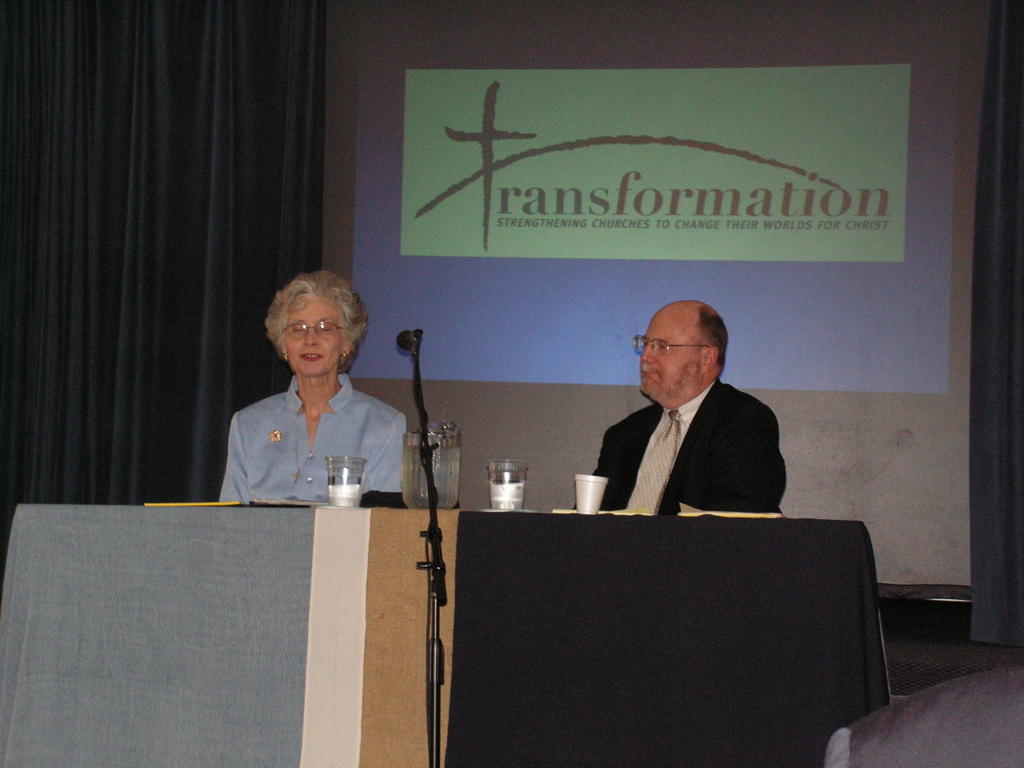
Peggy Johnson, President, ABCUSA and Roy Medley, General Secretary of ABCUSA, face unconvinced crowd at Christ First Baptist Church of Covina, CA, yesterday, September 7, 2005.
AP Report: Schwartzenegger to Veto Same Sex Marriage Bill
A fascinating backdrop to the meetings in Covina:
SACRAMENTO, Calif. - Gov. Arnold Schwarzenegger said he would veto a bill to legalize same-sex marriage "out of respect for the will of the people," drawing heated criticism from gay rights supporters and cheers from conservative groups.
The bill, narrowly passed by lawmakers in the past week, would make California the first state to legalize same-sex marriage through its legislature. In Massachusetts, recognition of gay marriages came through a court ruling.
But Schwarzenegger said Wednesday the legislation would conflict with the intent of voters when they approved an initiative five years ago that prevents California from recognizing same-sex marriages performed in other states or countries.
"We cannot have a system where the people vote and the Legislature derails that vote," the governor's press secretary, Margita Thompson, said in a statement.
Conservatives hailed the announcement.
"I'm encouraged that the governor is going to stop the runaway Legislature, and he's going to represent the people," said Karen England of the Capitol Resource Institute, a Sacramento group that lobbied against the bill.
But gay rights advocates said the Republican governor had betrayed the bipartisan ideals that helped get him elected in the 2003 recall election.
"Clearly he's pandering to an extreme right wing, which was not how he got elected," said Geoff Kors, executive director of Equality California, one of the bill's sponsors. "He got elected with record numbers of lesbian and gay voters who had not previously voted for a Republican, and he sold us out."
The governor has until Oct. 9 to issue the veto. A veto override in California requires a two-thirds vote in both the Assembly and Senate. The Assembly approved the bill 41-35, while the Senate voted 21-15.
Despite his promise to veto the bill, Schwarzenegger still believes "gay couples are entitled to full protection under the law and should not be discriminated against based upon their relationship," Thompson's statement said. "He is proud that California provides the most rigorous protections in the nation for domestic partners."
California already gives same-sex couples many of the rights and duties of marriage if they register with the state as domestic partners.
Also Wednesday, in Massachusetts, a proposed ballot initiative that would ban same-sex marriages passed a major hurdle. The state attorney general ruled the initiative would be permitted under a section of the Massachusetts Constitution allowing voters to overturn court decisions.
The decision clears the way for conservative groups to begin gathering signatures and lobbying lawmakers in hopes of putting the issue before voters in 2008.
___
Associated Press writers Don Thompson and Kathleen Hennessey in Sacramento, Lisa Leff in San Francisco and Theo Emery in Boston contributed to this report.
SACRAMENTO, Calif. - Gov. Arnold Schwarzenegger said he would veto a bill to legalize same-sex marriage "out of respect for the will of the people," drawing heated criticism from gay rights supporters and cheers from conservative groups.
The bill, narrowly passed by lawmakers in the past week, would make California the first state to legalize same-sex marriage through its legislature. In Massachusetts, recognition of gay marriages came through a court ruling.
But Schwarzenegger said Wednesday the legislation would conflict with the intent of voters when they approved an initiative five years ago that prevents California from recognizing same-sex marriages performed in other states or countries.
"We cannot have a system where the people vote and the Legislature derails that vote," the governor's press secretary, Margita Thompson, said in a statement.
Conservatives hailed the announcement.
"I'm encouraged that the governor is going to stop the runaway Legislature, and he's going to represent the people," said Karen England of the Capitol Resource Institute, a Sacramento group that lobbied against the bill.
But gay rights advocates said the Republican governor had betrayed the bipartisan ideals that helped get him elected in the 2003 recall election.
"Clearly he's pandering to an extreme right wing, which was not how he got elected," said Geoff Kors, executive director of Equality California, one of the bill's sponsors. "He got elected with record numbers of lesbian and gay voters who had not previously voted for a Republican, and he sold us out."
The governor has until Oct. 9 to issue the veto. A veto override in California requires a two-thirds vote in both the Assembly and Senate. The Assembly approved the bill 41-35, while the Senate voted 21-15.
Despite his promise to veto the bill, Schwarzenegger still believes "gay couples are entitled to full protection under the law and should not be discriminated against based upon their relationship," Thompson's statement said. "He is proud that California provides the most rigorous protections in the nation for domestic partners."
California already gives same-sex couples many of the rights and duties of marriage if they register with the state as domestic partners.
Also Wednesday, in Massachusetts, a proposed ballot initiative that would ban same-sex marriages passed a major hurdle. The state attorney general ruled the initiative would be permitted under a section of the Massachusetts Constitution allowing voters to overturn court decisions.
The decision clears the way for conservative groups to begin gathering signatures and lobbying lawmakers in hopes of putting the issue before voters in 2008.
___
Associated Press writers Don Thompson and Kathleen Hennessey in Sacramento, Lisa Leff in San Francisco and Theo Emery in Boston contributed to this report.
TODAY'S MEETING OF THE PACIFIC SOUTHWEST REGION BOARD MAY WELL CAST FUTURE OF WHOLE ABC/USA

Today's meeting of the ABC of the Pacific Southwest Region Board could shape the future of the whole denomination. That's the consensus as the Board grapples with the implications of Dr. Roy Medley's assesment that the PSW cannot exit the Budget Covenant with exiting the ABC.
This follows on the heels of a disasterous forum for Dr. Medley yesterday, in which pastors and church leaders from across the PSW made it clear that the Valley Forge position on homosexuality is not shared in the PSW. (See previous posts).
Dale Salico, PSW Exec
Now the issue is the response of the PSW Board. "The meeting [with Dr. Medley] put steel in the spines of the Board," remarked one pastor yesterday. "It makes it clear where we are coming from."
If PSW makes clear steps to leave, the domino effect could be dramatic. ABC of the West, Northwest, West Virginia and Indiana/Kentucky are expected to follow suit in rapid order. Other regions said to be on the line are Maine, Ohio, and Michigan.
Medley: a Good Man in a Bad Situation
I would agree with McFadden's assesment of Dr. Medley's demeanor yesterday, again from www.abeonline.com:
Actually...by the end of the meeting he seemed tired and sad. I did not detect any theatrics in his words, merely sadness. BTW, that would also be the predominant mood of those arguing for separation. Nobody was triumphalist or cocky. Everyone seemed duly aware of the seriousness of what was being discussed. I'm sure when Roy signed on for this tour of duty he did not imagine that he would be the instrument for division within the "family." For a man as committed to the ABCUSA as Roy, that must be an enormous burden to bear.
I urge all readers to pray for Dr. Medley.
Actually...by the end of the meeting he seemed tired and sad. I did not detect any theatrics in his words, merely sadness. BTW, that would also be the predominant mood of those arguing for separation. Nobody was triumphalist or cocky. Everyone seemed duly aware of the seriousness of what was being discussed. I'm sure when Roy signed on for this tour of duty he did not imagine that he would be the instrument for division within the "family." For a man as committed to the ABCUSA as Roy, that must be an enormous burden to bear.
I urge all readers to pray for Dr. Medley.
Wednesday, September 07, 2005
MEDLEY STUMBLES IN PSW GATHERING; MOMENTUM BUILDS FOR PSW SEPARATION


Dr. Roy Medley
General Secretary ABCUSA
As reported by Dennis McFadden from www.abeonline.org:
Today Dr. A. Roy Medley met with several hundred pastoral and lay leaders from the PSW in a specially called meeting at Christ First Baptist Church of Covina. He was accompanied by the current ABCUSA president, Mrs. Peggy Johnson . Together the President of the ABCUSA and the General Secretary fielded questions for more than two hours after a devotional on Biblical principles for dealing with conflict and controversial issues lead by Dr. Dale Salico, PSW Executive Minister. The crowd was comprised of pastoral and lay leaders from PSW congregations (the pastor and two leaders were invited from each of the PSW churches).
Most of the questions dealt with dissatisfaction with the lack of enforcement of the “homosexuality is incompatible with biblical teaching” resolution (the stated reason for the meeting). Of the two dozen or so questioners, one offered his services for any who “need to talk” because they feel out of sync with the majority in the room and one asked how we can repair the rupture in our relationship so that PSW won’t feel the need to leave the ABCUSA. Virtually all of the other questioners either asked questions related to the lack of enforcement of the homosexuality resolution, challenged the perceived elevation of soul competency over biblical authority, or dealt with technical aspects of Baptist polity and discipline.
Dr. Medley’s responses stayed fairly close to the answer that the genius of Baptist polity is the lack of hierarchy and the emphasis upon individuals coming to terms with Scripture as they feel led by the Holy Spirit. He opined that there were few if any mechanisms for enforcing conformity, even if he wanted to do so. He also averred that he has consistently spoken the ABCUSA position as being that of the “homosexuality is incompatible” resolution while affirming the right of congregations and individuals to dissent from that position.
The ABCUSA representatives were unfailingly gracious and essentially non-defensive. Roy listened carefully and never interrupted a speaker. The audience members frequently broke into applause at the comments by the questioners. No one became belligerant or showed obvious disrespect for the guests or the other members of the audience.
One might safely characterize the spoken comments, questions, and audience response as indicating a large majority favoring some determinate decision by VF. One pastor of a mega church thanked the guests, sympathized with their discomfort being in the "hot seat" and asked if we hadn't finally reached a point where we should simply "bless one another and move on with our separate ministries." He noted that while we have been wrangling endlessly over the issue of human sexuality, thousands of persons have slipped into a Christless eternity within driving distance of our churches.
A comment to Dennis:
Hmmm....
Dennis, that was an accurate description of the meeting.But in some ways it is like a chemist clinically describing an explosion.
For example, when the megachurch pastor suggested it was time to part ways, the applause was thunderous and kept going and going and going.
At times the tension was overwhelming. Men next to me shifted and groaned with agony as they listened to Medley's replies. Elderly pastors, after recounting their years of service to the ABC, declared in crackling voices that they could no longer be a part of the demonimation.
At one key moment, one person dropped the equivalent of a verbal nuclear bomb, eliciting numerous gasps and sounds of shock. But then, you could probably give a better account of that one.
Something big is brewing.
Dennis responds:
What nuclear bomb??? It was a comment attached to the end of a two minute mini lecture on Baptist polity.
All I did was to declare that after more than 50 years of ABC life and 25 years on the PSW ordination standards committee, the Biennial was utterly discouraging and depressing. The experienced radicalized me (particularly Dr. Herzog's invective laded diatribe and Dr. Medley's endorsement of tolerance at any price). I simply shared that I was ordained by another group last week, one that believes in biblical authority without embarrassment. While Dr. Medley is a good and decent man, he no longer captures my willingness to follow his lead.
As to Mike's question . . . the May action by PSW was described by Dale Salico in detail. Dr. Medley only responded when directly asked by a questioner. The pastor asked why Medley was willing to use the Covenant of Relationships to deal with financial support since he answered most questions with a "Baptists cannot enforce conformity" type response? "If you don't have any power . . . if you can't enforce the resolution on homosexuality . . . if your office is limited by our polity so that you can't do much of anything, then where did you get all this power to use against PSW all of a sudden?" This brought a good deal of laughter, partially due to the manner in which the question was asked.
GWGWGW correctly captures the emotional tone of the event. Hey, I tried to write a bit more objectively about it. However, it was an amazing experience. There were people in the audience who may have agreed with Dr. Medley, but they did not speak. All but two comments (and one of them was difficult to decipher) were solidly opposed to the position of the GS (albeit quite respectfully stated).
Ironically, if the Biennial applause lines for Dr. Medley's message were all at the expense of the evangelicals, all of the applause lines (MANY of them thunderous) in Covina were in favor of separation. Dr. Medley himself acknowledged this by gently chiding the group at the end of the meeting. He indicated in response to the final question that if separation occurs it will be a grief-filled day for him, for ABCUSA, and for the Lord. Then, he noted wryly that all of the loudest applause lines were in favor of a denominational split. We should be grieving not clapping he observed sadly.
Dennis E. McFadden
My comment: as one present, I can speak for myself. I applauded when Biblical truth was stated well. The schism has already occcured, and the sexual revisionists did it, and Dr. Medley, a good and well-meaning man, was complict in the schism.
Next comment from ABE Online:
So, since the two of you were there, what is your sense of the PSW's next move??? Obviously, the GS is betting the region will back away from the PSW Board's contingency plan. It sounds as though he laid the theatrics on thick at the end... "grieving the Lord", for goodness sake! He probably wanted to add "and quenching the Holy Spirit, too", but thought better of it... there were too many in the audience who would have taken him to task about who was REALLY doing the grieving and quenching!
Mike
Mike EdwardsLaymanFBC-Everett, WA
Watch this space. Key developments will occur in the next few days...
Subscribe to:
Posts (Atom)