I'm going to be doing a series of blogs on missional churches, emerging churches and reaching post-moderns. This spins out of the process we've been engaged in at my church of renewing our vision and focus as a church. Below is a pretty good intro the the missional church ideal as drawn from http://www.friendofmissional.org/.
Description a Missional Church
A missional church is one where people are exploring and rediscovering what it means to be Jesus' sent people as their identity and vocation.
A missional church will be made up of individuals willing and ready to be Christ's people in their own situation and place.
A missional church knows that they must be a cross-cultural missionary (contextual) people in their own community.
A missional church will be engaged with the culture (in the world) without being absorbed by the culture (not of the world). They will become intentionally indigenous.
A missional church understands that God is already present in the culture where it finds itself. Therefore, a missional church doesn't view its purpose as bringing God into the culture or taking individuals out of the culture to a sacred space.
A missional church will seek to plant all types of missional communities to expand the Kingdom of God.
A missional church seeks to put the good of their neighbor over their own.
A missional church will give integrity, morality, good character and conduct, compassion, love and a resurrection life filled with hope preeminence to give credence to their reasoned verbal witness.
A missional church practices hospitality by welcoming the stranger into the midst of the community.
A missional church will see themselves as a community or family on a mission together. There are no "Lone Ranger" Christians in a missional church.
A missional church will see themselves as representatives of Jesus and will do nothing to dishonor his name.
A missional church will be totally reliant on God in all it does. It will move beyond superficial faith to a life of supernatural living.
A missional church will be desperately dependent on prayer.
A missional church gathered will be for the purpose of worship, encouragement, supplemental teaching, training, and to seek God's presence and to be realigned with his God's missionary purpose.
A missional church is orthodox in its view of the Gospel and Scripture, but culturally relevant in its methods and practice so that it can engage the world view of the hearers.
A missional church will feed deeply on the scriptures throughout the week so they are always ready to speak up and tell anyone who asks why they're living the way they are.
A missional church will be a community where all members are involved in learning to be disciples of Jesus. Growth in discipleship is an expectation.
A missional church will help people discover and develop their spiritual gifts and will rely on gifted people for ministry instead of talented people.
A missional church is a healing community where people carry each other's burdens and help restore gently.
What Missional Church is Not
A missional church is not a dispenser of religious goods and services or a place where people come for their weekly spiritual fix.
A missional church is not a place where mature Christians come to be fed and have their needs met.
A missional church is not a place where professionals are hired to do the work of the church.
A missional church is not a place where the professionals teach their children and youth about God.
A missional church is not a church with a "good missions program." The people are the missions program and includes going to "Jerusalem, Judea and Samaria, and to the ends of the earth."
A missional church is not missional just because it is contemporary, young, hip, postmodern-sensitive, seeker-sensitive or even traditional.
A missional church is not about big programs and organizations to accomplish God's missionary purpose. This does not imply no program or organization, but that they will not drive mission. They will be used in support of people on mission.
A missional church is not involved in political party activism, either on the right or left. As Brian McLaren recently wrote, we need “purple peoplehood — people who don't want to be defined as red or blue, but have elements of both.
What Missional Church Looks Like
JR Woodward at Dream Awakener has a perspective on success that really helps my understanding of missional. His post "A Working Definition of Success" provides a working definition of what missional might look like. Here it is:
Not simply how many people come to our church services, but how many people our church serves.
Not simply how many people attend our ministry, but how many people have we equipped for ministry.
Not simply how many people minister inside the church, but how many minister outside the church.
Not simply helping people become more whole themselves, but helping people bring more wholeness to their world. (i.e. justice, healing, relief)
Not simply how many ministries we start, but how many ministries we help.
Not simply how many unbelievers we bring into the community of faith, but how many ‘believers' we help experience healthy community.
Not simply working through our past hurts, but working alongside the Spirit toward wholeness.
Not simply counting the resources that God gives us to steward, but counting how many good stewards are we developing for the sake of the world.
Not simply how we are connecting with our culture but how we are engaging our culture.
Not simply how much peace we bring to individuals, but how much peace we bring to our world.
Not simply how effective we are with our mission, but how faithful we are to our God.
Not simply how unified our local church is, but how unified is "the church" in our neighborhood, city and world?
Not simply how much we immerse ourselves in the text, but how faithfully we live in the story of God.
Not simply being concerned about how our country is doing, but being concern for the welfare of other countries.
Not simply how many people we bring into the kingdom, but how much of the kingdom we bring to the earth.
Monday, September 04, 2006

Saturday, September 02, 2006
More of Siloam Pool and Street Excavated
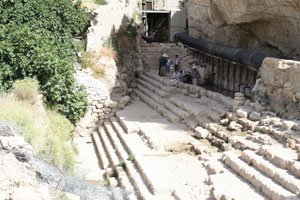
Lost in all the Hezbollah mayhem in northern Israel this summer is the progress being made on a key archaeological site in Jerusalem: the excavation of the Siloam Pool area. I saw the area on February 1 of this year, and was impressed with the discovery: the little pool that had been identified as the Pool of Siloam was but a catch basin for the Olympic-sized pool that was found when a leak developed in a sewage line.
More of the area has been cleared in the months since. See the update on the Biblical Archaeological Society's website. The photo above is from the report by Hershel Shanks.
He reports:
After bathing (or purifying) oneself in the Siloam Pool, where Jesus cured the blind man (see “The Siloam Pool,” BAR, September/October 2005), ancient pilgrims could ascend ten steps to a lovely columned plaza that has now been exposed by archaeologists Ronny Reich and Eli Shukron on behalf of the Israel Antiquities Authority.
The newly discovered plaza leads to a street that is not yet open to the public. Pictures of the street have just been released.
The archaeologists believe this street goes all the way up to the western wall of the Temple Mount, from which the pilgrims ascended to the Temple precincts through gateways on the southern side.
Be sure to read the whole report and check the photos.
The Siloam Pool and street is located in the City of David section of Jerusalem, on the site of the Old Testament city, now outside and to ther southeast of the walled city. Look for more developments from this area. In February, we were told that some working on the site believe that they made have found the walls of the Millo, the Palace of David and the Kings of Judah.
Friday, September 01, 2006
A "Gay" Take on the Woodside Explusion
Church Dumped By Baptists For Ministering To Gays
by 365Gay.com Newscenter Staff
September 1, 2006 - 3:00 pm ET
(Flint, Michigan) A Flint, Michigan church that opened its doors to gays and lesbians has been ordered out of the Baptist denomination.
Woodside Baptist Church - the oldest Baptist church in the region - began ministering to gays and lesbians five years ago.
Other Baptist churches in area denounced the move, and over the past five years the situation has grown progressively worse.
This week the North Region of the American Baptist Churches of Michigan voted to sever all ties with Woodside. The decision will be presented to the American Baptist USA Churches regional meeting next month for affirmation.
Pastor Deborah Kohler says the action was not unexpected. Still, she says that the Region is honoring Christ's teachings of loving one another without judgment.
Kohler said her 270 parishioners would like to remain part of the Baptist churches, but not at the expense of ending its open-door policy.
Meanwhile, in Oklahoma, a megachurch in Tulsa has voted to quit the Presbyterian Church U-S-A. over the denomination's the support for gay pastors.
The Kirk of the Hills Presbyterian Church, with just over three-thousand members voted 967-to-36 to leave.
The church elders had recommended the departure. Church members also accepted a recommendation to join the Evangelical Presbyterian Church which does not permit gay clergy.
©365Gay.com 2006
Why are all these churches (1) old as dirt, (2) tiny and (3) have female pastors? Your comments appreciated.
BTW, Dennis McFadden of www.hisbarkingdog.blogspot.com is of the opinion (as I am) that Valley Forge will once again pass up a chance to do the right (that is correct, God-honoring and Biblically sound) thing.
by 365Gay.com Newscenter Staff
September 1, 2006 - 3:00 pm ET
(Flint, Michigan) A Flint, Michigan church that opened its doors to gays and lesbians has been ordered out of the Baptist denomination.
Woodside Baptist Church - the oldest Baptist church in the region - began ministering to gays and lesbians five years ago.
Other Baptist churches in area denounced the move, and over the past five years the situation has grown progressively worse.
This week the North Region of the American Baptist Churches of Michigan voted to sever all ties with Woodside. The decision will be presented to the American Baptist USA Churches regional meeting next month for affirmation.
Pastor Deborah Kohler says the action was not unexpected. Still, she says that the Region is honoring Christ's teachings of loving one another without judgment.
Kohler said her 270 parishioners would like to remain part of the Baptist churches, but not at the expense of ending its open-door policy.
Meanwhile, in Oklahoma, a megachurch in Tulsa has voted to quit the Presbyterian Church U-S-A. over the denomination's the support for gay pastors.
The Kirk of the Hills Presbyterian Church, with just over three-thousand members voted 967-to-36 to leave.
The church elders had recommended the departure. Church members also accepted a recommendation to join the Evangelical Presbyterian Church which does not permit gay clergy.
©365Gay.com 2006
Why are all these churches (1) old as dirt, (2) tiny and (3) have female pastors? Your comments appreciated.
BTW, Dennis McFadden of www.hisbarkingdog.blogspot.com is of the opinion (as I am) that Valley Forge will once again pass up a chance to do the right (that is correct, God-honoring and Biblically sound) thing.
Tuesday, August 29, 2006
Michigan Baptists Take a Stand; Will Valley Forge Undermine Associations and Regions Again?
FIRST, HERE'S THE STORY, as reported in the MSM (Mainstream Media):
In opening arms to gays, Woodside Church cast from state Baptist group
THE FLINT JOURNAL FIRST EDITION
Tuesday, August 29, 2006
By George Jaksagjaksa@flintjournal.com
Woodside Church banished
A 10-county Baptist group has voted to sever ties with Woodside Church over its acceptance of gays.
If the ouster sticks, Woodside would be the first American Baptist Church USA in Michigan disaffiliated over homosexuality.
FLINT - Woodside Church has become the first Baptist church in the state to be disaffiliated with area Baptists because of its stand on homosexuality.
By a vote of 18-3, churches in a 10-county area that are members of the American Baptist Churches USA have elected to sever all ties with Woodside, Flint's oldest Baptist church.
The action will be presented to American Baptist USA churches in Michigan on Sept. 9 for affirmation.
The Rev. Ray A. Strawser II, treasurer of the North Area Executive Committee, said member churches voted to "dis-fellowship" Woodside after five Flint-area Baptist churches objected to Woodside's open stand toward homosexuality and the congregation's decision in May to join the Association of Welcoming and Affirming Baptists.
"We are American Baptists who believe homosexuality is incompatible with biblical teaching," said Strawser, pastor of First Baptist Church in Owosso.
The action did not come as a surprise to the 275-member congregation of Woodside, 1508 E. Court St.
"We anticipated that this would happen," said the Rev. Deborah Kohler, pastor of Woodside.
Kohler said the decision won't affect the church's Baptist foundation, even though it might be forced to seek affiliation with a Baptist group in another state if the Michigan church bans it.
"There is nothing they can do to keep us from being Baptists," said Kohler. "We can find other churches to connect with."
Woodside also is affiliated with the United Church of Christ.
Woodside's view toward homosexuals is well-known. About five years ago, it took a formal stand of openness to all without regard to sexual orientation.
"We believe Jesus, as we know him and understand him through the Gospels, teaches us to love everyone just as they are without judgment," Kohler said.
Strawser said that even if Woodside is kicked out of the American Baptist Church at the September regional meeting, it can still affiliate with other Baptist groups in the U.S.
He said churches in California have affiliated with churches in Wisconsin, and one in Ohio joined a Rochester, N.Y., association.
Woodside also could appeal the state decision to the U.S. American Baptist Church, he said.
Jack LeSage, an openly gay Woodside member, said he was disappointed with the decision that came after a series of meetings, including one with Woodside members.
"Woodside has been a very positive, supportive and welcoming and affirming congregation," LeSage said.
Miriam Schaefer, a Woodside member who has been a Baptist for all of her 88 years, also supports the church's position on homosexuals.
"I don't think Jesus would kick them out," Schaefer said. "They are our brothers and sisters. If they want to be members of our church and support us, we shouldn't say no to them."
Strawser said that in the 1940s, a church was kicked out of American Baptist Churches USA for a different reason, but Woodside would be the first over the homosexual issue.
American Baptist Churches USA has 1.5 million members with 5,800 churches in America.
OK, now here's the $64 question. In the current environment, with the PSW debacle as a fresh wound, will Valley Forge continue the insane attack on local accountibility to associations and regions by allowing Woodside to find a home with say ABC of WI, or will they respect the action of the association? Watch this story carefully. My guess is they will continue to trash local accountibility based on precedence and an arrogance that will not be restrained by the puny action of what they view as Michigander yokels. Michigan! Ohio! West Virginia! Indiana! Take notice! The Empire will strike back!
In opening arms to gays, Woodside Church cast from state Baptist group
THE FLINT JOURNAL FIRST EDITION
Tuesday, August 29, 2006
By George Jaksagjaksa@flintjournal.com
Woodside Church banished
A 10-county Baptist group has voted to sever ties with Woodside Church over its acceptance of gays.
If the ouster sticks, Woodside would be the first American Baptist Church USA in Michigan disaffiliated over homosexuality.
FLINT - Woodside Church has become the first Baptist church in the state to be disaffiliated with area Baptists because of its stand on homosexuality.
By a vote of 18-3, churches in a 10-county area that are members of the American Baptist Churches USA have elected to sever all ties with Woodside, Flint's oldest Baptist church.
The action will be presented to American Baptist USA churches in Michigan on Sept. 9 for affirmation.
The Rev. Ray A. Strawser II, treasurer of the North Area Executive Committee, said member churches voted to "dis-fellowship" Woodside after five Flint-area Baptist churches objected to Woodside's open stand toward homosexuality and the congregation's decision in May to join the Association of Welcoming and Affirming Baptists.
"We are American Baptists who believe homosexuality is incompatible with biblical teaching," said Strawser, pastor of First Baptist Church in Owosso.
The action did not come as a surprise to the 275-member congregation of Woodside, 1508 E. Court St.
"We anticipated that this would happen," said the Rev. Deborah Kohler, pastor of Woodside.
Kohler said the decision won't affect the church's Baptist foundation, even though it might be forced to seek affiliation with a Baptist group in another state if the Michigan church bans it.
"There is nothing they can do to keep us from being Baptists," said Kohler. "We can find other churches to connect with."
Woodside also is affiliated with the United Church of Christ.
Woodside's view toward homosexuals is well-known. About five years ago, it took a formal stand of openness to all without regard to sexual orientation.
"We believe Jesus, as we know him and understand him through the Gospels, teaches us to love everyone just as they are without judgment," Kohler said.
Strawser said that even if Woodside is kicked out of the American Baptist Church at the September regional meeting, it can still affiliate with other Baptist groups in the U.S.
He said churches in California have affiliated with churches in Wisconsin, and one in Ohio joined a Rochester, N.Y., association.
Woodside also could appeal the state decision to the U.S. American Baptist Church, he said.
Jack LeSage, an openly gay Woodside member, said he was disappointed with the decision that came after a series of meetings, including one with Woodside members.
"Woodside has been a very positive, supportive and welcoming and affirming congregation," LeSage said.
Miriam Schaefer, a Woodside member who has been a Baptist for all of her 88 years, also supports the church's position on homosexuals.
"I don't think Jesus would kick them out," Schaefer said. "They are our brothers and sisters. If they want to be members of our church and support us, we shouldn't say no to them."
Strawser said that in the 1940s, a church was kicked out of American Baptist Churches USA for a different reason, but Woodside would be the first over the homosexual issue.
American Baptist Churches USA has 1.5 million members with 5,800 churches in America.
OK, now here's the $64 question. In the current environment, with the PSW debacle as a fresh wound, will Valley Forge continue the insane attack on local accountibility to associations and regions by allowing Woodside to find a home with say ABC of WI, or will they respect the action of the association? Watch this story carefully. My guess is they will continue to trash local accountibility based on precedence and an arrogance that will not be restrained by the puny action of what they view as Michigander yokels. Michigan! Ohio! West Virginia! Indiana! Take notice! The Empire will strike back!
Sunday, August 27, 2006
Mainline Churches: an Old Man's Game
Variations on this story have appeared over the last few years. Again, note that mainline denominations, including the ABC, are always cited. Where's the data on the SBC, the Assemblies of God, the Vineyard, Calvary Chapel and the rising tide of non-aligned megachurches? I suspect the data would be strikingly different. This is more evidence that the "mainlines" are being sidelined.
Churches hunger for young clergy
Ministerial ranks thin on leaders under age 35
By MARK DAVISThe Atlanta Journal-ConstitutionPublished on: 08/28/06
She was visiting a Zambian nursery filled with children whose parents had died of AIDS when the Rev. Katie Givens Kime had time to talk with the 18-year-old woman who had come with her, all the way from Atlanta.
Did she like being a minister? the teen asked. How had she become one?
The Rev. Ben Anthony, 28, an associate pastor at St Luke's Episcopal Church in Atlanta, is an exception in the ranks of a graying clergy.
Kime considered her answers, and the questioner. The young woman, who was on a church mission trip with Kime, was bound for college; what the minster told her, Kime knew, could help the young woman answer some of life's questions later on.
Ministers, answered Kime, are important. They touch lives. They make a difference.
"What might happen, is that [she] will remember that conversation — remember it forever," said Kime, an associate pastor at Trinity Presbyterian Church in Atlanta. "And maybe [she] might ... choose the ministry."
Believers can only pray that she might. At 27, Kime is a relative rarity in the ranks of Protestant ministers — a young pastor.
Concerned about the dwindling numbers of clergy under the age of 35, an Atlanta nonprofit organization is about to launch Calling Congregations, a nationwide effort to help churches identify and educate young ministers within their ranks. The Fund for Theological Education, which will oversee the initiative, hopes it will recruit 500 churches to find young clergy by 2009.
Established in 1954, FTE is an ecumenical organization that stresses theological training and scholarship with fellowships, workshops and other programs. Its president, Ann Svennungsen, thinks Calling Congregations could help fill a growing gap in pulpits across the country.
With increasing numbers of baby boomer ministers eyeing retirement within the next few years, churches need to move fast to find their replacements, she said. The best place to look, she said, is among "communities of disciples" — congregations.
Funded by a $6 million grant from the Lilly Endowment of Indianapolis, Calling Congregations will focus first on churches in and around Chicago. Early next year, it will begin contacting churches in the Atlanta area and elsewhere in the Southeast. The ecumenical program will focus on Methodist, American Baptist, United Church of Christ, Episcopal, Lutheran and Presbyterian denominations, among others.
The program will link participating congregations with each other, provide technical support and offer advice to churches searching their pews for new ministers. Most important, it will offer up to $5,000 in matching funds to help defray the costs of educating young pastors, Svennungsen said.
The need for young blood is acute, agreed the Rev. Ed Tomlinson, executive assistant to Bishop G. Lindsey Davis of the North Georgia United Methodist Conference. The organization, the largest Methodist congregation in the nation, represents about 342,000 Methodists attending more than 900 churches.
Tomlinson calls young pastors the "hen's teeth" of the church — rare. "We need to get young men and young women who are capable [ministers] coming out of our churches," he said.
A study conducted by the Wesley Theological Seminary of Washington underscores how pervasive the shortage is.
The seminary, which trains Methodist ministers, focused the recruitment of ministers within its own ranks from 1985 to 2005. It also surveyed American Baptists, Disciples of Christ, Episcopal, Lutheran, Nazarene and Presbyterian Church in the USA organizations.
Bottom line: Ministers born after 1971 are hard to come by.
The survey found:
• Ministers under 35 comprised about 7 percent of the denominations' supply of pastors.
• Ministers ages 35-54 represented the largest number of pastors — 52 percent.
• Ministers 55 and older comprised 41 percent of the active pastors.
Despite those findings, said Svennungsen, denominations have been slow to recruit young people. "If the lawyers [association] faced this [shortage of young practitioners], they'd be up in arms," she said.
So why won't they come?
Ask a church official why more young people aren't coming to the ministry and the answers will vary. Some will cite the pay — starting salaries may hover around $30,000.
Others, such as Kime, think the career has lost some of its prestige. Some people are liable to think ministers are just following orders from an earthly hierarchy.
"Pastors aren't seen as individual thinkers," she said.
Still others are likely to echo the Rev. Carter McInnis, a 29-year-old Methodist minister who last year started a church at a Lawrenceville elementary school.
"I think we're missing out in college," he said. "Sometimes, that's where the church loses its touch."
Churches also lose touch, said the Rev. Jeri Parris Perkins, senior pastor at First Presbyterian Church in Hartsville, S.C. She's worked with the FTE in the past and has pledged the support of her 600-member church in Calling Congregations. The organization plans to enlist that church, plus others in the Southeast, beginning in January.
Churches, Perkins said, need to nurture promising youngsters, giving them roles — in choirs, Sunday school, youngsters' worship services. In time, they may decide the pastorate is a life they want, she said.
The shortage of young ministers, she acknowledges, is real: In 2001, her church began looking for a young associate minister to work with the church's youth. It searched for a year before hiring a 31-year-old pastor.
She is confident the program may make future searches easier.
"The FTE has been wise in understanding that people most often hear calls to the ministry through the church," she said.
The Rev. Ben Anthony is one. An associate pastor at St. Luke's Episcopal Church in downtown Atlanta, he's 28.
Anthony became interested in spiritual matters while taking religion courses in college but wasn't satisfied with what he learned in the classroom. He had to know more and found it in church. In 2003, he got his master's in divinity degree from Emory University.
Anthony, like Kime and McInnis, knows he is the exception, not the rule, in religious life. "I've had to redefine what a peer is," he said.
He also hopes that he won't always be the anomaly, that his peers are waiting to be discovered in congregations all over the country.
They are waiting, Anthony thinks, for the word — from above, certainly, but also from within the walls where they worship.
Churches hunger for young clergy
Ministerial ranks thin on leaders under age 35
By MARK DAVISThe Atlanta Journal-ConstitutionPublished on: 08/28/06
She was visiting a Zambian nursery filled with children whose parents had died of AIDS when the Rev. Katie Givens Kime had time to talk with the 18-year-old woman who had come with her, all the way from Atlanta.
Did she like being a minister? the teen asked. How had she become one?
The Rev. Ben Anthony, 28, an associate pastor at St Luke's Episcopal Church in Atlanta, is an exception in the ranks of a graying clergy.
Kime considered her answers, and the questioner. The young woman, who was on a church mission trip with Kime, was bound for college; what the minster told her, Kime knew, could help the young woman answer some of life's questions later on.
Ministers, answered Kime, are important. They touch lives. They make a difference.
"What might happen, is that [she] will remember that conversation — remember it forever," said Kime, an associate pastor at Trinity Presbyterian Church in Atlanta. "And maybe [she] might ... choose the ministry."
Believers can only pray that she might. At 27, Kime is a relative rarity in the ranks of Protestant ministers — a young pastor.
Concerned about the dwindling numbers of clergy under the age of 35, an Atlanta nonprofit organization is about to launch Calling Congregations, a nationwide effort to help churches identify and educate young ministers within their ranks. The Fund for Theological Education, which will oversee the initiative, hopes it will recruit 500 churches to find young clergy by 2009.
Established in 1954, FTE is an ecumenical organization that stresses theological training and scholarship with fellowships, workshops and other programs. Its president, Ann Svennungsen, thinks Calling Congregations could help fill a growing gap in pulpits across the country.
With increasing numbers of baby boomer ministers eyeing retirement within the next few years, churches need to move fast to find their replacements, she said. The best place to look, she said, is among "communities of disciples" — congregations.
Funded by a $6 million grant from the Lilly Endowment of Indianapolis, Calling Congregations will focus first on churches in and around Chicago. Early next year, it will begin contacting churches in the Atlanta area and elsewhere in the Southeast. The ecumenical program will focus on Methodist, American Baptist, United Church of Christ, Episcopal, Lutheran and Presbyterian denominations, among others.
The program will link participating congregations with each other, provide technical support and offer advice to churches searching their pews for new ministers. Most important, it will offer up to $5,000 in matching funds to help defray the costs of educating young pastors, Svennungsen said.
The need for young blood is acute, agreed the Rev. Ed Tomlinson, executive assistant to Bishop G. Lindsey Davis of the North Georgia United Methodist Conference. The organization, the largest Methodist congregation in the nation, represents about 342,000 Methodists attending more than 900 churches.
Tomlinson calls young pastors the "hen's teeth" of the church — rare. "We need to get young men and young women who are capable [ministers] coming out of our churches," he said.
A study conducted by the Wesley Theological Seminary of Washington underscores how pervasive the shortage is.
The seminary, which trains Methodist ministers, focused the recruitment of ministers within its own ranks from 1985 to 2005. It also surveyed American Baptists, Disciples of Christ, Episcopal, Lutheran, Nazarene and Presbyterian Church in the USA organizations.
Bottom line: Ministers born after 1971 are hard to come by.
The survey found:
• Ministers under 35 comprised about 7 percent of the denominations' supply of pastors.
• Ministers ages 35-54 represented the largest number of pastors — 52 percent.
• Ministers 55 and older comprised 41 percent of the active pastors.
Despite those findings, said Svennungsen, denominations have been slow to recruit young people. "If the lawyers [association] faced this [shortage of young practitioners], they'd be up in arms," she said.
So why won't they come?
Ask a church official why more young people aren't coming to the ministry and the answers will vary. Some will cite the pay — starting salaries may hover around $30,000.
Others, such as Kime, think the career has lost some of its prestige. Some people are liable to think ministers are just following orders from an earthly hierarchy.
"Pastors aren't seen as individual thinkers," she said.
Still others are likely to echo the Rev. Carter McInnis, a 29-year-old Methodist minister who last year started a church at a Lawrenceville elementary school.
"I think we're missing out in college," he said. "Sometimes, that's where the church loses its touch."
Churches also lose touch, said the Rev. Jeri Parris Perkins, senior pastor at First Presbyterian Church in Hartsville, S.C. She's worked with the FTE in the past and has pledged the support of her 600-member church in Calling Congregations. The organization plans to enlist that church, plus others in the Southeast, beginning in January.
Churches, Perkins said, need to nurture promising youngsters, giving them roles — in choirs, Sunday school, youngsters' worship services. In time, they may decide the pastorate is a life they want, she said.
The shortage of young ministers, she acknowledges, is real: In 2001, her church began looking for a young associate minister to work with the church's youth. It searched for a year before hiring a 31-year-old pastor.
She is confident the program may make future searches easier.
"The FTE has been wise in understanding that people most often hear calls to the ministry through the church," she said.
The Rev. Ben Anthony is one. An associate pastor at St. Luke's Episcopal Church in downtown Atlanta, he's 28.
Anthony became interested in spiritual matters while taking religion courses in college but wasn't satisfied with what he learned in the classroom. He had to know more and found it in church. In 2003, he got his master's in divinity degree from Emory University.
Anthony, like Kime and McInnis, knows he is the exception, not the rule, in religious life. "I've had to redefine what a peer is," he said.
He also hopes that he won't always be the anomaly, that his peers are waiting to be discovered in congregations all over the country.
They are waiting, Anthony thinks, for the word — from above, certainly, but also from within the walls where they worship.
Friday, August 25, 2006
Pray for These Indonesians!
Last night, I met with some internationals in my church. By the end of September, we plan to have live interpretation of worship available in Mandarin, Spanish and Indonesian. You can imagine how the article below piqued my interest.
Execution 'Stayed Indefinitely' for 3 Indonesian Catholics
Art Toalston
WASHINGTON (BP) -- The execution of three ethnic Indonesian Christians has been “stayed indefinitely,” a spokesperson for International Christian Concern told Baptist Press Aug. 23.
The international civil rights organization nevertheless is continuing to urge Christians to contact the Indonesian embassies in Washington, Ottawa and London to press for “a wide-ranging investigation” into Christian-Muslim violence on Indonesia’s Sulawesi island in 2000 - “so that everyone who is guilty can be charged or amnestied.”
In other developments, Indonesia’s Supreme Court has rejected a second appeal for a pardon of the three men, AsiaNews reported Aug. 23. (AsiaNews is a Catholic news service based in Rome).
AsiaNews reported that a defense attorney for the men said he will challenge the court’s ruling by contending that it only has authority to make a recommendation to the country’s president, Susilo Bambang Yudhoyono, regarding the appeal for a pardon.
The three men, Fabianus Tibo, Marianus Riwu and Dominggus da Silva, all Catholics, were convicted in 2001 for inciting Christian-Muslim violence that led to the killing of some 1,000 people in the Poso port region of Indonesia’s Sulawesi island.
AsiaNews also reported that the chief prosecutor for the region “lost his job” on Aug. 20, but the news service was unable to report further details.
The prosecutor is the one responsible for scheduling the execution under Indonesian law, AsiaNews reported.
The execution of the three men by firing squad had been scheduled Aug. 12 but was delayed at the last moment. Protests of the execution were waged not only by International Christian Concern but also by the Vatican and the European Union and townspeople in the Poso region, including an estimated 10,000 people on Aug. 18.
The nation’s police chief, Gen. Sutanto, as he is known, had said the executions would be carried out some time after Aug. 20, the Associated Press reported Aug. 11.
Heightening international attention over the fate of three Catholic men has been similar uncertainty over the scheduled execution of three Muslim militants for their convictions in the 2002 bombings that killed 202 people in nation’s Bali resort area.
The militants’ Aug. 22 execution was delayed after they decided to move forward with a final appeal, according to news reports. In all, 33 people were convicted for the plot.
Jeff King, president of International Christian Concern, had noted in an Aug. 11 news release that the Indonesian government “views the executions of these Christians as a way to balance justice –- very important in Indonesian society.”
“Overall concerns of justice or whether these men are the fall guys for thousands of other guilty individuals is secondary,” King stated.
The Poso conflict included attacks initiated by both Muslims and Christians. The turmoil also stirred an influx of Muslim fighters from the paramilitary Laskar Jihad movement, which TIME magazine reported as having “launched a campaign against Christian villages in Sulawesi ... to sweep all Christians out of the area.”
King noted in the Aug. 11 news release: “One of the most amazing aspects of this case is that in attacks from 1998 to 2003, there were approximately 10,000 Christians murdered, 1,000 churches burned down and 80,000 homes burned down. In that orgy of violence directed against Christians, the only individuals the government chose to convict were these three [Christian] men. This is quite alarming especially considering all the indications that local and regional government officials aided and abetted these attacks against Christians.”
In an Aug. 9 news release, International Christian Concern had stated, “While these men [Tibo, Riwu and da Silva] have admitted their involvement in the conflict, they were the only ones charged in a conflict in which massive numbers of Muslims participated... This is a glaring injustice and hints of massive coverup by the Indonesian government.”
Execution 'Stayed Indefinitely' for 3 Indonesian Catholics
Art Toalston
WASHINGTON (BP) -- The execution of three ethnic Indonesian Christians has been “stayed indefinitely,” a spokesperson for International Christian Concern told Baptist Press Aug. 23.
The international civil rights organization nevertheless is continuing to urge Christians to contact the Indonesian embassies in Washington, Ottawa and London to press for “a wide-ranging investigation” into Christian-Muslim violence on Indonesia’s Sulawesi island in 2000 - “so that everyone who is guilty can be charged or amnestied.”
In other developments, Indonesia’s Supreme Court has rejected a second appeal for a pardon of the three men, AsiaNews reported Aug. 23. (AsiaNews is a Catholic news service based in Rome).
AsiaNews reported that a defense attorney for the men said he will challenge the court’s ruling by contending that it only has authority to make a recommendation to the country’s president, Susilo Bambang Yudhoyono, regarding the appeal for a pardon.
The three men, Fabianus Tibo, Marianus Riwu and Dominggus da Silva, all Catholics, were convicted in 2001 for inciting Christian-Muslim violence that led to the killing of some 1,000 people in the Poso port region of Indonesia’s Sulawesi island.
AsiaNews also reported that the chief prosecutor for the region “lost his job” on Aug. 20, but the news service was unable to report further details.
The prosecutor is the one responsible for scheduling the execution under Indonesian law, AsiaNews reported.
The execution of the three men by firing squad had been scheduled Aug. 12 but was delayed at the last moment. Protests of the execution were waged not only by International Christian Concern but also by the Vatican and the European Union and townspeople in the Poso region, including an estimated 10,000 people on Aug. 18.
The nation’s police chief, Gen. Sutanto, as he is known, had said the executions would be carried out some time after Aug. 20, the Associated Press reported Aug. 11.
Heightening international attention over the fate of three Catholic men has been similar uncertainty over the scheduled execution of three Muslim militants for their convictions in the 2002 bombings that killed 202 people in nation’s Bali resort area.
The militants’ Aug. 22 execution was delayed after they decided to move forward with a final appeal, according to news reports. In all, 33 people were convicted for the plot.
Jeff King, president of International Christian Concern, had noted in an Aug. 11 news release that the Indonesian government “views the executions of these Christians as a way to balance justice –- very important in Indonesian society.”
“Overall concerns of justice or whether these men are the fall guys for thousands of other guilty individuals is secondary,” King stated.
The Poso conflict included attacks initiated by both Muslims and Christians. The turmoil also stirred an influx of Muslim fighters from the paramilitary Laskar Jihad movement, which TIME magazine reported as having “launched a campaign against Christian villages in Sulawesi ... to sweep all Christians out of the area.”
King noted in the Aug. 11 news release: “One of the most amazing aspects of this case is that in attacks from 1998 to 2003, there were approximately 10,000 Christians murdered, 1,000 churches burned down and 80,000 homes burned down. In that orgy of violence directed against Christians, the only individuals the government chose to convict were these three [Christian] men. This is quite alarming especially considering all the indications that local and regional government officials aided and abetted these attacks against Christians.”
In an Aug. 9 news release, International Christian Concern had stated, “While these men [Tibo, Riwu and da Silva] have admitted their involvement in the conflict, they were the only ones charged in a conflict in which massive numbers of Muslims participated... This is a glaring injustice and hints of massive coverup by the Indonesian government.”
Wednesday, August 23, 2006
Do Churches Need Buildings?
This is a monthly column I write for Temple City Life.
UNCOMMON SENSE
With Glenn Layne
DO CHURCHES NEED BUILDINGS?
Often when I meet someone, and they learn I am a pastor, they say, “So where’s your church?” I dutifully answer, “It’s the brick church on Baldwin Avenue, just north of Las Tunas.” Usually that does it unless they say, “But I thought that was in Arcadia.” Oh, life on the city line.
But when I answer their question, there’s a little theological voice in the back of my head that says, “You mean, where does the church I serve meet?” In reality, come 2 AM on a Tuesday night, and you will find an empty church meeting building, but the church is out there, living in Temple City, Arcadia, San Gabriel, El Monte, Monrovia, Baldwin Park, Alhambra…that’s the real church.
There are times I hate having a building. Buildings are expensive. You have to build ‘em, heat ‘em, cool ‘em, pay for electricity and water and my person least favorite, insurance.
It’s an interesting fact: go back to the New Testament, it’s nothing less than amazing how fast early Christians became indifferent to the Temple. The Temple in Jerusalem was the largest temple on earth—larger than any temple in Rome or Greece or India or China. But one of the last things Jesus taught on was that within a generation of His death, the Temple would be destroyed; more than that, He put Himself forward as the True Temple of God, God’s true dwelling place, and later in the New Testament the people who followed Jesus were also called God’s Temple. But early Christians were uninterested in the Jerusalem Temple or any other building as God’s dwelling.
It was about 400 years before Christians started building church buildings. That time lag corresponded with a loss of the clear teachings of Jesus and the apostles that buildings no longer sufficed to be the “dwelling of God.” The human heart lurches back to shrines and temples and churches that are regarded as “the house of God.” So for the next 1,600 Christiana constructed bigger and bigger palaces for God, from Constantinople to Rome to London—to a glass cathedral in Garden Grove.
I find myself asking a question. Do churches need buildings? Clearly, Biblically the answer is NO. We did fine without them for 400 years. If we need to, we can do without them again.
When I was a college student, the school I went to had a winter term option in Salzburg, Austria. A soaring cathedral dominates the center of the old city. Other Gothic and Rococo structures grace the city. But my favorite place of worship was cut into the hillside a short walk from the cathedral. The guide said that this cave was modified by early Christians as a place of worship no later than 200 AD. It was crude and dark. And I felt at home. Yes, we can go back to the catacombs if we need to.
But I am the pastor of a church that owns a chunk of real estate here in Temple City—six buildings and two homes! What does that mean for us?
In a word: if a church owns property, they’d better justify it by heavy use. One of the things that makes me happy is how heavily used our property is. I don’t know how many times I’ve driven on to the church campus and seen a lot full of cars, and I had no idea what was going on! We love to extend the use of the property to the community.
For example, we host two other congregations (Rock Mountain—Mandarin-speaking and the Kachin-Burmese church.) We have a preschool (started here in 1965, one of the oldest in the LA area). We have two ESL classes with nearly 100 students. We host the dinners for the Blue Banner project as well as the interdenominational Men’s Bible Study Fellowship. Periodically, we’ve hosted after-school tutoring, as well as fund-raising dinners for People for People and for various area school auxiliaries. We’re hoping to add citizenship classes this fall as well as a drop in center for immigrants and others. In other words, we are convinced that God put us here to serve and bless the community. Why? Well, as I like to put it, to make Jesus look good.
On the other hand, I cannot imagine a worse use of God’s resources than a church that’s open for a few hours on Sunday, maybe a weekday Bible study and choir practice. That’s inward-looking and downright selfish. That’s a church as a shrine, a temple. God calls the church to be people—and if we own property, it had better be to bless the whole community.
UNCOMMON SENSE
With Glenn Layne
DO CHURCHES NEED BUILDINGS?
Often when I meet someone, and they learn I am a pastor, they say, “So where’s your church?” I dutifully answer, “It’s the brick church on Baldwin Avenue, just north of Las Tunas.” Usually that does it unless they say, “But I thought that was in Arcadia.” Oh, life on the city line.
But when I answer their question, there’s a little theological voice in the back of my head that says, “You mean, where does the church I serve meet?” In reality, come 2 AM on a Tuesday night, and you will find an empty church meeting building, but the church is out there, living in Temple City, Arcadia, San Gabriel, El Monte, Monrovia, Baldwin Park, Alhambra…that’s the real church.
There are times I hate having a building. Buildings are expensive. You have to build ‘em, heat ‘em, cool ‘em, pay for electricity and water and my person least favorite, insurance.
It’s an interesting fact: go back to the New Testament, it’s nothing less than amazing how fast early Christians became indifferent to the Temple. The Temple in Jerusalem was the largest temple on earth—larger than any temple in Rome or Greece or India or China. But one of the last things Jesus taught on was that within a generation of His death, the Temple would be destroyed; more than that, He put Himself forward as the True Temple of God, God’s true dwelling place, and later in the New Testament the people who followed Jesus were also called God’s Temple. But early Christians were uninterested in the Jerusalem Temple or any other building as God’s dwelling.
It was about 400 years before Christians started building church buildings. That time lag corresponded with a loss of the clear teachings of Jesus and the apostles that buildings no longer sufficed to be the “dwelling of God.” The human heart lurches back to shrines and temples and churches that are regarded as “the house of God.” So for the next 1,600 Christiana constructed bigger and bigger palaces for God, from Constantinople to Rome to London—to a glass cathedral in Garden Grove.
I find myself asking a question. Do churches need buildings? Clearly, Biblically the answer is NO. We did fine without them for 400 years. If we need to, we can do without them again.
When I was a college student, the school I went to had a winter term option in Salzburg, Austria. A soaring cathedral dominates the center of the old city. Other Gothic and Rococo structures grace the city. But my favorite place of worship was cut into the hillside a short walk from the cathedral. The guide said that this cave was modified by early Christians as a place of worship no later than 200 AD. It was crude and dark. And I felt at home. Yes, we can go back to the catacombs if we need to.
But I am the pastor of a church that owns a chunk of real estate here in Temple City—six buildings and two homes! What does that mean for us?
In a word: if a church owns property, they’d better justify it by heavy use. One of the things that makes me happy is how heavily used our property is. I don’t know how many times I’ve driven on to the church campus and seen a lot full of cars, and I had no idea what was going on! We love to extend the use of the property to the community.
For example, we host two other congregations (Rock Mountain—Mandarin-speaking and the Kachin-Burmese church.) We have a preschool (started here in 1965, one of the oldest in the LA area). We have two ESL classes with nearly 100 students. We host the dinners for the Blue Banner project as well as the interdenominational Men’s Bible Study Fellowship. Periodically, we’ve hosted after-school tutoring, as well as fund-raising dinners for People for People and for various area school auxiliaries. We’re hoping to add citizenship classes this fall as well as a drop in center for immigrants and others. In other words, we are convinced that God put us here to serve and bless the community. Why? Well, as I like to put it, to make Jesus look good.
On the other hand, I cannot imagine a worse use of God’s resources than a church that’s open for a few hours on Sunday, maybe a weekday Bible study and choir practice. That’s inward-looking and downright selfish. That’s a church as a shrine, a temple. God calls the church to be people—and if we own property, it had better be to bless the whole community.
Monday, August 21, 2006
The Heirs of Haystack
This came over the transum today. Note: Bart Campolo is Tony's son, and is probably a better speaker than his dad.
Haystack Bicentennial Celebration- August 21, 2006
On an August afternoon in 1806, five Williams College students met in a field, as was their habit, to talk and pray and, like so many young people, to dream of a better world. When a sudden thunderstorm interrupted, they sought shelter under a haystack — and there resolved to spend their lives in service, carrying their faith “into all the world.” Within a few years the American foreign missions movement had been born – and, to this day, countless people around the globe trace their Christian lineage through a hayfield in northwestern Massachusetts.
Over the weekend of September 22-24, on the bucolic Williams campus in the Berkshires of northwestern Massachusetts, Williams College and Williamstown’s First Congregational Church will co-convene a weekend conference and celebration to mark this important anniversary. The celebration has been designed by an ecumenical coalition coming from many denominations: United Church of Christ, United Methodist, American Baptist, Episcopal and Presbyterian, evangelicals and progressives, all of whom trace their involvement in faith-based work around the world to the Haystack prayer meeting of 1806. It will draw panelists, workshop leaders, scholars, students and participants from all over the region and the nation; registration is open to all.
The program will include a Saturday morning keynote by Ghanian-born author, historian and Yale professor Lamin Sanneh and a Sunday worship celebration featuring Bart Campolo, Founder of Mission Year. Throughout the weekend music and dance will recall the international relationships begun as a result of the original Haystack missionaries. Two specialists in world music will introduce participants to songs of faith from many cultures: C. Michael Hawn of Southern Methodist University and Patrick Evans of Yale Divinity School. Evening programs on Friday and Saturday nights will feature student artists and an ecumenical jazz ensemble.
The location of the celebration on a college campus is not only a matter of history. Since that August day in 1806, young people have followed their faith to every part of the world in response to physical and spiritual needs—establishing schools, equipping hospitals, founding churches. They have been supported by the prayers and offerings of generations of North American Christians.
Conference co-organizer Rick Spalding, Williams College Chaplain, said, “The Haystack Movement has changed the shape of lives and communities, brought cultures into dialogue and, sometimes, into conflict, and inspired generations of Christians to engage the wounds, needs, and hopes of the world. We hope this weekend will gather people from the widest array of theological perspectives to celebrate, pray, and discuss the nature of Christian mission in a new century.” Co-organizer Carrie Bail, pastor of the First Congregational Church which will host several weekend events, added, “Our fondest hope is that a new generation of young people might be inspired by the same Haystack Spirit, to go out into the world open to having their hearts changed while in the process of serving others around the world.”
On Saturday afternoon, a panel discussion entitled “The Legacies of Haystack: What Is Mission?” will feature Dennis Dickerson, professor of history at Vanderbilt University; Ada Maria Isasi-Diaz, professor of Christian ethics and theology at Drew University; Timothy Tennent, Associate Professor of World Missions and Director of Missions Programs at Gordon-Conwell Theological Seminary; and John Thomas, General Minister and President of the United Church of Christ. The panel will be moderated by Denise Buell, chair of the Department of Religion at Williams College.
More than a dozen workshops round out the weekend. Topics include: The New Great Awakening, Nicaraguan Liberation Theology Comes Home, Pilgrimage to South Africa, New Models for Urban Ministry, Lessons Learned from Hawaii, Mission and Life Direction, The Churches in Myanmar, Singing the World’s Song, and others. A description of all workshops to be offered, and a complete schedule of the weekend, can be found at http://haystack.williams.edu.
Distinguished keynote speaker Lamin Sanneh, Professor of Missons and World Christianity at Yale University, earned his Ph.D. at University of London and now specializes in religious history, Christian mission, and inter-religious dialogue. He is an editor-at-large of The Christian Century; holder of Commandeur de l’Ordre Nationale du Lion, Senegal’s highest national honor; and has served on two Pontifical Commissions at the Vatican.
A leading voice in reflection on the nature of Christian social action and much in demand as a speaker, worship leader Bart Campolo founded Mission Year, a national Christian service program recruiting young adults to work in inner-city neighborhoods in partnership with local churches. Campolo is also founder of Kingdomworks, a ministry of training and inspiration now part of Larry Acosta’s Urban Youth Ministry Institute. Ordained Baptist minister C. Michael Hawn is professor of sacred music at Perkins School of Theology at Southern Methodist University. He earned his divinity degree at Southern Baptist Theological Seminary and is the author of numerous articles, curriculum materials, and resources for enlivening congregational singing. His specialties include hymnology, global music, and cross-cultural worship.
Patrick Evans, Senior Lecturer in the Practice of Sacred Music at Yale’s Institute of Sacred Music and also an accomplished vocal recitalist and church musician, specializes in the interaction of the traditional western musical canon with global hymnody and African-American gospel traditions. Both musicians will lead several participatory sessions during the weekend.
The Cleveland-based ecumenical and multi-cultural jazz ensemble Oîkos, featuring saxophonist Rev. Clifford Aerie, Minister of Imagination, Creativity and the Arts for the national United Church of Christ and pianist Dr. Christopher Bakriges, Professor of Ethno-musicology at Elms College, will perform on Saturday night. Composing musical reflections from a variety of cultures that blend ethnic stories and interpretive dance, Oîkos has performed in concert, worship and workshop settings throughout the world.
Haystack Bicentennial Celebration- August 21, 2006
On an August afternoon in 1806, five Williams College students met in a field, as was their habit, to talk and pray and, like so many young people, to dream of a better world. When a sudden thunderstorm interrupted, they sought shelter under a haystack — and there resolved to spend their lives in service, carrying their faith “into all the world.” Within a few years the American foreign missions movement had been born – and, to this day, countless people around the globe trace their Christian lineage through a hayfield in northwestern Massachusetts.
Over the weekend of September 22-24, on the bucolic Williams campus in the Berkshires of northwestern Massachusetts, Williams College and Williamstown’s First Congregational Church will co-convene a weekend conference and celebration to mark this important anniversary. The celebration has been designed by an ecumenical coalition coming from many denominations: United Church of Christ, United Methodist, American Baptist, Episcopal and Presbyterian, evangelicals and progressives, all of whom trace their involvement in faith-based work around the world to the Haystack prayer meeting of 1806. It will draw panelists, workshop leaders, scholars, students and participants from all over the region and the nation; registration is open to all.
The program will include a Saturday morning keynote by Ghanian-born author, historian and Yale professor Lamin Sanneh and a Sunday worship celebration featuring Bart Campolo, Founder of Mission Year. Throughout the weekend music and dance will recall the international relationships begun as a result of the original Haystack missionaries. Two specialists in world music will introduce participants to songs of faith from many cultures: C. Michael Hawn of Southern Methodist University and Patrick Evans of Yale Divinity School. Evening programs on Friday and Saturday nights will feature student artists and an ecumenical jazz ensemble.
The location of the celebration on a college campus is not only a matter of history. Since that August day in 1806, young people have followed their faith to every part of the world in response to physical and spiritual needs—establishing schools, equipping hospitals, founding churches. They have been supported by the prayers and offerings of generations of North American Christians.
Conference co-organizer Rick Spalding, Williams College Chaplain, said, “The Haystack Movement has changed the shape of lives and communities, brought cultures into dialogue and, sometimes, into conflict, and inspired generations of Christians to engage the wounds, needs, and hopes of the world. We hope this weekend will gather people from the widest array of theological perspectives to celebrate, pray, and discuss the nature of Christian mission in a new century.” Co-organizer Carrie Bail, pastor of the First Congregational Church which will host several weekend events, added, “Our fondest hope is that a new generation of young people might be inspired by the same Haystack Spirit, to go out into the world open to having their hearts changed while in the process of serving others around the world.”
On Saturday afternoon, a panel discussion entitled “The Legacies of Haystack: What Is Mission?” will feature Dennis Dickerson, professor of history at Vanderbilt University; Ada Maria Isasi-Diaz, professor of Christian ethics and theology at Drew University; Timothy Tennent, Associate Professor of World Missions and Director of Missions Programs at Gordon-Conwell Theological Seminary; and John Thomas, General Minister and President of the United Church of Christ. The panel will be moderated by Denise Buell, chair of the Department of Religion at Williams College.
More than a dozen workshops round out the weekend. Topics include: The New Great Awakening, Nicaraguan Liberation Theology Comes Home, Pilgrimage to South Africa, New Models for Urban Ministry, Lessons Learned from Hawaii, Mission and Life Direction, The Churches in Myanmar, Singing the World’s Song, and others. A description of all workshops to be offered, and a complete schedule of the weekend, can be found at http://haystack.williams.edu.
Distinguished keynote speaker Lamin Sanneh, Professor of Missons and World Christianity at Yale University, earned his Ph.D. at University of London and now specializes in religious history, Christian mission, and inter-religious dialogue. He is an editor-at-large of The Christian Century; holder of Commandeur de l’Ordre Nationale du Lion, Senegal’s highest national honor; and has served on two Pontifical Commissions at the Vatican.
A leading voice in reflection on the nature of Christian social action and much in demand as a speaker, worship leader Bart Campolo founded Mission Year, a national Christian service program recruiting young adults to work in inner-city neighborhoods in partnership with local churches. Campolo is also founder of Kingdomworks, a ministry of training and inspiration now part of Larry Acosta’s Urban Youth Ministry Institute. Ordained Baptist minister C. Michael Hawn is professor of sacred music at Perkins School of Theology at Southern Methodist University. He earned his divinity degree at Southern Baptist Theological Seminary and is the author of numerous articles, curriculum materials, and resources for enlivening congregational singing. His specialties include hymnology, global music, and cross-cultural worship.
Patrick Evans, Senior Lecturer in the Practice of Sacred Music at Yale’s Institute of Sacred Music and also an accomplished vocal recitalist and church musician, specializes in the interaction of the traditional western musical canon with global hymnody and African-American gospel traditions. Both musicians will lead several participatory sessions during the weekend.
The Cleveland-based ecumenical and multi-cultural jazz ensemble Oîkos, featuring saxophonist Rev. Clifford Aerie, Minister of Imagination, Creativity and the Arts for the national United Church of Christ and pianist Dr. Christopher Bakriges, Professor of Ethno-musicology at Elms College, will perform on Saturday night. Composing musical reflections from a variety of cultures that blend ethnic stories and interpretive dance, Oîkos has performed in concert, worship and workshop settings throughout the world.
Friday, August 18, 2006
THE ERA OF THE SERVING CHURCH
This is my column for our quarterly newsletter, released today in its e-form:
As I write this (in the hot, hot dog days of summer), the Vision Task Force is coming down the stretch as we focus on discerning God’s desire for our church as we serve in the first and second decades of the 21st century. The official rollout of the vision is planned for October to the Diaconate and in November to the whole congregation, but this could be bumped back if we’re not quite ready, so stay tuned.
As with any “roll-out”, I don’t want to jump the gun before the Task Force is completely done, but I do think I can give you a sneak preview of things to come—you know, kind of like the trailers at the movies, the previews of coming attractions.
There are two big issues we’ve seen as central to discerning the Lord’s will for our church: the multi-lingual, multi-cultural nature of the community we serve. There is no future for this church unless we embrace the immigrants the Lord has seen fit to send to live in the San Gabriel Valley. We have discussed a number of specific strategies to open the door to our immigrant community
The second big issue has to do with how effective outreach can occur today. In the past, churches like ours could rely on a steady stream of people for whom the church is a recognized place of refuge and guidance. For many people “coming to church” meant, “coming back to church” after a long time, even if it was a childhood experience. In the “church culture” era, there was a basic understanding of the faith, and much of evangelism built on that basic understanding. According to one source, the national average in “interest in spiritual things” is 85%; the average for communities in the San Gabriel Valley is just 50%.
So, how do you break through with the Good News of Jesus in the present environment? We have heard this described as “the end of North American church culture.” Now, this is NOT the end of the church—but the end of the “church culture” of potlucks, mission circles and fall retreats. The reality is that fewer and fewer people have this in their background. You can also describe this more technically as the rise of post-modern as well-as post-Christian culture.
Regarding the end of the church culture issue, we have become convicted that service (that is, serving the people of our community) is the way into their hearts and lives that will enable us to effectively present Jesus Christ. We have come to a moment in time in which the first question people ask isn’t “Is it true?” but rather, “Does it work in your life, really?” The truth of the faith is judged by the ability of the faith to change people into genuine selfless, living servants.
In a way, this realization was foreshadowed in the theme we selected for this year: “Acts of Outrageous Love.”
Finally, and one of the hardest areas is what you might think of issue 2 ½. We have become convinced that certain changes need to be made in the way we are organized for ministry. The reality is that to become the kind of community serving church we believe the Lord is calling is to faces a great barrier: it is fairly easy, and far more comfortable to become wrapped up in church “business” and procedural matters. We need to minimize that side of church life so we can maximize loving God and serving people.
Now what I haven’t shared are a lot of the specifics, the new vision statement and the new church motto we’re still working on. Those stews are still on the stove.
Instead of getting into details that are still being developed, let’s think for a few minutes on what being a servant church looks like—what we believe the Lord is calling us to.
Maybe the best way to glimpse what I mean by a Servant Church is to contrast it to other models of the church we have adopted here in America. One is the Refuge Church. “We are a place of refuge. We don’t change, and we regard all change as accommodation to worldliness.” This church is poised for success if 1971 ever rolls around again.
Another is the Muscle Church. “This is our town, and we call the shots around here. We believe we bring in a little of God’s kingdom whenever we elect people we favor and get the legislation passed that we want.”
Another is the Technique Church. (This last one has been a huge temptation for evangelical churches for years.) “We attend all the latest seminars and apply the most recent research. We know what techniques grow a church and we apply them aggressively.”
The Servant Church is, well, a little different. It agrees with the Refuge church that Biblical truth is timeless, but it refuses to be a Protestant monastery, hidden away from the world. Like the Muscle Church, it agrees we must engage the world. But it is suspicious of the idea that you can ever pass a law or elect a candidate that brings the kingdom of God one inch closer. It agrees with the Technique Church that research and knowing what’s happening in the church and in effective churches is valuable, but distrusts the idea that mere technique can affect the kind of change in a human heart, a church or a community.
Instead, the Servant Church believes that God has called it to engage the community in which it is located primarily through deeds of love, done consistently and unselfishly. The Servant Church does not suck people into a vortex of church activities so much as equips them to make a positive, Kingdom-building impact on their families, their work or school and the community. The Servant Church turns itself inside out. It becomes a fellowship of the transformed transforming their worlds for Jesus Christ.
Further, while the Servant Church never hesitates to proclaim the Good News of Jesus, it has come to recognize that the primary way into the lives and hearts of people is to meet them at some point of need and to serve them there. That is the essential reason I call this the Servant Church model.
The Servant Church takes its cue from Jesus Himself:
For even the Son of Man did not come to be served, but to serve, and to give his life as a ransom for many. (Mark 10:45)
Jesus knew that the Father had put all things under his power, and that he had come from God and was returning to God; so he got up from the meal, took off his outer clothing, and wrapped a towel around his waist. After that, he poured water into a basin and began to wash his disciples' feet, drying them with the towel that was wrapped around him. (John 13:3-5)
But I am among you as one who serves. (Luke 22:27)
These are exciting and challenging days. I urge you to be much in prayer as God’s call becomes increasingly clear for the times we now live in.
As I write this (in the hot, hot dog days of summer), the Vision Task Force is coming down the stretch as we focus on discerning God’s desire for our church as we serve in the first and second decades of the 21st century. The official rollout of the vision is planned for October to the Diaconate and in November to the whole congregation, but this could be bumped back if we’re not quite ready, so stay tuned.
As with any “roll-out”, I don’t want to jump the gun before the Task Force is completely done, but I do think I can give you a sneak preview of things to come—you know, kind of like the trailers at the movies, the previews of coming attractions.
There are two big issues we’ve seen as central to discerning the Lord’s will for our church: the multi-lingual, multi-cultural nature of the community we serve. There is no future for this church unless we embrace the immigrants the Lord has seen fit to send to live in the San Gabriel Valley. We have discussed a number of specific strategies to open the door to our immigrant community
The second big issue has to do with how effective outreach can occur today. In the past, churches like ours could rely on a steady stream of people for whom the church is a recognized place of refuge and guidance. For many people “coming to church” meant, “coming back to church” after a long time, even if it was a childhood experience. In the “church culture” era, there was a basic understanding of the faith, and much of evangelism built on that basic understanding. According to one source, the national average in “interest in spiritual things” is 85%; the average for communities in the San Gabriel Valley is just 50%.
So, how do you break through with the Good News of Jesus in the present environment? We have heard this described as “the end of North American church culture.” Now, this is NOT the end of the church—but the end of the “church culture” of potlucks, mission circles and fall retreats. The reality is that fewer and fewer people have this in their background. You can also describe this more technically as the rise of post-modern as well-as post-Christian culture.
Regarding the end of the church culture issue, we have become convicted that service (that is, serving the people of our community) is the way into their hearts and lives that will enable us to effectively present Jesus Christ. We have come to a moment in time in which the first question people ask isn’t “Is it true?” but rather, “Does it work in your life, really?” The truth of the faith is judged by the ability of the faith to change people into genuine selfless, living servants.
In a way, this realization was foreshadowed in the theme we selected for this year: “Acts of Outrageous Love.”
Finally, and one of the hardest areas is what you might think of issue 2 ½. We have become convinced that certain changes need to be made in the way we are organized for ministry. The reality is that to become the kind of community serving church we believe the Lord is calling is to faces a great barrier: it is fairly easy, and far more comfortable to become wrapped up in church “business” and procedural matters. We need to minimize that side of church life so we can maximize loving God and serving people.
Now what I haven’t shared are a lot of the specifics, the new vision statement and the new church motto we’re still working on. Those stews are still on the stove.
Instead of getting into details that are still being developed, let’s think for a few minutes on what being a servant church looks like—what we believe the Lord is calling us to.
Maybe the best way to glimpse what I mean by a Servant Church is to contrast it to other models of the church we have adopted here in America. One is the Refuge Church. “We are a place of refuge. We don’t change, and we regard all change as accommodation to worldliness.” This church is poised for success if 1971 ever rolls around again.
Another is the Muscle Church. “This is our town, and we call the shots around here. We believe we bring in a little of God’s kingdom whenever we elect people we favor and get the legislation passed that we want.”
Another is the Technique Church. (This last one has been a huge temptation for evangelical churches for years.) “We attend all the latest seminars and apply the most recent research. We know what techniques grow a church and we apply them aggressively.”
The Servant Church is, well, a little different. It agrees with the Refuge church that Biblical truth is timeless, but it refuses to be a Protestant monastery, hidden away from the world. Like the Muscle Church, it agrees we must engage the world. But it is suspicious of the idea that you can ever pass a law or elect a candidate that brings the kingdom of God one inch closer. It agrees with the Technique Church that research and knowing what’s happening in the church and in effective churches is valuable, but distrusts the idea that mere technique can affect the kind of change in a human heart, a church or a community.
Instead, the Servant Church believes that God has called it to engage the community in which it is located primarily through deeds of love, done consistently and unselfishly. The Servant Church does not suck people into a vortex of church activities so much as equips them to make a positive, Kingdom-building impact on their families, their work or school and the community. The Servant Church turns itself inside out. It becomes a fellowship of the transformed transforming their worlds for Jesus Christ.
Further, while the Servant Church never hesitates to proclaim the Good News of Jesus, it has come to recognize that the primary way into the lives and hearts of people is to meet them at some point of need and to serve them there. That is the essential reason I call this the Servant Church model.
The Servant Church takes its cue from Jesus Himself:
For even the Son of Man did not come to be served, but to serve, and to give his life as a ransom for many. (Mark 10:45)
Jesus knew that the Father had put all things under his power, and that he had come from God and was returning to God; so he got up from the meal, took off his outer clothing, and wrapped a towel around his waist. After that, he poured water into a basin and began to wash his disciples' feet, drying them with the towel that was wrapped around him. (John 13:3-5)
But I am among you as one who serves. (Luke 22:27)
These are exciting and challenging days. I urge you to be much in prayer as God’s call becomes increasingly clear for the times we now live in.
Wednesday, August 02, 2006
Is Roy Medley More Like Ehud Olmert or Darth Sidious?
Last fall when the face-off between the PSW (now Transformation Ministries) and the ABCUSA began in earnest, I found myself amazed by the poor judgmemt exercised by Dr. Roy Medley, ABCUSA General Secretary. It would have been relatively easy to reach an accomodation with PSW: find a way to de-couple the financial covenant from the covenant of relationships. Instead, Medley chose to come to California and force the issue. I wondered why.
Last week, Medley again exercised what seemed to me to poor judgment: he chose to alienate the left of the ABC with a letter that I have argued means NOTHING. (See July 19: "Why the Theo-Left Has Nothing to Fear from the Medley Letter"). However the thin-skins in the AWAB crowd have gone ape. Ken Pennings, exec of AWAB tore into Medley:
I urge Roy and all American Baptists to repent of this kind of exclusion of God's Lesbian, Gay, Bisexual, Transgender, Allied people, and 1) to welcome the Association of Welcoming and Affirming Baptists as an official exhibitor at the 2007 ABCUSA Biennial; 2) to endorse qualified LGBT-Allied chaplains; and 3) to joyfully hire qualified LGBT-Allied people on his immediate staff. Also, I urge Roy to retract his letter and to confess his lapse in judgment in posting it. [Click HERE for the full text.]
In other words, we demand a pro-theo-left confessionalism that embraces what the Scriptures reject. Gosh, I thought we didn't go for confessionalism. Whoopsie.
It seems Dr. Medley has a two-front war on his hands: the left and the right. He seems to be in the position of Israeli PM Ehud Olmert: a two-front war (Gaza and Hizballah).
Or is he?
Maybe Medley's intentional snubbing of PSW wasn't a glitch in his programming, but was instead his central program. Maybe he's more like Darth Sidious (AKA Chancellor/Emperor Palaptine) of the Star Wars saga.
In the Star Wars legend, Sidious manufactures a war between the Separatists and the Republic so he can position himself in the center as the wise leader hero, wipe out the Jedi and make himself supreme Sith leader. (Don't push this too far--I don't.)
Could it be that Medley and the VF leadership intentionally snubbed the PSW as a means to driving out the most troublesome theo-right region, and now is intentionally snubbing the AWAB crowd to placate the remaining regions?
Maybe I'm giving Dr. Medley too much insidious credit (get the pun?) Maybe not. We'll see.
Last week, Medley again exercised what seemed to me to poor judgment: he chose to alienate the left of the ABC with a letter that I have argued means NOTHING. (See July 19: "Why the Theo-Left Has Nothing to Fear from the Medley Letter"). However the thin-skins in the AWAB crowd have gone ape. Ken Pennings, exec of AWAB tore into Medley:
I urge Roy and all American Baptists to repent of this kind of exclusion of God's Lesbian, Gay, Bisexual, Transgender, Allied people, and 1) to welcome the Association of Welcoming and Affirming Baptists as an official exhibitor at the 2007 ABCUSA Biennial; 2) to endorse qualified LGBT-Allied chaplains; and 3) to joyfully hire qualified LGBT-Allied people on his immediate staff. Also, I urge Roy to retract his letter and to confess his lapse in judgment in posting it. [Click HERE for the full text.]
In other words, we demand a pro-theo-left confessionalism that embraces what the Scriptures reject. Gosh, I thought we didn't go for confessionalism. Whoopsie.
It seems Dr. Medley has a two-front war on his hands: the left and the right. He seems to be in the position of Israeli PM Ehud Olmert: a two-front war (Gaza and Hizballah).
Or is he?
Maybe Medley's intentional snubbing of PSW wasn't a glitch in his programming, but was instead his central program. Maybe he's more like Darth Sidious (AKA Chancellor/Emperor Palaptine) of the Star Wars saga.
In the Star Wars legend, Sidious manufactures a war between the Separatists and the Republic so he can position himself in the center as the wise leader hero, wipe out the Jedi and make himself supreme Sith leader. (Don't push this too far--I don't.)
Could it be that Medley and the VF leadership intentionally snubbed the PSW as a means to driving out the most troublesome theo-right region, and now is intentionally snubbing the AWAB crowd to placate the remaining regions?
Maybe I'm giving Dr. Medley too much insidious credit (get the pun?) Maybe not. We'll see.
Tuesday, July 25, 2006
The Nature Alliance Between the Traditionally Religious and Political Conservatism
An article on Yahoo News regarding the desire of the religious left to counter the influence of the religious right in the upcoming 2006 elections triggered some thoughts. First, a personal note: I have a BA in political science from Alderson-Broaddus College and an MA in political science from Ohio University. At OU, my specialty was political philosophy but I have my creds in US politics as well. (In the 2004 presidential election, I actually called each state correctly and even the margin, 3%.)
What is largely misunderstood by almost everybody is why the traditionally religious (Catholic, Protestant and Jewish) tend to favor political conservatism. The assumption is that this voter bloc (actually a complex series of overlapping voter blocs) is moved by hot-button issues: same-sex marriage, abortion, stem-cell research and so forth. The truth is far more basic and complicated.
The traditionally religious embrace delayed gratification and "the long view" as the cornerstone of making right decisions. So does political conservatism. The heart of political conservatism is delayed, not immediate gratification, coupled with a conviction that immediate gratification is deeply corrupting not only to individuals, but to nations as well.
The Yahoo articles cited above notes, "Exit polls in the 2004 White House election showed Bush had a big edge among regular churchgoers while Democrat John Kerry' had strong backing among those who said they never attend." As recently as the 1970s, there was no significant difference between the parties in terms of religious fervency.
There were three events which changed that. First, George McGovern was the Democrat nominee for President in 1972, and he ran on a platform of immediate gratification (immediate withdrawal from Vietnam.) Second, a self-identified "born again" Christian, Jimmy Carter was the sucessful nominee of the Democratic Party in 1976, elected by a surprisingly small margin after the Watergate meltdown. In retrospect, that was the last time evangelicals and other traditionally religious people supported a Democratic nominee. Carter proved to be both a disaster as President and cosmically unlucky. (This is said by one who cast his ballot for him twice.)
The final event was the election of Republican Ronald Reagan in 1980. While Reagan did not possess the evangelical bone fides of Carter, including a failed marriage, Reagan embodied the idea of delayed gratification in his policies and in his demeanor. "Reagan Democrats" gradually made the transition over to the GOP not so much on specific issues (which the Gipper could articulate so well) as on the Reagan ethos.
The effort on the part of the religious left to offset the religious right is unlikely to succeed not so much on the basis of specific policies as much as on the much deeper long-view, delayed gratification issue.
I know this column is a departure from the usual fare of Durable Data; I hope you found it helpful. You can leave your comments below. If you are recieving this by email, it is posted at www.durabledata.blogspot.com.
What is largely misunderstood by almost everybody is why the traditionally religious (Catholic, Protestant and Jewish) tend to favor political conservatism. The assumption is that this voter bloc (actually a complex series of overlapping voter blocs) is moved by hot-button issues: same-sex marriage, abortion, stem-cell research and so forth. The truth is far more basic and complicated.
The traditionally religious embrace delayed gratification and "the long view" as the cornerstone of making right decisions. So does political conservatism. The heart of political conservatism is delayed, not immediate gratification, coupled with a conviction that immediate gratification is deeply corrupting not only to individuals, but to nations as well.
The Yahoo articles cited above notes, "Exit polls in the 2004 White House election showed Bush had a big edge among regular churchgoers while Democrat John Kerry' had strong backing among those who said they never attend." As recently as the 1970s, there was no significant difference between the parties in terms of religious fervency.
There were three events which changed that. First, George McGovern was the Democrat nominee for President in 1972, and he ran on a platform of immediate gratification (immediate withdrawal from Vietnam.) Second, a self-identified "born again" Christian, Jimmy Carter was the sucessful nominee of the Democratic Party in 1976, elected by a surprisingly small margin after the Watergate meltdown. In retrospect, that was the last time evangelicals and other traditionally religious people supported a Democratic nominee. Carter proved to be both a disaster as President and cosmically unlucky. (This is said by one who cast his ballot for him twice.)
The final event was the election of Republican Ronald Reagan in 1980. While Reagan did not possess the evangelical bone fides of Carter, including a failed marriage, Reagan embodied the idea of delayed gratification in his policies and in his demeanor. "Reagan Democrats" gradually made the transition over to the GOP not so much on specific issues (which the Gipper could articulate so well) as on the Reagan ethos.
The effort on the part of the religious left to offset the religious right is unlikely to succeed not so much on the basis of specific policies as much as on the much deeper long-view, delayed gratification issue.
I know this column is a departure from the usual fare of Durable Data; I hope you found it helpful. You can leave your comments below. If you are recieving this by email, it is posted at www.durabledata.blogspot.com.
Friday, July 21, 2006
Why Am I Not Surprised?
Just give us the same rights, say same-sex couples, and we'll prove to you that we're just like straight people. So the divorce is "just like straight people", right? Wrong. The average same- sex marriage in the Netherlands is 18 months. The same Dutch same-sex marriage partner had an average of six sexual partners outside the marriage. Just like straight people? I think not. It's not as if we don't have a laboratory (Europe) where this has been tried. It has been a disaster, and does indeed affect all marriages, including the God-ordained marriage of opposite sex couples by further degrading this necessary pillar of society.
Same-sex marriage pioneers separate
Thu Jul 20, 10:35 PM ET
BOSTON - The lesbian couple whose lawsuit led to legal same-sex marriage in Massachusetts have announced they have separated.
"Julie and Hillary Goodridge are amicably living apart," Mary Breslauer, a local political consultant, said Thursday night on their behalf. Breslauer declined to comment on how long they had been separated or whether the couple planned to divorce.
The Goodridges were among seven gay couples whose lawsuit helped thrust Massachusetts into the center of a nationwide debate on gay marriage. The state's Supreme Judicial Court issued its narrow 4-3 ruling in November 2003 in their favor — saying gays and lesbians had a right under the state constitution to wed.
The Goodridges were married May 17, 2004, the first day same-sex marriages became legal under the court ruling, by a Unitarian Universalist minister. Their daughter, Annie, now 10, served as ring-bearer and flower girl.
Now, Breslauer said, for Annie's sake, the Goodridges want privacy.
The child figured prominently in the Goodridges' case. When Julie Goodridge gave birth by cesarean section, there were complications. Hillary Goodridge, at the time having no legal relationship with mother or child, said she was barred several times from seeing her daughter and partner.
"Even though their number one priority was their daughter," Breslauer said, "marriage makes her also their legal obligation. Their daughter is more protected because they are married."
Julie Goodridge declined to comment, saying Breslauer was the family's acting spokeswoman. Hillary Goodridge did not return a telephone message left at a business listing Thursday night.
"The plaintiff couple in this case are real people with real lives. They're not immune from life's ups and downs," Breslauer said. "Certainly over the course of time there will be same sex couples that separate just as happens in other marriages."
Source: http://news.yahoo.com/s/ap/20060721/ap_on_re_us/gay_marriage_separation
Same-sex marriage pioneers separate
Thu Jul 20, 10:35 PM ET
BOSTON - The lesbian couple whose lawsuit led to legal same-sex marriage in Massachusetts have announced they have separated.
"Julie and Hillary Goodridge are amicably living apart," Mary Breslauer, a local political consultant, said Thursday night on their behalf. Breslauer declined to comment on how long they had been separated or whether the couple planned to divorce.
The Goodridges were among seven gay couples whose lawsuit helped thrust Massachusetts into the center of a nationwide debate on gay marriage. The state's Supreme Judicial Court issued its narrow 4-3 ruling in November 2003 in their favor — saying gays and lesbians had a right under the state constitution to wed.
The Goodridges were married May 17, 2004, the first day same-sex marriages became legal under the court ruling, by a Unitarian Universalist minister. Their daughter, Annie, now 10, served as ring-bearer and flower girl.
Now, Breslauer said, for Annie's sake, the Goodridges want privacy.
The child figured prominently in the Goodridges' case. When Julie Goodridge gave birth by cesarean section, there were complications. Hillary Goodridge, at the time having no legal relationship with mother or child, said she was barred several times from seeing her daughter and partner.
"Even though their number one priority was their daughter," Breslauer said, "marriage makes her also their legal obligation. Their daughter is more protected because they are married."
Julie Goodridge declined to comment, saying Breslauer was the family's acting spokeswoman. Hillary Goodridge did not return a telephone message left at a business listing Thursday night.
"The plaintiff couple in this case are real people with real lives. They're not immune from life's ups and downs," Breslauer said. "Certainly over the course of time there will be same sex couples that separate just as happens in other marriages."
Source: http://news.yahoo.com/s/ap/20060721/ap_on_re_us/gay_marriage_separation
Thursday, July 20, 2006
And Now, For Something Completely Different...
I write a column for the local monthly paper, Temple City Life. My August column (due today) is below, just for fun.
UNCOMMON SENSE
With Glenn Layne
To Boldly Go…to Temple City
It’s been called the most famous split infinitive in the English language: “To boldly go where no man had gone before.” You remember split infinitives, right? The bane of High School English teachers, the split infinitive is when you insert a word between the “to” and the “go.” I read somewhere that the reason that split infinitives are supposed to be so evil (pronounce that “eeeee-vil”) is that infinitives cannot be split in Latin. In Latin, infinitives are always one word (for example educere, to educate). The old rule way, if you can’t do it in Latin, you can’t do it in English either!
Most modern grammarians aren’t as hard core on split infinitives, and I have a feeling that the famous Star Trek split infinitive may have something to do with it. Yes, unless you’ve been hiding under a rock for the last 45 years, you know about Star Trek. But do you know the Temple City connection to Star Trek? Attention Temple City Historical Society!
Most of what I’m about to share comes from the book Star Trek Creator (David Alexander, 1994), which is the authorized biography of Gene Roddenberry. As an authorized biography, it glosses over some of Roddenberry’s very deep flaws—especially his womanizing, something his first wife could not abide, but which his second wife, Majel Barrett (also know as Nurse Chapel and Lwaxana Troi, from her TV roles) did.
Born in 1921 El Paso, Texas, Roddenberry spent his boyhood in the Los Felix neighborhood of Los Angeles where his family had moved so his father could pursue a career with the LAPD. Gene took classes in police studies at LA City College and headed that school's Police Club.
In that role, he liaised with the FBI, thanking them for sending speakers and securing copies of the FBI Code and publications for club use, and attempted to take fingerprint records of the college community for the FBI's Civil Identification Division.
He later transferred his academic interest to flight and qualified for a pilot’s license. When the war broke out, Roddenberry joined the US Army Air Corp. He flew many combat missions in the Pacific Theater and was awarded the Distinguished Flying Cross.
After the war, he was a commercial pilot for Pan Am for a time. He received a Civil Aeronautics commendation for his efforts following a crash in the Syrian Desert, while on a flight to India.
Roddenberry left Pan Am to pursue writing for television in Los Angeles. He fell back on his early training as a policeman and joined the LAPD. He served the LAPD from 1949–1956.
Here’s where the Temple City connection comes in. While Roddenberry was flying for Pan Am (and living on the east coast), his parents moved out to the wide open spaces of the suburbs, to the new town of Temple City. David Alexander gives the exact address: 2710 Green Street. Now there is a Green Street, but no modern home has that address, so I suspect that some re-numbering has occurred. Gene and his first wife, Eileen, moved in with his parents to the house on Green Street in 1948.
Apparently, life in Temple City agreed with the younger Roddenberrys. Gene and Eileen moved into another house in Temple City a few years later. Again, David Alexander gives the exact address, 9855 Key West Street, which is indeed on the map, and yes, I was curious enough to drive over and have a look. Alexander says that the little house was at least partially built by Roddenberry and his father. This would be his home until 1964, the same year in which the original pilot for Star Trek would be filmed. Then he would move—where else?—to Beverly Hills.
Long before Star Trek became a reality, Roddenberry was writing scripts for many of the popular television series of the 1950s, such as Have Gun, Will Travel. Working in television had been his plan since leaving Pan Am; he worked his way up in the LAPD to become a public relations officer and a speech-writer for Chief Parker. He also managed to get himself assigned as a liaison between the LAPD and the entertainment industry.
If you follow the timeline, that means that Star Trek was born in the mind of Gene Roddenberry while living in Temple City. Why, maybe we need a plaque on the house on Key West: “Home of Gene Roddenberry, and Birthplace of the World Famous Star Trek Television and Motion Picture Series.” Maybe we need a Roddenberry Square and a Captain Kirk Avenue. Think of the commercial possibilities: Mr. Spock’s Science Academy. Mr. Scott’s Industrial Repair. Uhura’s Cell Phones. You get the idea. (Please note: tongue plated firmly in cheek.)
And now, as Paul Harvey would say, you know the rest of the story.
UNCOMMON SENSE
With Glenn Layne
To Boldly Go…to Temple City
It’s been called the most famous split infinitive in the English language: “To boldly go where no man had gone before.” You remember split infinitives, right? The bane of High School English teachers, the split infinitive is when you insert a word between the “to” and the “go.” I read somewhere that the reason that split infinitives are supposed to be so evil (pronounce that “eeeee-vil”) is that infinitives cannot be split in Latin. In Latin, infinitives are always one word (for example educere, to educate). The old rule way, if you can’t do it in Latin, you can’t do it in English either!
Most modern grammarians aren’t as hard core on split infinitives, and I have a feeling that the famous Star Trek split infinitive may have something to do with it. Yes, unless you’ve been hiding under a rock for the last 45 years, you know about Star Trek. But do you know the Temple City connection to Star Trek? Attention Temple City Historical Society!
Most of what I’m about to share comes from the book Star Trek Creator (David Alexander, 1994), which is the authorized biography of Gene Roddenberry. As an authorized biography, it glosses over some of Roddenberry’s very deep flaws—especially his womanizing, something his first wife could not abide, but which his second wife, Majel Barrett (also know as Nurse Chapel and Lwaxana Troi, from her TV roles) did.
Born in 1921 El Paso, Texas, Roddenberry spent his boyhood in the Los Felix neighborhood of Los Angeles where his family had moved so his father could pursue a career with the LAPD. Gene took classes in police studies at LA City College and headed that school's Police Club.
In that role, he liaised with the FBI, thanking them for sending speakers and securing copies of the FBI Code and publications for club use, and attempted to take fingerprint records of the college community for the FBI's Civil Identification Division.
He later transferred his academic interest to flight and qualified for a pilot’s license. When the war broke out, Roddenberry joined the US Army Air Corp. He flew many combat missions in the Pacific Theater and was awarded the Distinguished Flying Cross.
After the war, he was a commercial pilot for Pan Am for a time. He received a Civil Aeronautics commendation for his efforts following a crash in the Syrian Desert, while on a flight to India.
Roddenberry left Pan Am to pursue writing for television in Los Angeles. He fell back on his early training as a policeman and joined the LAPD. He served the LAPD from 1949–1956.
Here’s where the Temple City connection comes in. While Roddenberry was flying for Pan Am (and living on the east coast), his parents moved out to the wide open spaces of the suburbs, to the new town of Temple City. David Alexander gives the exact address: 2710 Green Street. Now there is a Green Street, but no modern home has that address, so I suspect that some re-numbering has occurred. Gene and his first wife, Eileen, moved in with his parents to the house on Green Street in 1948.
Apparently, life in Temple City agreed with the younger Roddenberrys. Gene and Eileen moved into another house in Temple City a few years later. Again, David Alexander gives the exact address, 9855 Key West Street, which is indeed on the map, and yes, I was curious enough to drive over and have a look. Alexander says that the little house was at least partially built by Roddenberry and his father. This would be his home until 1964, the same year in which the original pilot for Star Trek would be filmed. Then he would move—where else?—to Beverly Hills.
Long before Star Trek became a reality, Roddenberry was writing scripts for many of the popular television series of the 1950s, such as Have Gun, Will Travel. Working in television had been his plan since leaving Pan Am; he worked his way up in the LAPD to become a public relations officer and a speech-writer for Chief Parker. He also managed to get himself assigned as a liaison between the LAPD and the entertainment industry.
If you follow the timeline, that means that Star Trek was born in the mind of Gene Roddenberry while living in Temple City. Why, maybe we need a plaque on the house on Key West: “Home of Gene Roddenberry, and Birthplace of the World Famous Star Trek Television and Motion Picture Series.” Maybe we need a Roddenberry Square and a Captain Kirk Avenue. Think of the commercial possibilities: Mr. Spock’s Science Academy. Mr. Scott’s Industrial Repair. Uhura’s Cell Phones. You get the idea. (Please note: tongue plated firmly in cheek.)
And now, as Paul Harvey would say, you know the rest of the story.
Wednesday, July 19, 2006
Why the Theo-Left Has Nothing to Fear from the Medley Letter
Yesterday's letter from Dr. Roy Medley has the theo-left in the ABC in a tizzy. And it has confused the moderate-conservative mainstream. Into the breach we enter with a little Medley-exegesis.
SETTING: Valley Forge is scared to death that conservative regions such as ABC of the West, IND, OH, WV, etc., will follow the example of PSW. So, the strategy is to talk conservative. Head 'em off at the pass, boys.
Dear American Baptist:
The following call is being issued as a continuing part of our implementation of policies adopted by the General Board. I call it to your prayerful attention.
A Call for American Baptists to Live Lives of High Moral and Ethical Responsibility
I, therefore, the prisoner of the Lord, beseech you to walk worthy of the calling with which you were called… (Ephesians 4:1)
A life centered in Christ makes Christ the model and is worthy of replication (Philippians 3:10). There are many dimensions to the Christ-centered life including—but not limited to—integrity, stewardship, compassion, spiritual practices, and sexual discipline (Ephesians 6:13). In various times and ways American Baptists have spoken to these aspects of the life of discipleship.
While not the most important discipleship issue in the New Testament, nor our highest priority of ministry lest we focus on one set of sins above others that afflict us such as racism, greed, sexism and gluttony, nonetheless, sexual concerns increasingly dominate our attention (Romans 1:28). We live in a culture obsessed with sex. We see evidence of sexual abuse every day. We are stunned at the reports of sexual impropriety by persons in caring professions (1 Corinthians 6:18). Many persons have been victims of these abuses. The result is an environment of deep suspicion regarding the sexual integrity of persons in authority. In this context, the matter of homosexual practices continues to divide American Baptists.
Hmm, that's stating the obvious. Of course, sexism is ranked as worse than adultery, a nod to the theo-left that's a bit humorous. Overall, this is a continuation of RM's typical can't-we-all-get-along ditty.
The official position of American Baptist Churches USA is that “the practice of homosexuality is incompatible with Christian teaching” and that marriage is intended to be “between a woman and a man” (Ephesians 5:31).
This is my personal belief, as the General Secretary of ABCUSA, but more so, it is my responsibility to uphold this as the official position of the General Board of ABCUSA. This has been implemented in the admission of official exhibitors at the ABCUSA Biennial, chaplain endorsements, and in the staffing practices of the staff accountable to me.
Well, duh, again, nothing new. Why does the theo-left think there's anything here at all?
Not only do I strive to live a life centered in Christ with moral integrity, I expect the same from my staff, and I call upon all American Baptists to live exemplary lives of the highest ethical responsibility in all matters, including matters of sexuality.
This is an oblique reference to that which cannot be named: namely, that there have been a number of ranking ABC leaders who have, shall we say, been indiscreet. RM says, cease and desist! That should make the ground shake.
Further, I call upon all American Baptists to practice Christ-like compassion (Colossians 3:12) and care for all of God’s people in our families, our communities, and our churches. The redeeming love of Jesus Christ must be extended to all persons, and there is no place for hate, violence, or injustice (Philippians 4:8).
Finally, I call upon all American Baptists to practice a life of prayer, purpose (Philippians 1:21) and passion (Philippians 3:13) in our lives together. We must pray with and for one another, share our purpose in Christ, and practice passionate care and regard for one another. In this way we bear witness to Jesus Christ (Philippians 2:1-11).
Yours in Christ,
Rev. Dr. A. Roy Medley
General Secretary
The theo-left has NOTHING to fear or even care about RM's missive. And the Biblically informed conservative churches and regions should not be in the least impressed by it. RM is a nice guy, but remember: the idea is to have a letter on hand to use to shut up conservatives. Expect no implementation. Expect National Ministries especially to quietly undermine it.
You can compare this to Lincoln and the Border States during the Civil War. In RM's world, the PSW is the South (in full rebellion) and the conservative regions can't be ticked off too much, even though you think that they're a bunch of yahoos.
SETTING: Valley Forge is scared to death that conservative regions such as ABC of the West, IND, OH, WV, etc., will follow the example of PSW. So, the strategy is to talk conservative. Head 'em off at the pass, boys.
Dear American Baptist:
The following call is being issued as a continuing part of our implementation of policies adopted by the General Board. I call it to your prayerful attention.
A Call for American Baptists to Live Lives of High Moral and Ethical Responsibility
I, therefore, the prisoner of the Lord, beseech you to walk worthy of the calling with which you were called… (Ephesians 4:1)
A life centered in Christ makes Christ the model and is worthy of replication (Philippians 3:10). There are many dimensions to the Christ-centered life including—but not limited to—integrity, stewardship, compassion, spiritual practices, and sexual discipline (Ephesians 6:13). In various times and ways American Baptists have spoken to these aspects of the life of discipleship.
While not the most important discipleship issue in the New Testament, nor our highest priority of ministry lest we focus on one set of sins above others that afflict us such as racism, greed, sexism and gluttony, nonetheless, sexual concerns increasingly dominate our attention (Romans 1:28). We live in a culture obsessed with sex. We see evidence of sexual abuse every day. We are stunned at the reports of sexual impropriety by persons in caring professions (1 Corinthians 6:18). Many persons have been victims of these abuses. The result is an environment of deep suspicion regarding the sexual integrity of persons in authority. In this context, the matter of homosexual practices continues to divide American Baptists.
Hmm, that's stating the obvious. Of course, sexism is ranked as worse than adultery, a nod to the theo-left that's a bit humorous. Overall, this is a continuation of RM's typical can't-we-all-get-along ditty.
The official position of American Baptist Churches USA is that “the practice of homosexuality is incompatible with Christian teaching” and that marriage is intended to be “between a woman and a man” (Ephesians 5:31).
This is my personal belief, as the General Secretary of ABCUSA, but more so, it is my responsibility to uphold this as the official position of the General Board of ABCUSA. This has been implemented in the admission of official exhibitors at the ABCUSA Biennial, chaplain endorsements, and in the staffing practices of the staff accountable to me.
Well, duh, again, nothing new. Why does the theo-left think there's anything here at all?
Not only do I strive to live a life centered in Christ with moral integrity, I expect the same from my staff, and I call upon all American Baptists to live exemplary lives of the highest ethical responsibility in all matters, including matters of sexuality.
This is an oblique reference to that which cannot be named: namely, that there have been a number of ranking ABC leaders who have, shall we say, been indiscreet. RM says, cease and desist! That should make the ground shake.
Further, I call upon all American Baptists to practice Christ-like compassion (Colossians 3:12) and care for all of God’s people in our families, our communities, and our churches. The redeeming love of Jesus Christ must be extended to all persons, and there is no place for hate, violence, or injustice (Philippians 4:8).
Finally, I call upon all American Baptists to practice a life of prayer, purpose (Philippians 1:21) and passion (Philippians 3:13) in our lives together. We must pray with and for one another, share our purpose in Christ, and practice passionate care and regard for one another. In this way we bear witness to Jesus Christ (Philippians 2:1-11).
Yours in Christ,
Rev. Dr. A. Roy Medley
General Secretary
The theo-left has NOTHING to fear or even care about RM's missive. And the Biblically informed conservative churches and regions should not be in the least impressed by it. RM is a nice guy, but remember: the idea is to have a letter on hand to use to shut up conservatives. Expect no implementation. Expect National Ministries especially to quietly undermine it.
You can compare this to Lincoln and the Border States during the Civil War. In RM's world, the PSW is the South (in full rebellion) and the conservative regions can't be ticked off too much, even though you think that they're a bunch of yahoos.
Tuesday, July 18, 2006
Why I Don't Fret: A Response to His Barking Dog
Over at Dennis McFadden's blog, my friend is fretting about the health and vitality of the reborn ABC of the Pacific Southwest, Transformation Ministries. With all due consideration to Dennis, I thought it would be good to say a few words about why I don't fret.
1. Dale Salico is a more than competent leader and administrator. Give him time to get the word out to churches. The fact that over 80% of delegates votes aye on April 29 is a testimony to his effectiveness and the support he has among the pastors of the region. The fall conference in Alhambra (Dennis' home church) will be a great time of affirmation, unity and renewed purpose.
2. Transmin's Board will be just as representative as under the PSW moniker, and more missionally focused than ever.
3. Yes, we are indeed entering a post-denominational era. This won't be easy, but I am convincved we have sufficient cohesion to hold together.
4. But the most compelling reason is that we have not yet reached a place of stasis. Other regions of the ABC, I am convinced, will separtate from the national body. When that happens, and it will, a new national fellowship of somekind will surely develop. We are still in the transitional era, and what will be is not yet clear.
1. Dale Salico is a more than competent leader and administrator. Give him time to get the word out to churches. The fact that over 80% of delegates votes aye on April 29 is a testimony to his effectiveness and the support he has among the pastors of the region. The fall conference in Alhambra (Dennis' home church) will be a great time of affirmation, unity and renewed purpose.
2. Transmin's Board will be just as representative as under the PSW moniker, and more missionally focused than ever.
3. Yes, we are indeed entering a post-denominational era. This won't be easy, but I am convincved we have sufficient cohesion to hold together.
4. But the most compelling reason is that we have not yet reached a place of stasis. Other regions of the ABC, I am convinced, will separtate from the national body. When that happens, and it will, a new national fellowship of somekind will surely develop. We are still in the transitional era, and what will be is not yet clear.
It Will Not Be Enough
DD is back after some vacation and a drought of bloggable stuff. The drought is over. A press release today regarding the reorganization of the ABC triggers this simple response: It Will Not Be Enough. DD's policy on what is needed is clear and will now be repeated:
1. Abolish the Office of the General Secretary.
2. Abolish the General Board.
3. Liberate the Missions Societies (AKA as Program Boards).
Valley Forge delenda est!
1. Abolish the Office of the General Secretary.
2. Abolish the General Board.
3. Liberate the Missions Societies (AKA as Program Boards).
Valley Forge delenda est!
Monday, July 03, 2006
Denomination to Valley Forge Leaders: Hit the Road, Jack and Don't Come 'Round No More, No More
A tip o' the hat to a great reporting done by Dwight Stinnet over at http://abcviewsfrommiddle.blogspot.com/. (He'll probably get in hot water for my praise--sorry). Buried in his reporatge is this bombshell, based on the survey done by the ABC this Spring:
27% believe that our national leaders are providing strong and effective leadership on the most important issues facing our denomination while 57% do not.
54% believe that our national leaders are failing to effectively address the needs and concerns of 21st century congregations 29% do not.
In the real world (AKA outside of the Wholly Donut) this is what's known as an abject failure of leadership. The PSW crisis is the most visible example of this failure, but not the only. Guys, hit the road.
Valley Forge delenda est!
27% believe that our national leaders are providing strong and effective leadership on the most important issues facing our denomination while 57% do not.
54% believe that our national leaders are failing to effectively address the needs and concerns of 21st century congregations 29% do not.
In the real world (AKA outside of the Wholly Donut) this is what's known as an abject failure of leadership. The PSW crisis is the most visible example of this failure, but not the only. Guys, hit the road.
Valley Forge delenda est!
Now That's a Great Title
Some people don't like Bill Gates because they are he puts bugs in his OS (hence Windows 95, 98, Mill, XP, MICKEYMOUSE, etc.) Now he's positioning himself as THE MAN WHO WILL SAVE THE WORLD WITH ALL THAT MONEY. Here's another, startling, take...
The Hell of Gates Shall Not Prevail
07/03/06
In what seems like a well-scripted one-two punch of the culture of death, the world's two richest men have dazzled our fawning media and society with their dangerous magic in the past several weeks.
The sequential announcement of the pending retirement of Bill Gates from Microsoft and the gift of some $40 billion from Warren Buffett to the Gates' foundation ought to strike fear in the heart of every unborn baby in the world. This is truly an unprecedented event: the world's second richest man giving the bulk of his immense fortune to the world's richest man for the singular purpose of population control. Wow.We ought not to forget who these two men are. It was Warren Buffett who funded the deadly abortion drug RU-486 and has sent suction machines to the Third World to make sure that the poor would not proliferate in his eugenic vision of a white-dominated world. He has an unfiltered bias toward population control and abortion.
Mr. Gates is hardly less of an anti-lifer though his philanthropy tends to be better-disguised. He dedicates millions to Planned Parenthood and their abortion machine. He funds condom-distribution efforts, youth education and "reproductive health" schemes all of which are disguised in compassionate terms as AIDS programs and women's rights initiatives. Needless to say, chastity is not his main concern. He is still young and has made it clear that his second career will be expending these vast resources in generous anti-life measures; he is a formidable force to reckon with. There is nothing that fuels the anti-life movement more than money. It exists, perhaps symbolically so, on filthy lucre, and with this one mammoth financial windfall I believe the abortion-promoting elite have pushed the already-imbalanced life vs. death battle beyond the point of no return. With Buffett's billions Gates may be, in a strictly worldly sense, unstoppable. The culture of life simply cannot compete with this kind of money. And this is precisely the point where the pro-life movement has needed to be for a long time: the point where all strictly human solutions are rendered impotent and we have no choice but to turn to an even greater power than the combined fortunes of the world's two richest men. Simply put, they have money, we have God; which means we live in hope for the definitive solution to this mess and they live in fear of a stock market crash. While we can never cease our human efforts to labor on behalf of the poorest of the world's poor, the unborn, neither can we pretend that our best efforts towards a worldly solution to the anti-life movement will be sufficient. Only God can win this fight, presuming our cooperation. He is not impressed by the wealth of men; in fact, He scoffs at it. He is impressed, however, with humility, and wants us on our knees every spare moment while we work for the unborn. Prayerful humility reminds us where our strength lies. It is not in money or in our efforts or cleverness. It is in Him. The prayers of the faithful will eventually undo the culture of death in much the same way that the prayers of the faithful toppled the institutions of Communism. We must always, in all ways and at all times make it our priority to buffet the gates of death with assiduous prayers for deliverance from this present darkness and trust that the hell of Gates shall not prevail.
Fr. Tom Euteneuer is president of Human Life International.
Source: http://www.catholicexchange.com/vm/index.asp?art_id=33561&vm_id=&action_type=get_results&quiz_id=1143&typeid=1&answer=3938&submit1=submit#quizpoll
The Hell of Gates Shall Not Prevail
07/03/06
In what seems like a well-scripted one-two punch of the culture of death, the world's two richest men have dazzled our fawning media and society with their dangerous magic in the past several weeks.
The sequential announcement of the pending retirement of Bill Gates from Microsoft and the gift of some $40 billion from Warren Buffett to the Gates' foundation ought to strike fear in the heart of every unborn baby in the world. This is truly an unprecedented event: the world's second richest man giving the bulk of his immense fortune to the world's richest man for the singular purpose of population control. Wow.We ought not to forget who these two men are. It was Warren Buffett who funded the deadly abortion drug RU-486 and has sent suction machines to the Third World to make sure that the poor would not proliferate in his eugenic vision of a white-dominated world. He has an unfiltered bias toward population control and abortion.
Mr. Gates is hardly less of an anti-lifer though his philanthropy tends to be better-disguised. He dedicates millions to Planned Parenthood and their abortion machine. He funds condom-distribution efforts, youth education and "reproductive health" schemes all of which are disguised in compassionate terms as AIDS programs and women's rights initiatives. Needless to say, chastity is not his main concern. He is still young and has made it clear that his second career will be expending these vast resources in generous anti-life measures; he is a formidable force to reckon with. There is nothing that fuels the anti-life movement more than money. It exists, perhaps symbolically so, on filthy lucre, and with this one mammoth financial windfall I believe the abortion-promoting elite have pushed the already-imbalanced life vs. death battle beyond the point of no return. With Buffett's billions Gates may be, in a strictly worldly sense, unstoppable. The culture of life simply cannot compete with this kind of money. And this is precisely the point where the pro-life movement has needed to be for a long time: the point where all strictly human solutions are rendered impotent and we have no choice but to turn to an even greater power than the combined fortunes of the world's two richest men. Simply put, they have money, we have God; which means we live in hope for the definitive solution to this mess and they live in fear of a stock market crash. While we can never cease our human efforts to labor on behalf of the poorest of the world's poor, the unborn, neither can we pretend that our best efforts towards a worldly solution to the anti-life movement will be sufficient. Only God can win this fight, presuming our cooperation. He is not impressed by the wealth of men; in fact, He scoffs at it. He is impressed, however, with humility, and wants us on our knees every spare moment while we work for the unborn. Prayerful humility reminds us where our strength lies. It is not in money or in our efforts or cleverness. It is in Him. The prayers of the faithful will eventually undo the culture of death in much the same way that the prayers of the faithful toppled the institutions of Communism. We must always, in all ways and at all times make it our priority to buffet the gates of death with assiduous prayers for deliverance from this present darkness and trust that the hell of Gates shall not prevail.
Fr. Tom Euteneuer is president of Human Life International.
Source: http://www.catholicexchange.com/vm/index.asp?art_id=33561&vm_id=&action_type=get_results&quiz_id=1143&typeid=1&answer=3938&submit1=submit#quizpoll
Look, Up in the Sky: It's the Son of Man!
Superman Returns -- and So Should the Church
Dr. Marc T. Newman
(AgapePress) - He is the son sent to save humankind. He is beaten, ridiculed, denied by those closest to him, and nearly gives his life in an attempt to save billions from death. Okay, I'll admit, the parallels are there if you are looking for them. One critic hailed the new hero of Superman Returns as Jesus Christ Superman -- a play on the rock opera from the 70s. But the mundane side of Superman's life seems to make identifying him with Jesus a stretch. Unless you are a disciple of Dan Brown's, that Superman was married (albeit briefly) to Lois Lane in Superman II presents a problem, and that he requires an alter-ego (Jesus did not hide who He was) suggests a bad fit.
But the single, most important non-starter in trying to apply the moniker of Savior of the World to Superman is that he strayed from his mission -- at least temporarily. There is no doubt that Superman is emblematic. But I would like to argue that, at least in Superman Returns, he has more to teach about the mission of the Church than the nature of the Christ. Superman Returns serves as a microcosm of what can occur when the Church abandons its mission to the world: it leads to bitterness and emboldens evil. However, the movie also suggests fruitful ways for the Church to re-engage.
For those interested in using the movie Superman Returns to examine why people reject the Gospel and what a good initial Christian response might look like, www.MovieMinistry.com has prepared an outreach Bible study that uses the film to kick off discussion and drive people to the Scriptures: Does the World Need a Savior? Do You?
Abandoning the MissionWhen critics compare Superman to Jesus, one piece of evidence they provide is that his father, Jor-el, has sent his only son, Superman (Kal-el*) to Earth to be "the light" that shows people "the way." Yet when astronomers discover remnants of Superman's home planet, Krypton, his curiosity is piqued and, without a word, Superman leaves the Earth he was sent to save. Jesus never abandoned His mission to satisfy His curiosity. But this lesson in Superman Returns could easily serve as a cautionary tale to the Church. God has commissioned the Church to use its time, talent, and resources for evangelism and good works -- to cooperate with God in saving the world. Unfortunately, the Church, like Superman, often becomes distracted.
For example, as researcher George Barna has pointed out, only a sliver of Christians tithe, and many churches have refocused much more of their spending on themselves by way of facilities and church programs than they do on evangelism, outreach, and missions. Gene Edward Veith, reporting in WORLD Magazine in 2005, notes that the church designates only two percent of its income to missions. We would be embarrassed to know what percentage goes to feed the hungry, clothe the naked, and aid the sick -- activities which, along with the Great Commission to spread the Gospel, were explicitly commanded by Christ of His followers. The Church cannot abandon the mission with impunity. We ought to expect a backlash.
The Embittered Abandoned
The only reason given by Superman for leaving his job so abruptly, without preparing anyone for his departure from the field, was that giving notice would have been personally uncomfortable. Deserting hurting people is a sure way to embitter them. In response to Superman abdicating his responsibilities, Lois Lane (reporter for Metropolis' Daily Planet) writes a Pulitzer Prize-winning column about how the world doesn't need Superman. Upon his return, she says to his face, "The world doesn’t need a savior, and neither do I." The lesson? Abandon the battle long enough and people might conclude they are better off without you.
It is not true, of course. In a world wracked by overwhelming evil only the foolish would deny the need of a savior. But when the world sees those commissioned to reach out to them looking inward instead, they cannot help questioning the sincerity of those who claim to save. Terry Mattingly reports on a story in John and Sylvia Ronnsvalle's book, Behind the Stained Glass Windows: Money Dynamics in the Church, which reveals much about the attitude that has soured some on the Church and salvation. People's discomfort with change, the authors note, often trumps the mission of the Church. A couple of men, in one case study, accosted their evangelistic pastor, one saying, "We want you to stop talking about inviting other people into this church. There are too many new people now. We don't know half the people who come here and there are new people in leadership positions."
Some of the most comfortable places in the world are museums. Everything is climate-controlled to ensure that the artifacts inside don't change. Personal comfort is a great model if you are trying to preserve the past, but a lousy one if you want to advance the Kingdom. Jesus taught His disciples to leave their own comfort behind and to seek out those that others had rejected.
Emboldened Evil
In addition to embittering Lois, Superman's departure emboldened evil. While Superman was on Earth doing his job, his nemesis, Lex Luthor, was safely behind bars. But when Superman leaves to satisfy his curiosity about his dead world, Luthor schemes in the land of the living to escape his bonds. Luthor is not merely a criminal; he has pretensions toward godhood. But his parole is granted because Superman is not available at the hearing to speak against Luthor's release. Taking advantage of Superman's absence, Luthor has plenty of time to ferret out the Man of Steel's secrets and become a potent adversary.
Edmund Burke once argued that "The only thing necessary for the triumph of evil is for good men to do nothing." When the Church becomes obsessed with her own desires, plans, and programs and forgets her commission to combat evil by evangelizing sinners and doing the good works that God has set before her, then evil triumphs. If the Church will not share the Gospel, demonic alternatives will rise to give the lost false hope. If the Church abandons the arts, the arts come to reflect an evil purpose. If the Church abandons medicine, we get abortion on demand and euthanasia. When the Church abandons the poor, we get eugenics programs and one-child-only national policies. When the Church is disengaged, the world does not stand still. And when we return, we cannot expect evil to give way without a fight.
Strategy for Re-Engagement
Superman Returns is as good at suggesting recovery as it is about diagnosing the problem. Once Superman gets a grip on what he has done, he apologizes and re-engages. Good re-enters the fray against titanic evil. The idea that good overcomes evil is not merely a sop to wishful thinkers. It is a truth deeply ingrained in humanity. Superman Returns relies on the universality of that feeling to work. The film also recognizes the need for sacrifice to attain the good end. This movie is not about cheap forgiveness and easy victories.
Christians, particularly those in the affluent West, might well begin re-engagement by apologizing for the fields we have abandoned in pursuing our own personal peace. We are not each responsible for every fight -- none of us are "faster than a speeding bullet" -- however, we all ought to be fighting somewhere. Breast-beating should be short in duration -- there are still battles before us. Sacrifices must be made as we re-prioritize our time, talents, and treasure to reflect those of the Great Commissioner. By leaving the dead to bury the dead, by not looking back once we have put our hand to the plow, by engaging our culture with God's Good News, we can further God's Kingdom and beat back the usurping forces of the evil one -- a super analogy from one of the first big films of the summer.
Marc T. Newman, PhD (marc@movieministry.com) is the president of MovieMinistry.com -- an organization that provides sermon and teaching illustrations from popular film, and helps the Church use movies to reach out to others and connect with people.
© 2006 AgapePress
*Is it just coincidence that this is Hebrew for "voice of God"?
Dr. Marc T. Newman
(AgapePress) - He is the son sent to save humankind. He is beaten, ridiculed, denied by those closest to him, and nearly gives his life in an attempt to save billions from death. Okay, I'll admit, the parallels are there if you are looking for them. One critic hailed the new hero of Superman Returns as Jesus Christ Superman -- a play on the rock opera from the 70s. But the mundane side of Superman's life seems to make identifying him with Jesus a stretch. Unless you are a disciple of Dan Brown's, that Superman was married (albeit briefly) to Lois Lane in Superman II presents a problem, and that he requires an alter-ego (Jesus did not hide who He was) suggests a bad fit.
But the single, most important non-starter in trying to apply the moniker of Savior of the World to Superman is that he strayed from his mission -- at least temporarily. There is no doubt that Superman is emblematic. But I would like to argue that, at least in Superman Returns, he has more to teach about the mission of the Church than the nature of the Christ. Superman Returns serves as a microcosm of what can occur when the Church abandons its mission to the world: it leads to bitterness and emboldens evil. However, the movie also suggests fruitful ways for the Church to re-engage.
For those interested in using the movie Superman Returns to examine why people reject the Gospel and what a good initial Christian response might look like, www.MovieMinistry.com has prepared an outreach Bible study that uses the film to kick off discussion and drive people to the Scriptures: Does the World Need a Savior? Do You?
Abandoning the MissionWhen critics compare Superman to Jesus, one piece of evidence they provide is that his father, Jor-el, has sent his only son, Superman (Kal-el*) to Earth to be "the light" that shows people "the way." Yet when astronomers discover remnants of Superman's home planet, Krypton, his curiosity is piqued and, without a word, Superman leaves the Earth he was sent to save. Jesus never abandoned His mission to satisfy His curiosity. But this lesson in Superman Returns could easily serve as a cautionary tale to the Church. God has commissioned the Church to use its time, talent, and resources for evangelism and good works -- to cooperate with God in saving the world. Unfortunately, the Church, like Superman, often becomes distracted.
For example, as researcher George Barna has pointed out, only a sliver of Christians tithe, and many churches have refocused much more of their spending on themselves by way of facilities and church programs than they do on evangelism, outreach, and missions. Gene Edward Veith, reporting in WORLD Magazine in 2005, notes that the church designates only two percent of its income to missions. We would be embarrassed to know what percentage goes to feed the hungry, clothe the naked, and aid the sick -- activities which, along with the Great Commission to spread the Gospel, were explicitly commanded by Christ of His followers. The Church cannot abandon the mission with impunity. We ought to expect a backlash.
The Embittered Abandoned
The only reason given by Superman for leaving his job so abruptly, without preparing anyone for his departure from the field, was that giving notice would have been personally uncomfortable. Deserting hurting people is a sure way to embitter them. In response to Superman abdicating his responsibilities, Lois Lane (reporter for Metropolis' Daily Planet) writes a Pulitzer Prize-winning column about how the world doesn't need Superman. Upon his return, she says to his face, "The world doesn’t need a savior, and neither do I." The lesson? Abandon the battle long enough and people might conclude they are better off without you.
It is not true, of course. In a world wracked by overwhelming evil only the foolish would deny the need of a savior. But when the world sees those commissioned to reach out to them looking inward instead, they cannot help questioning the sincerity of those who claim to save. Terry Mattingly reports on a story in John and Sylvia Ronnsvalle's book, Behind the Stained Glass Windows: Money Dynamics in the Church, which reveals much about the attitude that has soured some on the Church and salvation. People's discomfort with change, the authors note, often trumps the mission of the Church. A couple of men, in one case study, accosted their evangelistic pastor, one saying, "We want you to stop talking about inviting other people into this church. There are too many new people now. We don't know half the people who come here and there are new people in leadership positions."
Some of the most comfortable places in the world are museums. Everything is climate-controlled to ensure that the artifacts inside don't change. Personal comfort is a great model if you are trying to preserve the past, but a lousy one if you want to advance the Kingdom. Jesus taught His disciples to leave their own comfort behind and to seek out those that others had rejected.
Emboldened Evil
In addition to embittering Lois, Superman's departure emboldened evil. While Superman was on Earth doing his job, his nemesis, Lex Luthor, was safely behind bars. But when Superman leaves to satisfy his curiosity about his dead world, Luthor schemes in the land of the living to escape his bonds. Luthor is not merely a criminal; he has pretensions toward godhood. But his parole is granted because Superman is not available at the hearing to speak against Luthor's release. Taking advantage of Superman's absence, Luthor has plenty of time to ferret out the Man of Steel's secrets and become a potent adversary.
Edmund Burke once argued that "The only thing necessary for the triumph of evil is for good men to do nothing." When the Church becomes obsessed with her own desires, plans, and programs and forgets her commission to combat evil by evangelizing sinners and doing the good works that God has set before her, then evil triumphs. If the Church will not share the Gospel, demonic alternatives will rise to give the lost false hope. If the Church abandons the arts, the arts come to reflect an evil purpose. If the Church abandons medicine, we get abortion on demand and euthanasia. When the Church abandons the poor, we get eugenics programs and one-child-only national policies. When the Church is disengaged, the world does not stand still. And when we return, we cannot expect evil to give way without a fight.
Strategy for Re-Engagement
Superman Returns is as good at suggesting recovery as it is about diagnosing the problem. Once Superman gets a grip on what he has done, he apologizes and re-engages. Good re-enters the fray against titanic evil. The idea that good overcomes evil is not merely a sop to wishful thinkers. It is a truth deeply ingrained in humanity. Superman Returns relies on the universality of that feeling to work. The film also recognizes the need for sacrifice to attain the good end. This movie is not about cheap forgiveness and easy victories.
Christians, particularly those in the affluent West, might well begin re-engagement by apologizing for the fields we have abandoned in pursuing our own personal peace. We are not each responsible for every fight -- none of us are "faster than a speeding bullet" -- however, we all ought to be fighting somewhere. Breast-beating should be short in duration -- there are still battles before us. Sacrifices must be made as we re-prioritize our time, talents, and treasure to reflect those of the Great Commissioner. By leaving the dead to bury the dead, by not looking back once we have put our hand to the plow, by engaging our culture with God's Good News, we can further God's Kingdom and beat back the usurping forces of the evil one -- a super analogy from one of the first big films of the summer.
Marc T. Newman, PhD (marc@movieministry.com) is the president of MovieMinistry.com -- an organization that provides sermon and teaching illustrations from popular film, and helps the Church use movies to reach out to others and connect with people.
© 2006 AgapePress
*Is it just coincidence that this is Hebrew for "voice of God"?
Thursday, June 29, 2006
Valley Forge Responds to Crisis by Dithering over Words and Waging War on Critics
Rome is burning, or at least the American Baptist version of Rome, and the reaction thus far remains useless, dithering and mad. Recent feeble attempts to reform the organization, assuring the inclusion of the word "transformation" to make the Titanic deck chair movement appear more dramatic, are falling short.
DD's policy on the needed reforms of the ABC are clear, simply, and the only way forward: abolish the Office of General Secretary, abolish the General Board, liberate the societies (AKA the "program boards")--the so-called Michigan plan taken to its logical conclusion. Valley Forge delenda est!
As Dennis McFadden reports:
In a round of e-mails circulating between members of the General Executive Council, industrial strength wordsmithing has been applied to the upcoming press release describing actions of the GEC. At this point, the participants are intent on finding a way to work the word "transformational" into the statement in place of the more pedestrian "helpful," "progressive," or "positive." They want to be seen as advocating truly radical and transformational, rather than merely incremental, changes in the organization supporting ABC life.
The very fact that GEC members are leaking material to Dennis shows the disgust that some in the inner circles have for the VF execs. As Washington was once rocked by the question, "Who lost China?" a question that GEC members must ask now is, "Who lost the PSW?" But Medley and company, just months out from the disaster, seem bored by that question.
Rather the reaction to the loss of the PSW is to find a new partner, the Cooperative Baptist Fellowship. Clearly after mastering the lyrics to "Fifty Ways to Leave Your Lover," VF is hoping to find a new darling in the CBF.
And in true Greek tragedy fashion, the execution of the messenger is comtemplated. Earlier this Spring, one VF insider darkly said to Dennis McFaddden (via email), "May God have mercy on your soul." (Doesn't that sound like the last words before the lever is thrown on the gallows? It also reveals that salvation is earned by absolute trust in the denomination, a very creative bit of theology. Sounds a bit pre-Reformational, though.)
Now, with another scowl at McFadden. As Dennis was sent insider info from people more concerned about the Gospel than making Medley, Wright-Riggines et al. look visionary, they were excoroiated in this paranoid neo-Stalinist email:
Dear Sisters and Brothers of GEC:
I thought we had an open, positive, ethical spirit among GEC members at the recent meeting. Therefore I am shocked to find this morning a new post on beacon churches blog by Dennis McFadden that cites the email message I sent to all of you on Tuesday concerning the UCC restructure information I accessed for our information as we discern the appropriate structure for this time. You will note that he quotes my message to you when I transmitted the link. Given the destructive blogging behavior of Dennis, it is beyond comprehension that any committed American Baptist regional or national executive would continue to leak him information exchanged among GEC members for the edification of the body. As I have told Dennis recently, he who attributes his convictions to "what Paul wrote" must be aware that Paul wrote frequently on the need to edify the body, not destroy it.
Can we be better than this?
The interesting thing is that it was beyond the comprehension of the writer. It seems that a lot of things are beyond the comprehension of the VF elite.
So Obadiah went to meet Ahab and told him, and Ahab went to meet Elijah. When he saw Elijah, he said to him, "Is that you, you troubler of Israel?"
"I have not made trouble for Israel," Elijah replied. "But you and your father's family have..."
DD's policy on the needed reforms of the ABC are clear, simply, and the only way forward: abolish the Office of General Secretary, abolish the General Board, liberate the societies (AKA the "program boards")--the so-called Michigan plan taken to its logical conclusion. Valley Forge delenda est!
As Dennis McFadden reports:
In a round of e-mails circulating between members of the General Executive Council, industrial strength wordsmithing has been applied to the upcoming press release describing actions of the GEC. At this point, the participants are intent on finding a way to work the word "transformational" into the statement in place of the more pedestrian "helpful," "progressive," or "positive." They want to be seen as advocating truly radical and transformational, rather than merely incremental, changes in the organization supporting ABC life.
The very fact that GEC members are leaking material to Dennis shows the disgust that some in the inner circles have for the VF execs. As Washington was once rocked by the question, "Who lost China?" a question that GEC members must ask now is, "Who lost the PSW?" But Medley and company, just months out from the disaster, seem bored by that question.
Rather the reaction to the loss of the PSW is to find a new partner, the Cooperative Baptist Fellowship. Clearly after mastering the lyrics to "Fifty Ways to Leave Your Lover," VF is hoping to find a new darling in the CBF.
And in true Greek tragedy fashion, the execution of the messenger is comtemplated. Earlier this Spring, one VF insider darkly said to Dennis McFaddden (via email), "May God have mercy on your soul." (Doesn't that sound like the last words before the lever is thrown on the gallows? It also reveals that salvation is earned by absolute trust in the denomination, a very creative bit of theology. Sounds a bit pre-Reformational, though.)
Now, with another scowl at McFadden. As Dennis was sent insider info from people more concerned about the Gospel than making Medley, Wright-Riggines et al. look visionary, they were excoroiated in this paranoid neo-Stalinist email:
Dear Sisters and Brothers of GEC:
I thought we had an open, positive, ethical spirit among GEC members at the recent meeting. Therefore I am shocked to find this morning a new post on beacon churches blog by Dennis McFadden that cites the email message I sent to all of you on Tuesday concerning the UCC restructure information I accessed for our information as we discern the appropriate structure for this time. You will note that he quotes my message to you when I transmitted the link. Given the destructive blogging behavior of Dennis, it is beyond comprehension that any committed American Baptist regional or national executive would continue to leak him information exchanged among GEC members for the edification of the body. As I have told Dennis recently, he who attributes his convictions to "what Paul wrote" must be aware that Paul wrote frequently on the need to edify the body, not destroy it.
Can we be better than this?
The interesting thing is that it was beyond the comprehension of the writer. It seems that a lot of things are beyond the comprehension of the VF elite.
So Obadiah went to meet Ahab and told him, and Ahab went to meet Elijah. When he saw Elijah, he said to him, "Is that you, you troubler of Israel?"
"I have not made trouble for Israel," Elijah replied. "But you and your father's family have..."
Subscribe to:
Posts (Atom)