Last night I shared a dinner table with the Catholic couple who are the prime movers in the local Pregnancy Help Center. Interesting times when I have more in common with them than with theo-left Protestants. Today, I heard excerpts from this message on the Hewitt show on KLRA. Chaput is the Catholic Archbishop of Denver; he was speaking at a Catholic prayer breakfast in Orange County, CA.
Shamelessly ripped off from Hugh Hewitt...
SEEING CLEARLY -- Most Rev. Charles J. Chaput, O.F.M. Cap. - 12.7.06
Each year, as we move toward Christmas, a friend of mine puts together a list of his favorite Christmas songs. Every year it's the usual mix of Silent Night, The Shepherds ' Carol, 0 Little Town of Bethlehem - things like that. But every year he also includes Dr. Elmo's great Christmas classic, Grandma Got Run Over by a Reindeer.
The lyrics go like this:
Grandma got run over by a reindeer,
Walking home from our house, Christmas Eve,
You can say you don't believe in Santa,
But as for me and Grandpa -- we believe.
I finally asked him why he puts this song on his list. He said, "For the pagans. A little belief is better than none at all."
I haven't been able to get this song out of my head - partly because it's so goofy, but also because it raises a couple of questions. Who really owns Christmas? The pagans? The Christians? Toys-R-Us? The ACLU? Why are we supposed to be happy this month? And what exactly are we celebrating?
Let me answer the questions this way.
The Louvre Museum in Paris holds about 35,000 pieces of art from the 14th to the 20th centuries. And one of the most beautiful collections in the Louvre is the paintings of the Middle Ages. Medieval art is Christian art. One reason for that is obvious. The Church had the influence and the resources to pay for great art. Another reason is that the political leaders of that age shared that same Christian faith. So did the people. And so did the artists. As a result, paintings from the Middle Ages combine beauty, simplicity and faith in a very powerful way.
Most Medieval art tried to do two things: touch the heart with its beauty and teach the mind with its story. It opened a window on the Bible to people who couldn't read. The recurring scenes in Medieval art are events like the Annunciation, the Visitation, the Birth of Christ, the Gift of the Magi, the Baptism in the Jordan, the Temptation in the Desert, Judas' Kiss, the Crucifixion and the Resurrection.
The paintings had power not just because they were ways of teaching the faith. They had power because theyconnected the human condition with Christian hope and Christian purpose.
We're born, we grow, we suffer, we die. So do the people we love. Do our lives mean anything? And if they do,what do they mean? These are the questions that really matter to all of us. They mattered even more urgently to people with shorter life spans 700 years ago. Medieval art is about birth, growth, suffering, death and the hope of new life, all viewed through the person of Jesus Christ. It's about God. But it's also about us as human beings --because Jesus Christ is not only God; he's also human.
When a Medieval artist painted Pilate showing a beaten and bloody Christ to the mob with the words ecce homo --"behold the man"- - he spoke to the suffering of every man and woman who viewed the painting. That's the genius of the Gospel and the art it inspires. Christian art is about the dignity of the human person loved and redeemed by God.
It's about meaning.
Some of you may be thinking, if Medieval art was such a big deal, how come nobody does it anymore? That's a fairquestion. I have a one-word answer: perspective. It's an interesting word, "perspective." It comes from the Latin verb perspicere, which means, "to see clearly."
In art, perspective is the technique of representing three dimensional objects on a two-dimensional surface.Medieval painters didn't know how to do this.
Starting in the 14th century, painters began figuring out how to put depth of field in their work. They learned how to create the illusion of a round apple on a flat piece of canvas. It's basically a math problem with horizon lines and vanishing points.
Within a hundred years, every painter used the new perspective techniques in his work. Nobody painted the old way. And very soon nobody looked at or experienced a painting the same way. There was a different perspective. Seven hundred years ago, a painter might take months or years to finish a scene like the Nativity. Seven hundred years later, a teen-ager of our time can do a three dimensional, photo-realistic image of the same scene in a few hours with a free piece of software called Blender 3D.
But their perspectives are not at all the same.
The word "perspective" has two different meanings. It's not just a technique in art. It also means our frame of reference. It's our basic way of looking at people, ideas and events. Our perspective not only shapes how we understand the world; it also reveals a lot about what we believe and who we choose to be.
Here's the point. As we finish 2006, we know a lot more than we did 700 years ago. We eat better. We live longer. We have nicer clothes. We own more stuff. But are we happier? Are we wiser? Do our lives have more beauty and harmony and meaning? Are we more humane with each other?
Our perspective on the world has changed in fundamental ways. But is the soul of modern life any deeper or holier? Given the wars and injustices of the last century, we'd better think very carefully before we answer.
I believe that Americans are a blessed people. Most of us believe in God. We go to church at higher rates than any other developed country. We still work hard. We still have a deep love of family and personal integrity. And most of the good things we have, we've labored honestly to earn.
Americans enjoy more freedom, more mobility, better education, better career choices and better medical care than any other country in history. We have more personal wealth. We have more leisure time. We have a society genuinely based on law that at least tries to ensure justice for everybody. And in science, technology, commerce and military power, the United States has no equal.
But Americans also have a growing inequality of wealth, education and opportunity. We face a decline of ideas and public service; growing moral ambiguity; a spirit of entitlement with rights exalted over responsibilities; a cult of personal consumption; and a civic vocabulary that seems to get more brutish and more confused every year.
This last point about our civic vocabulary is important.
The language we use in public discourse matters. Words are like a paintbrush. They're a very powerful tool. They can form or deform the human conscience.
Words like "tolerance" and "consensus" are important democratic working principles. But they aren't Christianvirtues, and they should never take priority over other words like charity, justice, faith and truth, either in our personal lives or in our public choices.
Here's another word: choice. Choice is usually a good thing. But it's never an end in itself. Choice is worthless -in fact, it's a form of idolatry - if all the choices are meaningless or bad.
Here's another word: pluralism. These days pluralism usually serves as a codeword for getting Christians to shut up in the public square out of some misguided sense of courtesy. But pluralism is just a demographic fact. It's not an ideology. And it's never a valid excuse for being quiet about our key moral convictions.
Here's another word: community. Community is more than a collection of persons. Community requires mutual respect, a shared future, and submission to each other's needs based on common beliefs and principles. It's not just an elegant name for an interest group. Talking about the "abortion-rights community" makes as much sense as talking about the "big tobacco community."
Here's another couple of words: the common good. The common good does not mean the sum of what most people want right now. The common good is that which constitutes the best source of justice and happiness for a community and its members in the light of truth. The common good is never served by killing the weakest members of a community. It's also not served when the appetites and behaviors of individual members get a license to undermine the life of the wider community.
Finally, let's take one more word: democracy. Democracy does not mean putting aside our religious and moral beliefs for the sake of public policy. In fact, it demands exactly the opposite. Democracy depends on people of character fighting for their beliefs in the public square - legally, ethically and non-violently, but forcefully and without apology. Democracy is not God. Only God is God. Even democracy stands under the judgment of God and God's truths about human purpose and dignity. The passengers ina car can democratically elect to go in the wrong direction. But they're still just as dead -- with or without a majorityopinion -- when they go over a cliff.
The fallout from this confusion in the language of American life can be summed up in five trends: first, therise of an unhealthy individualism among citizens; second, growing tribal warfare among interest groups; third, more and more cynicism toward public life and service; fourth, a decline in democratic involvement; and fifth, image over substance in public debate, which results in politics as a kind of cynical sound-bite management.
In recent years, some people in both political parties would like to blame the conflicts in American public life onreligious believers. The argument goes like this. Religion is so powerful and so personal that whenever it enters public life in an organized way, it divides people. It repels. It polarizes. It oversimplifies complex issues. It creates bitterness. It invites extremism. And finally it violates the spirit of the Constitution by muddling up the separation of Church and state that keeps Americans from sliding into intolerance.
The same argument goes on to claim that, once they're free from the burden of religious interference, mature citizens and leaders can engage in reasoned discourse, putting aside superstition and private obsessions to choose the best course for the widest public. Because the state is above moral and religious tribalism, it can best guarantee the rights of everyone. Therefore a fully secularized public square would be the adulthood of the American Experiment.
That's the hype. Here's the reality.
First of all, key differences exist between public institutions which are non-sectarian, and secularist ideology.
Everybody can live with the former. No Christian in his or her right mind should want to live with the latter.
Whenever you hear loud fretting about an irrational fear of an Established Church, somebody's trying to forcereligious believers and communities out of the public discussion of issues.
Second, the American Experiment -- more than any other modem state -- is the product of religiously shapedconcepts and tradition. It can't survive for long without respecting the source of that tradition. A fully secularized public life would mean policy by the powerful for the powerful because no permanent principles can exist in a morally neutral vacuum.
Finally, secularism isn't really morally neutral. It's actively destructive. It undermines community. It attacksthe heart of what it means to be human. It rejects the sacred while posturing itself as neutral to the sacred. Itignores the most basic questions of social purpose and personal meaning by writing them off as privateidiosyncrasies. It also just doesn 't work -- in fact, by its nature it can't work -- as a life-giving principle for society.
And despite its own propaganda, it's never been a natural, evolutionary, historical result of human progress.
Certain beliefs have always held Americans together as a people. Christianity and its Jewish roots have always provided the grounding for our most important national principles, like inalienable rights and equality under the law. But as a country, we're losing the Founders' perspective on the meaning of our shared public life. We have wealth and power and free time and choices and toys-- but we no longer see clearly who we are. Material thingsdon't give us meaning. We're in danger of becoming the "men without chests" that C.S. Lewis talked about in The Abolition of Man - people sapped of their heart, energy, courage and convictions by the machinery they helped to create. And if we can't find a way to heal that interior emptiness, then as an experiment in the best ideals of human freedom, America will fail.
I began by talking about Christmas. Who owns it? Why are we supposed to be happy? What are we really celebrating?
Good will, joy, peace, harmony, the giving of gifts - these are beautiful and holy things deeply linked to Christmas.
But not to Santa Claus. And especially not to a politically correct, secular Santa Claus. Joy is not generic. Good will needs a reason. We don't suddenly become generous because the radio plays Jingle Bells.
Christmas is about the birth of Jesus Christ. We believe that Jesus is the messiah of Israel, the only Son of God, the Word of God made flesh. We believe that He was born in poverty in Bethlehem in order to grow and preach God's kingdom, and suffer, die and rise from the dead - all for the sake of our redemption, because God loves us. Christmas is a feast of love, but it's God's love first that makes it possible. Christmas begins our deliverance from sin and death. That's why St. Leo the Great called it the "birthday of joy." What begins in the stable ends in our salvation. That’s why we celebrate Christmas, and it's the best and only reason the human heart needs.
Catholics observe these last few weeks every year before Christmas as the season of Advent. It's a time when the Church asks us to prepare our lives to receive Jesus the child at Christmas, and Jesus the king at the end of time.
How can we best do that? The tradition of the Church tells us by vigil and by prayer.
The season of Advent is a vigil. The word "vigil" means to keep watch during normal sleeping hours, to pay attention when others are sleeping. It comes from a very old Indo- European word "weg", which means "be lively or active."
So to keep vigil or to be vigilant does not mean passive waiting but active, restless waiting, expectant waiting for the Lord. It means paying attention to what is going on in the world around us, and not being asleep. It means acting, living out our mission to be God's agents in the world.
Every truly Christian life is a kind of martyrdom, because what martyr means is witness. That's our task -- a life of conscious, deliberate witness for Jesus Christ and our Catholic faith, in our families, our friendships, our business dealings and our public actions. When Jesus said, "make disciples of all nations," and "you will be my witnesses,"
He didn't mean the guy down the road. He was speaking to you and to me.
The Advent tradition of the Church is vigil and prayer.
There are two places in the New Testament - lst Corinthians and Revelation - where we find a prayer in the Aramaic language, the Semitic dialect spoken by Jesus. Since this prayer is in Aramaic it must come from the veryearliest days of the Church. The prayer is "Marana tha"
and means "Lord, come!"
St. Augustine tells us that God is indebted to us, not because of anything we have done, but because of His promises. God always keeps His promises. So we call on Him to come again.
Our Advent prayer is "Lord, come!"
Lord, come - into our world!
Lord, come - into our lives!
Lord, come -- and purify our longings!
Lord, come - to free us from our compulsions and sins!
Lord, come - into our relationships!
Lord, come - into our work!
Lord, come - into our sufferings!
And into the darkness of our troubled world.
We speak these words - "Marana-than - with a real and confident urgency, not only for ourselves and our personal lives, but also for our Church and our nation.
Earlier I mentioned the power of perspective in painting, and the power of perspective in our lives. I hope the meaning of that word stays with you in the coming days of Advent -- perspicere, "to see clearly."
Twelve months ago, on Christmas Day, Pope Benedict XVI published his first encyclical. He called it Deus Caritas Est- "God is love." Here's a line from it that I want to sharewith you as I close: "The Christian program - the program of the Good Samaritan, the program of Jesus -- is 'a heart which sees.' This heart sees where love is needed and acts accordingly" (31, b).
Being faithful to your spouse and family; defending the unborn child; helping the poor; visiting the sick; respecting the immigrant; protecting the dignity and meaning of marriage; working for justice; leading with character - this is the Christian program, the result of hearts which see.
What I ask God to give to you and to me, to our nation and to our Church this Christmas, is the one gift that really does matter: hearts that see, and see clearly.
God grant all of us a blessed Advent and a joyful Christmas.
Thursday, December 07, 2006

Why Are We Here?
This is the third message on vision I shared at my church, Nov. 19 just past.
Why Are We Here? The Mission and Purpose of First Baptist Church
November 19, 2006
Vision 2006 Message Three
Rick Warren was recently named by Newsweek Magazine as one of the most influential leaders in America. They cited his church, Saddleback Community Church down in Orange County, one of the largest churches in America; his work to alleviate AIDS in Africa; his philanthropy (now’s that he’s a best-selling author, he’s giving away vast sums) and his book The Purpose Driven Life. What they didn’t mention was that well before Rick wrote The Purpose Driven Life, he wrote another book called The Purpose Driven Church. All the life principles found in The Purpose Driven Life were first worked out at Saddleback church and then put to print in The Purpose Driven Church.
Rick’s point in both books is that most churches, and most Christians, wander through life as if God just wants us to do whatever sounds good to us and hope that he’ll bless it. So we meander through life, doing as we please, and hope that that’s OK with God.
But remember the way we talked about God’s vision for the church last week—comparing that to driving to Jacksonville? God’s directive to His church as just as clear and concrete as a road trip across America to north Florida. That’s our “vision.” That’s our goal.
US 10 runs all the way across the country. The west end is in Santa Monica and the east end is in Jacksonville. Your vision, your goal, is to drive to Jacksonville. But you need more than a vision. You need a car!
For the car to move, it has to have wheels and an engine. The wheels are where the rubber meets the road and makes the car move forward. The engine is where the action really is: it’s what makes the trip to Jacksonville possible.
For the last several months, a team of nine people from our church body has sought God for our vision as a church, here in the first decade of the 21st century. God is changeless, His word is changeless, but as we saw, His purposes do change. So went we put pen to paper, we expressed the vision God is calling us to this way:
We want to be a church in which the greatness of Jesus Christ can be experienced and entered into by people from all nations and which will continue to impact and transform the San Gabriel Valley by deeds of love done in His name.
That’s the destination, that’s our “going to Jacksonville.” Then we saw the four wheels on this car, the four values we hold dear as a church:
Worshipping God
The Family of God
Growth in Christ
Impact on the Community
Values are things you hold dear—the things truly important to you. We are saying that the highest value to us is that of worshipping God. That our life together in the family of God is also of great importance, as well as continued spiritual growth and finally that we cannot rest until we see the Kingdom of God have increasing impact on our community, especially as we see people turn to God and become part of the family of God.
But there’s one big piece missing yet. We have a destination and we have the wheels. But where’s the engine?
That’s when we talk about what’s at the core, our mission. You might as well say (as Rick Warren would) our purpose. Why do we exist? Why is First Baptist here? What is our purpose?
I’ve told this story before, but bear with me. When I was in Ohio, there was a real up and coming church about 30 miles south of us, Ginghamsburg United Methodist. Mike Slaughter’s been the pastor there for about 20 years. He came and spoke at my church, Piqua Baptist. He told the story how when he went to Ginghamsburg, it was a little country church on the I-75 freeway just north of Dayton. They had about 75 people and the church was best known in the community for the chicken dinners they put on. People would literally come from miles around for these chicken dinners. As a matter of fact, as he met people in the community and would say that he was the pastor at Ginghamsburg, people would say, “Oh, the chicken dinner church!”
10 years later, that church of 75 was a church of 750. They had built a new facility that was visible from the freeway and sponsored all kinds of ministries, even an inner city ministry in Dayton. And yet, Mike said, he would still have the occasional member say, “I remember when we were the chicken dinner church. Boy, those were the days. I wish we could go back to that!” If there was ever a case of missing God’s purpose, that’s it!
As we talked and read and prayed, it became increasingly clear to us that there were two great issues we needed to grapple with to seize, understand and act upon to be part of God’s plan for us in this place and time. The first one we talked about is the international nature of our community. That’s the most obvious big change in our community now as compared to even 10 years ago, and the farther back you go the difference is all the more striking.
Go into the lobby at either Temple City or Arcadia High. Look at the portraits of the valedictorians. In the 60s or the 70s, they are all native born white Americans. But starting in the late 80s to the present, it starts to shift. And today, for the last several years, those valedictorians are more likely to be named Wong than Jones.
I am convinced that God has a purpose in the movement of peoples. As a matter of fact, George Barna reported that the single greatest movement of people living in the United States toward the gospel of Jesus in the 1990s was the influx of Asian Americans. If you live in the San Gabriel Valley, you’re in the center of one of the most dramatic things God is doing in the USA today. I’ve had numerous encounters with Asians who are running hard after knowing Jesus Christ, and many, many of them are young people.
I don’t know about you, but I don’t want to be left on the sidelines of what God is doing. I want to be in the thick of it. That requires some intentionality. It doesn’t happen by chance. It means focusing, making it our central to purpose and our mission.
The second thing that we discussed at length is the fact that the Christian faith, and the church, doesn’t have the same respect it had in the general population a generation ago. For people who have never been “church-goers”, the church seems kind of weird. We’re mostly known for what we’re against: abortion, same-sex marriage, stem cell research, evolution and so forth. To people on the outside, we seem negative and gloomy. We may know that the word “gospel” means “Good News”; for them, “gospel” is a type of music.
The image of the church has as well taken a beating from scandals—from the Catholic Church child abuse scandals back to the Jim Bakker to Jimmy Swaggart sex scandals of the 1980s. And for some, 911 was proof that anybody who takes any “religion” seriously are at least potentially dangerous.
All this was again was taken into account when we set out to write down our understanding of our mission. Here it is:
Our Mission
Our purpose is...
--To spread the news that Jesus Christ is the Savior of the world and to make faithful disciples from people of many nations. (Matthew 28:19-20)
--To demonstrate the reality of God’s love for our neighbors through service to the community (Mark 12:30-31, Luke 10:29-37)
--To glorify God by preparing believers for personal growth and purposeful action(Mark 1:16-18, John 15:8)
To spread, to demonstrate, to glorify: all words that speak of action. Let’s look at those one by one.
To spread the news that Jesus Christ is the Savior of the world and to make faithful disciples from people of many nations. (Matthew 28:19-20)
We don’t exist to do chicken dinners. We don’t exist to serve the needs of our members. We don’t exist to enact legislation. We don’t exist to maintain an interfaith dialogue. We don’t exist to uphold a tradition. We don’t exist to uphold a denomination. We exist to “spread the news that Jesus Christ is the Savior of the world and to make faithful disciples from people of many nations.”
Making Christ known is number one. There are many good things, but only one Best Thing. The best thing is spreading the Good News that Jesus is the Savior—the Spiritual Rescuer—of the world. He calls all people everywhere to turn to Him. And in this place, with the international nature of the community, we make it clear that when we make Him known, then we “make faithful disciples from people of many nations.” That means native-born Americans, people from Latin America and the Caribbean, from all over Asia and from anywhere else people come from to live in this area. We are an international church with an international congregation with an international mission.
The pattern was laid down by Jesus Himself in Matthew 28:18-20:
18Then Jesus came to them and said, "All authority in heaven and on earth has been given to me. 19Therefore go and make disciples of all nations, baptizing them in the name of the Father and of the Son and of the Holy Spirit, 20and teaching them to obey everything I have commanded you. And surely I am with you always, to the very end of the age."
He has all authority, and He sends us to all nations, and He’s with us always. Making Him known is what gets us up in the morning. We have a purpose, a mission, each one of us: to make Jesus known to peoples from every nation God sees fit to bring within our sphere of influence.
The second part of that mission or purpose is:
To demonstrate the reality of God’s love for our neighbors through service to the community. (Mark 12:30-31, Luke 10:29-37)
The world is tired of windbags who talk about love and who don’t deliver. A wife knows she is loved not by the words her husband says but by the deeds he lives by and the respect she is shown. The world will listen to us talk about God’s love if they see some demonstration of it in our lives. This is the second thing that gets us up in the morning; that puts wind in our sails: the opportunity to demonstrate the reality of God’s love to our neighbors through tangible service.
So we’re not talking about demonstrating God’s love through fliers, or preaching from flatbed trucks, or through some way that feels like it’s some kind of trick or manipulation. We’re going to focus on those kinds of things that show Jesus’ love and care and character through deeds, through service to the community. We’re going to let our light shine. We’re going to, as Jesus says in Mark 12:30-31, love our neighbor as much as we love ourselves. We’re going to stop and help that wounded person by the side of the road, as the Good Samaritan does in the story Jesus tells in Luke 10:29-37. This is an area I want to explore in much greater detail next week, as we share on the One Great Passion God has called us to.
The third part of our mission or purpose is:
To glorify God by preparing believers for personal growth and purposeful action.(Mark 1:16-18, John 15:8)
Many churches think that they are “successful” if they get people to just show up. (Somebody put it this way: show up, sit down, shut up, give money and don’t cause trouble.) Well, we don’t measure “success” that way. In his book The Present Future, Reggie McNeal compares it to a gym. Say you join the local YMCA and for six months straight, you come three times a week. You sign in at the desk. Then you drink coffee and eat donuts and sit with other people who talk about working out. You study the history of exercise and the words for exercise in Hebrew and Greek, and then you go to the Athletic Assembly. You sing songs about exercise and a top athlete lectures on the benefits of exercise. Then you go home. Anything wrong with this picture? You got it. You were there for six hours a week and closest thing you got to working out was carrying in the box of donuts!
God’s word doesn’t let us off the hook so easily. In Mark 1:16-18, Jesus calls us to be fishers for people. That means work. That means getting up early, going out late, getting wet from the water, cold in the winter and hot in the summer to draw people into His net of faith, into the family of God. He also didn’t call an elite corps of Super-Mega-Fishers; He called all of His followers to be fishing for people. And remember: if you’re not fishing, you’re not following.
He expects us to be fruitful. In John 15:8, Jesus says,
This is to my Father's glory, that you bear much fruit, showing yourselves to be my disciples.
This is a purposeful church:
--To spread the news that Jesus Christ is the Savior of the world and to make faithful disciples from people of many nations. --To demonstrate the reality of God’s love for our neighbors through service to the community --To glorify God by preparing believers for personal growth and purposeful action
We don’t wander in circles. These are clear Biblical marching orders. This isn’t trivia. This isn’t making chicken dinners. This is being on the cutting edge of what God is doing, and what God is calling us to.
And beneath it all there is one great holy passion—a holy passion that I want to share with you next week.
Why Are We Here? The Mission and Purpose of First Baptist Church
November 19, 2006
Vision 2006 Message Three
Rick Warren was recently named by Newsweek Magazine as one of the most influential leaders in America. They cited his church, Saddleback Community Church down in Orange County, one of the largest churches in America; his work to alleviate AIDS in Africa; his philanthropy (now’s that he’s a best-selling author, he’s giving away vast sums) and his book The Purpose Driven Life. What they didn’t mention was that well before Rick wrote The Purpose Driven Life, he wrote another book called The Purpose Driven Church. All the life principles found in The Purpose Driven Life were first worked out at Saddleback church and then put to print in The Purpose Driven Church.
Rick’s point in both books is that most churches, and most Christians, wander through life as if God just wants us to do whatever sounds good to us and hope that he’ll bless it. So we meander through life, doing as we please, and hope that that’s OK with God.
But remember the way we talked about God’s vision for the church last week—comparing that to driving to Jacksonville? God’s directive to His church as just as clear and concrete as a road trip across America to north Florida. That’s our “vision.” That’s our goal.
US 10 runs all the way across the country. The west end is in Santa Monica and the east end is in Jacksonville. Your vision, your goal, is to drive to Jacksonville. But you need more than a vision. You need a car!
For the car to move, it has to have wheels and an engine. The wheels are where the rubber meets the road and makes the car move forward. The engine is where the action really is: it’s what makes the trip to Jacksonville possible.
For the last several months, a team of nine people from our church body has sought God for our vision as a church, here in the first decade of the 21st century. God is changeless, His word is changeless, but as we saw, His purposes do change. So went we put pen to paper, we expressed the vision God is calling us to this way:
We want to be a church in which the greatness of Jesus Christ can be experienced and entered into by people from all nations and which will continue to impact and transform the San Gabriel Valley by deeds of love done in His name.
That’s the destination, that’s our “going to Jacksonville.” Then we saw the four wheels on this car, the four values we hold dear as a church:
Worshipping God
The Family of God
Growth in Christ
Impact on the Community
Values are things you hold dear—the things truly important to you. We are saying that the highest value to us is that of worshipping God. That our life together in the family of God is also of great importance, as well as continued spiritual growth and finally that we cannot rest until we see the Kingdom of God have increasing impact on our community, especially as we see people turn to God and become part of the family of God.
But there’s one big piece missing yet. We have a destination and we have the wheels. But where’s the engine?
That’s when we talk about what’s at the core, our mission. You might as well say (as Rick Warren would) our purpose. Why do we exist? Why is First Baptist here? What is our purpose?
I’ve told this story before, but bear with me. When I was in Ohio, there was a real up and coming church about 30 miles south of us, Ginghamsburg United Methodist. Mike Slaughter’s been the pastor there for about 20 years. He came and spoke at my church, Piqua Baptist. He told the story how when he went to Ginghamsburg, it was a little country church on the I-75 freeway just north of Dayton. They had about 75 people and the church was best known in the community for the chicken dinners they put on. People would literally come from miles around for these chicken dinners. As a matter of fact, as he met people in the community and would say that he was the pastor at Ginghamsburg, people would say, “Oh, the chicken dinner church!”
10 years later, that church of 75 was a church of 750. They had built a new facility that was visible from the freeway and sponsored all kinds of ministries, even an inner city ministry in Dayton. And yet, Mike said, he would still have the occasional member say, “I remember when we were the chicken dinner church. Boy, those were the days. I wish we could go back to that!” If there was ever a case of missing God’s purpose, that’s it!
As we talked and read and prayed, it became increasingly clear to us that there were two great issues we needed to grapple with to seize, understand and act upon to be part of God’s plan for us in this place and time. The first one we talked about is the international nature of our community. That’s the most obvious big change in our community now as compared to even 10 years ago, and the farther back you go the difference is all the more striking.
Go into the lobby at either Temple City or Arcadia High. Look at the portraits of the valedictorians. In the 60s or the 70s, they are all native born white Americans. But starting in the late 80s to the present, it starts to shift. And today, for the last several years, those valedictorians are more likely to be named Wong than Jones.
I am convinced that God has a purpose in the movement of peoples. As a matter of fact, George Barna reported that the single greatest movement of people living in the United States toward the gospel of Jesus in the 1990s was the influx of Asian Americans. If you live in the San Gabriel Valley, you’re in the center of one of the most dramatic things God is doing in the USA today. I’ve had numerous encounters with Asians who are running hard after knowing Jesus Christ, and many, many of them are young people.
I don’t know about you, but I don’t want to be left on the sidelines of what God is doing. I want to be in the thick of it. That requires some intentionality. It doesn’t happen by chance. It means focusing, making it our central to purpose and our mission.
The second thing that we discussed at length is the fact that the Christian faith, and the church, doesn’t have the same respect it had in the general population a generation ago. For people who have never been “church-goers”, the church seems kind of weird. We’re mostly known for what we’re against: abortion, same-sex marriage, stem cell research, evolution and so forth. To people on the outside, we seem negative and gloomy. We may know that the word “gospel” means “Good News”; for them, “gospel” is a type of music.
The image of the church has as well taken a beating from scandals—from the Catholic Church child abuse scandals back to the Jim Bakker to Jimmy Swaggart sex scandals of the 1980s. And for some, 911 was proof that anybody who takes any “religion” seriously are at least potentially dangerous.
All this was again was taken into account when we set out to write down our understanding of our mission. Here it is:
Our Mission
Our purpose is...
--To spread the news that Jesus Christ is the Savior of the world and to make faithful disciples from people of many nations. (Matthew 28:19-20)
--To demonstrate the reality of God’s love for our neighbors through service to the community (Mark 12:30-31, Luke 10:29-37)
--To glorify God by preparing believers for personal growth and purposeful action(Mark 1:16-18, John 15:8)
To spread, to demonstrate, to glorify: all words that speak of action. Let’s look at those one by one.
To spread the news that Jesus Christ is the Savior of the world and to make faithful disciples from people of many nations. (Matthew 28:19-20)
We don’t exist to do chicken dinners. We don’t exist to serve the needs of our members. We don’t exist to enact legislation. We don’t exist to maintain an interfaith dialogue. We don’t exist to uphold a tradition. We don’t exist to uphold a denomination. We exist to “spread the news that Jesus Christ is the Savior of the world and to make faithful disciples from people of many nations.”
Making Christ known is number one. There are many good things, but only one Best Thing. The best thing is spreading the Good News that Jesus is the Savior—the Spiritual Rescuer—of the world. He calls all people everywhere to turn to Him. And in this place, with the international nature of the community, we make it clear that when we make Him known, then we “make faithful disciples from people of many nations.” That means native-born Americans, people from Latin America and the Caribbean, from all over Asia and from anywhere else people come from to live in this area. We are an international church with an international congregation with an international mission.
The pattern was laid down by Jesus Himself in Matthew 28:18-20:
18Then Jesus came to them and said, "All authority in heaven and on earth has been given to me. 19Therefore go and make disciples of all nations, baptizing them in the name of the Father and of the Son and of the Holy Spirit, 20and teaching them to obey everything I have commanded you. And surely I am with you always, to the very end of the age."
He has all authority, and He sends us to all nations, and He’s with us always. Making Him known is what gets us up in the morning. We have a purpose, a mission, each one of us: to make Jesus known to peoples from every nation God sees fit to bring within our sphere of influence.
The second part of that mission or purpose is:
To demonstrate the reality of God’s love for our neighbors through service to the community. (Mark 12:30-31, Luke 10:29-37)
The world is tired of windbags who talk about love and who don’t deliver. A wife knows she is loved not by the words her husband says but by the deeds he lives by and the respect she is shown. The world will listen to us talk about God’s love if they see some demonstration of it in our lives. This is the second thing that gets us up in the morning; that puts wind in our sails: the opportunity to demonstrate the reality of God’s love to our neighbors through tangible service.
So we’re not talking about demonstrating God’s love through fliers, or preaching from flatbed trucks, or through some way that feels like it’s some kind of trick or manipulation. We’re going to focus on those kinds of things that show Jesus’ love and care and character through deeds, through service to the community. We’re going to let our light shine. We’re going to, as Jesus says in Mark 12:30-31, love our neighbor as much as we love ourselves. We’re going to stop and help that wounded person by the side of the road, as the Good Samaritan does in the story Jesus tells in Luke 10:29-37. This is an area I want to explore in much greater detail next week, as we share on the One Great Passion God has called us to.
The third part of our mission or purpose is:
To glorify God by preparing believers for personal growth and purposeful action.(Mark 1:16-18, John 15:8)
Many churches think that they are “successful” if they get people to just show up. (Somebody put it this way: show up, sit down, shut up, give money and don’t cause trouble.) Well, we don’t measure “success” that way. In his book The Present Future, Reggie McNeal compares it to a gym. Say you join the local YMCA and for six months straight, you come three times a week. You sign in at the desk. Then you drink coffee and eat donuts and sit with other people who talk about working out. You study the history of exercise and the words for exercise in Hebrew and Greek, and then you go to the Athletic Assembly. You sing songs about exercise and a top athlete lectures on the benefits of exercise. Then you go home. Anything wrong with this picture? You got it. You were there for six hours a week and closest thing you got to working out was carrying in the box of donuts!
God’s word doesn’t let us off the hook so easily. In Mark 1:16-18, Jesus calls us to be fishers for people. That means work. That means getting up early, going out late, getting wet from the water, cold in the winter and hot in the summer to draw people into His net of faith, into the family of God. He also didn’t call an elite corps of Super-Mega-Fishers; He called all of His followers to be fishing for people. And remember: if you’re not fishing, you’re not following.
He expects us to be fruitful. In John 15:8, Jesus says,
This is to my Father's glory, that you bear much fruit, showing yourselves to be my disciples.
This is a purposeful church:
--To spread the news that Jesus Christ is the Savior of the world and to make faithful disciples from people of many nations. --To demonstrate the reality of God’s love for our neighbors through service to the community --To glorify God by preparing believers for personal growth and purposeful action
We don’t wander in circles. These are clear Biblical marching orders. This isn’t trivia. This isn’t making chicken dinners. This is being on the cutting edge of what God is doing, and what God is calling us to.
And beneath it all there is one great holy passion—a holy passion that I want to share with you next week.
Tuesday, December 05, 2006
Conservative Californian Churches Separate from Liberal National Body. Sound Familiar?
It's deja vu all over again...
Episcopal head responds to diocese vote
Tue Dec 5, 2:45 AM ET
FRESNO, Calif. - Members of a conservative Episcopal diocese who voted to distance themselves from the faith's national denomination received a letter Monday from church leaders lamenting their decision.
The Fresno-based Diocese of San Joaquin voted Saturday to affirm its membership in the worldwide Anglican Communion, in what diocese leaders called a first step toward a formal break with the national church over the ordination of gays and women. The Episcopal Church is the U.S. wing of the 77 million-member Anglican family.
"I lament the actions of the Bishop and Convention of the Diocese of San Joaquin to repudiate their membership in the Episcopal Church," Presiding Bishop Katharine Jefferts Schori said in a prepared statement Monday.
"Our task as the Episcopal Church is God's mission of reconciling the world, and actions such as this distract and detract from that mission," she said.
While San Joaquin Bishop John-David Schofield has said he remains open to proposals that would allow the diocese "theological respect and freedom," the diocese had no official response to the letter, the Rev. Canon Bill Gandenberger said.
The resolution approved by a majority of clergy and lay delegates last weekend won't become final unless it receives a two-thirds majority vote at a diocesan convention next year.
Episcopal head responds to diocese vote
Tue Dec 5, 2:45 AM ET
FRESNO, Calif. - Members of a conservative Episcopal diocese who voted to distance themselves from the faith's national denomination received a letter Monday from church leaders lamenting their decision.
The Fresno-based Diocese of San Joaquin voted Saturday to affirm its membership in the worldwide Anglican Communion, in what diocese leaders called a first step toward a formal break with the national church over the ordination of gays and women. The Episcopal Church is the U.S. wing of the 77 million-member Anglican family.
"I lament the actions of the Bishop and Convention of the Diocese of San Joaquin to repudiate their membership in the Episcopal Church," Presiding Bishop Katharine Jefferts Schori said in a prepared statement Monday.
"Our task as the Episcopal Church is God's mission of reconciling the world, and actions such as this distract and detract from that mission," she said.
While San Joaquin Bishop John-David Schofield has said he remains open to proposals that would allow the diocese "theological respect and freedom," the diocese had no official response to the letter, the Rev. Canon Bill Gandenberger said.
The resolution approved by a majority of clergy and lay delegates last weekend won't become final unless it receives a two-thirds majority vote at a diocesan convention next year.
Monday, December 04, 2006
More on Vision
Last week, I posted the first message I shared in December about our church vision. Here's the second message, from November 12.
Four Biblical Values for a High-Impact Church
Last week we talked about the absolute necessity to understand our times and to seek God’s will for the generation we live in. We saw what Acts 13:36 says about what a blessing it is to serve God’s purpose in our times. There Paul speaks about King David, 1,000 years in his past, and says:
"For when David had served God's purpose in his own generation, he fell asleep; he was buried with his fathers and his body decayed.”
What a great thing! David knew that God’s unfolding plan was to unite and establish the kingdom of Israel, and he did it. He knew that his purpose was not that of Adam or Noah or Abraham or Moses or Samuel—all who had gone before him. And looking back, we can see that what God had planned for those who followed David would be completely different: for Solomon, or Elijah, or Isaiah, or John the Paul or the apostle Peter.
We also had a look at the…
…men of Issachar, who understood the times and knew what Israel should do…
(1 Chronicles 12:32)
The examples of David, and of the “men of Issachar” are reminders that we are called to be people of discernment. We are called to be wise. We are called to think carefully. God does not change. Jesus Christ is the same yesterday, today and forever. God’s word does not change. It’s the fully inspired, infallible word of God. God’s truth does not change. God’s standards of right and wrong do not change. But the times change. God’s plan for our moment in time is different that it was for 1906, or 1946, or even 1996.
I’m a real fan of the space program. When Armstrong and Aldrin landed Apollo 11 in July 1969, I was a few weeks short of my 12th birthday. At the time it seemed simple. Walter Cronkite and all the news media were slow to let us know just how close they came to crashing that day.
For months, the astronauts practiced their descent in a simulator. For a long part of their descent, the Lunar Module had to fly “on its back” with the astronauts looking up away from the moon. At the right time, they would pitch forward and then they would sight the landmarks they knew as the headed to “Tranquility Base”, the name for their landing spot—a very smooth section of soil that would make for an easy landing.
As Armstrong and Aldrin pitched forward, just 7,500 feet about the lunar soil, they were shocked to find that none of the landmarks they’d become familiar with in training were in sight. They were off target. The area before them was rugged and full of boulders and craters. Aldrin later wrote that his first thought was, “Where’s our craters? Who moved our craters?” Armstrong had to take over from the computer and manually land the Lunar Module—with only 19 seconds of fuel to spare.
And sometimes we find ourselves saying, “Where’s our community? Where are our friends? Where’s our church? How come things changed so much? Who moved everything?” No matter how much the terrain has changed, God’s with us as we come in for a landing, and He’s provided us with all the fuel we need.
Last week, I explained how nine church members have been meeting over the last several months seeking just what God’s vision for us it—what his purpose for us in 2006 and in the immediate years to come. And I shared with you the statement we wrote to express our understanding of that vision:
Our Vision
We want to be a church in which the greatness of Jesus Christ can be experienced and entered into by people from all nations and which will continue to impact and transform the San Gabriel Valley by deeds of love done in His name.
Jesus at the center! He gets the glory! But people, real people, the people “out there,” the people who live here in the area, the hundreds of thousands who don’t know Jesus are on our minds and in our hearts.
You can think of vision as the goal. Say you decided to drive to Jacksonville, Florida. US 10 runs all the way across the country. The west end is in Santa Monica and the east end is in Jacksonville. Your vision, your goal, is to drive to Jacksonville. But you need more than a vision. You need a car!
Now at the risk of really oversimplifying a car, let’s break it down to just two parts: the wheels and the engine. The wheels are where the rubber meets the road and makes the car move forward. The engine is where the action really is: it’s what makes the trip to Jacksonville possible.
This week, I’m talking about the wheels: four biblical values for our church to “run on.” Next week, I’ll talk about the engine—the mission or purpose of our church. It’s where the vroom! comes from.
Here are those for values stated briefly:
1. Worshipping God
2. The Family of God
3. Growth in Christ
4. Impact on the Community
The order is very intentional. God comes first. His worship is number one.
Next comes the value of the family of God. God’s plan from all eternity has been to create a family for Himself. We are called to be an active part in that family.
Next comes growth in Christ. We were never designed by God to sit and wait to die. We are called to grow in our faith, to grow in our love of God and love of His word and ways. We are called to be more like Jesus—to be “conformed to the image of His Son.” That’s the next value.
Finally, the last value we identified, the last wheel on this car, is “impact on the community.” Personal growth is not enough. God’s kingdom is the issue. He wants to expand His kingdom through us. The heart of this is to gather more and more people into God’s family, to know and to love Jesus Christ. And at the center of that is a heart to reach out and serve the needs of this community. As a servant church, we gain a hearing to people who don’t know Him. That kind of authenticity breaks through walls of prejudice.
Let me go through each of those in a little more detail.
Worshipping God
Here’s how we stated that value:
We were made to love God with all our hearts. We believe that real worship is both the celebration of the love of God as well as surrender to the will of God.
Real worship isn’t defined by the type of music that’s played. It isn’t defined by whether worship is at this time or that time. It isn’t defined by terms like traditional or contemporary or liturgical or informal. It isn’t defined by being “seeker-friendly” or by being “evangelistic.” It isn’t defined by singing praise out of a book or off of a screen. Real worship is loving God with all our hearts.
Jesus defined real worship for us when He told us that the greatest command is…
30Love the Lord your God with all your heart and with all your soul and with all your mind and with all your strength.' 31The second is this: `Love your neighbor as yourself.' There is no commandment greater than these." (Mark 12:30-31)
Love of God comes first! And so it is.
The second value is…
The Family of God
Here’s what we wrote about that:
“We were made to experience being the family of God. We believe that real fellowship means time together, study together and service together. We believe that this best happens in the context of a small group. We believe that we are called to be an English-speaking church that warmly welcomes and enfolds people from all nations and languages.”
The family of God isn’t just a vague idea; it’s supposed to be experienced. We’re connected to each other. That means time, study and service that we undertake together.
Since you can’t know everybody, it means that a smaller group is essential. For a lot of us, that happens in our Sunday morning classes—but it’s not limited to that. Whenever we come together to fellowship, study and serve, the family of God should be “happening.”
The chief characteristic of a properly functioning family is love. God’s word is full of commands and reminders that we need to intentionally love one another. Love means putting the other person first. Love means imitating Jesus in the way He put others first. Paul tells the church at Philippi to imitate Christ in the way the relate to each other (Philippians 2:1-8:
1If you have any encouragement from being united with Christ, if any comfort from his love, if any fellowship with the Spirit, if any tenderness and compassion, 2then make my joy complete by being like-minded, having the same love, being one in spirit and purpose. 3Do nothing out of selfish ambition or vain conceit, but in humility consider others better than yourselves. 4Each of you should look not only to your own interests, but also to the interests of others.
5Your attitude should be the same as that of Christ Jesus:
6Who, being in very nature God,
did not consider equality with God something to be grasped,
7but made Himself nothing,
taking the very nature of a servant,
being made in human likeness.
8And being found in appearance as a man,
He humbled himself
and became obedient to death--
even death on a cross!
All kinds of churches are needed to reach the peoples of our area. We talked and prayed and talked some more and agreed that the Lord was calling us to be an English-speaking church that rolls out the red carpet, that makes it as easy as possible, for people from other lands where English is not the language spoken, to enter here, to be ministered here and to find real life in Christ. That’s part of our unique call, and part of this value we live by.
That leads to the third key value we identified:
Growth in Christ
Again, here’s what we wrote:
“We were made to continue to grow as followers of Jesus. We believe that real spiritual growth is a lifelong process. This means obedience to Jesus’ commands, regular study of God’s Word, living a life of prayer and serving one another in love.”
How long does it take to make a fully formed disciple of Jesus? A year? Three years? 10? No—it takes a whole lifetime, plus a little bit!
Jesus doesn’t want to make a superficial difference in our lives. We’re called to a way of life that is distinctly different. We are called to a life that becomes more and more centered on the Lord and His word. We need to learn how to live like Jesus in the way we love and care for one another.
In Ephesians 4:15, Paul writes this spiritual about growth:
Instead, speaking the truth in love, we will in all things grow up into him who is the Head, that is, Christ.
Spiritual growth is like flying a plane. When you turn off the engine, you glide for 10 seconds, then you crash! You have to keep growing or you slip back. When you rest, you rust.
Now here’s the last of the four. It’s…
Impact on the Community
Here’s how we wrote it up:
“We were made to change the world by making disciples from all nations. We believe that there is no one thing more important than sharing the greatness of Jesus to all persons, locally and globally.”
Jesus is great—too great to be kept to yourself! He gave us this command:
14"You are the light of the world. A city on a hill cannot be hidden. 15Neither do people light a lamp and put it under a bowl. Instead they put it on its stand, and it gives light to everyone in the house. 16In the same way, let your light shine before men, that they may see your good deeds and praise your Father in heaven.” (Matthew 5:14-16)
Jesus didn’t tell us to set our sights low. He told us to set them high—and wide. As wide as the whole world. The Great Commission is global.
These are four great values to stand on:
Worshipping God
The Family of God
Growth in Christ
Impact on the Community
Next week, and the week after, we’ll focus on what that means in very practical, hands-on terms.
The first time I led a mission work team was while I was pastoring in New Hampshire. When we came back, one member of the team, a guy named Ron asked me. “I know why we did what we did in the Dominican Republic. Why don’t we do that here?” When he said that, my heart leaped for joy. Why not? Why not look at the local community as our mission field?
Missions doesn’t start south of the border. It starts one inch outside the door. There are people here, within feet of where we’re sitting, who don’t know Jesus, and don’t know what they’re missing. And they’re unlikely to come to know Him if the first thing they hear from us is how messed up they are that they don’t know Him!
It can happen when we look out the doors with love and hope and faith; with a desire to serve and work and take the time needed. Jesus told us to change the world, and to let our light shine. Let’s light lamps of hope for the people who live all around us—for Jesus’ sake, and in Jesus’ power!
Four Biblical Values for a High-Impact Church
Last week we talked about the absolute necessity to understand our times and to seek God’s will for the generation we live in. We saw what Acts 13:36 says about what a blessing it is to serve God’s purpose in our times. There Paul speaks about King David, 1,000 years in his past, and says:
"For when David had served God's purpose in his own generation, he fell asleep; he was buried with his fathers and his body decayed.”
What a great thing! David knew that God’s unfolding plan was to unite and establish the kingdom of Israel, and he did it. He knew that his purpose was not that of Adam or Noah or Abraham or Moses or Samuel—all who had gone before him. And looking back, we can see that what God had planned for those who followed David would be completely different: for Solomon, or Elijah, or Isaiah, or John the Paul or the apostle Peter.
We also had a look at the…
…men of Issachar, who understood the times and knew what Israel should do…
(1 Chronicles 12:32)
The examples of David, and of the “men of Issachar” are reminders that we are called to be people of discernment. We are called to be wise. We are called to think carefully. God does not change. Jesus Christ is the same yesterday, today and forever. God’s word does not change. It’s the fully inspired, infallible word of God. God’s truth does not change. God’s standards of right and wrong do not change. But the times change. God’s plan for our moment in time is different that it was for 1906, or 1946, or even 1996.
I’m a real fan of the space program. When Armstrong and Aldrin landed Apollo 11 in July 1969, I was a few weeks short of my 12th birthday. At the time it seemed simple. Walter Cronkite and all the news media were slow to let us know just how close they came to crashing that day.
For months, the astronauts practiced their descent in a simulator. For a long part of their descent, the Lunar Module had to fly “on its back” with the astronauts looking up away from the moon. At the right time, they would pitch forward and then they would sight the landmarks they knew as the headed to “Tranquility Base”, the name for their landing spot—a very smooth section of soil that would make for an easy landing.
As Armstrong and Aldrin pitched forward, just 7,500 feet about the lunar soil, they were shocked to find that none of the landmarks they’d become familiar with in training were in sight. They were off target. The area before them was rugged and full of boulders and craters. Aldrin later wrote that his first thought was, “Where’s our craters? Who moved our craters?” Armstrong had to take over from the computer and manually land the Lunar Module—with only 19 seconds of fuel to spare.
And sometimes we find ourselves saying, “Where’s our community? Where are our friends? Where’s our church? How come things changed so much? Who moved everything?” No matter how much the terrain has changed, God’s with us as we come in for a landing, and He’s provided us with all the fuel we need.
Last week, I explained how nine church members have been meeting over the last several months seeking just what God’s vision for us it—what his purpose for us in 2006 and in the immediate years to come. And I shared with you the statement we wrote to express our understanding of that vision:
Our Vision
We want to be a church in which the greatness of Jesus Christ can be experienced and entered into by people from all nations and which will continue to impact and transform the San Gabriel Valley by deeds of love done in His name.
Jesus at the center! He gets the glory! But people, real people, the people “out there,” the people who live here in the area, the hundreds of thousands who don’t know Jesus are on our minds and in our hearts.
You can think of vision as the goal. Say you decided to drive to Jacksonville, Florida. US 10 runs all the way across the country. The west end is in Santa Monica and the east end is in Jacksonville. Your vision, your goal, is to drive to Jacksonville. But you need more than a vision. You need a car!
Now at the risk of really oversimplifying a car, let’s break it down to just two parts: the wheels and the engine. The wheels are where the rubber meets the road and makes the car move forward. The engine is where the action really is: it’s what makes the trip to Jacksonville possible.
This week, I’m talking about the wheels: four biblical values for our church to “run on.” Next week, I’ll talk about the engine—the mission or purpose of our church. It’s where the vroom! comes from.
Here are those for values stated briefly:
1. Worshipping God
2. The Family of God
3. Growth in Christ
4. Impact on the Community
The order is very intentional. God comes first. His worship is number one.
Next comes the value of the family of God. God’s plan from all eternity has been to create a family for Himself. We are called to be an active part in that family.
Next comes growth in Christ. We were never designed by God to sit and wait to die. We are called to grow in our faith, to grow in our love of God and love of His word and ways. We are called to be more like Jesus—to be “conformed to the image of His Son.” That’s the next value.
Finally, the last value we identified, the last wheel on this car, is “impact on the community.” Personal growth is not enough. God’s kingdom is the issue. He wants to expand His kingdom through us. The heart of this is to gather more and more people into God’s family, to know and to love Jesus Christ. And at the center of that is a heart to reach out and serve the needs of this community. As a servant church, we gain a hearing to people who don’t know Him. That kind of authenticity breaks through walls of prejudice.
Let me go through each of those in a little more detail.
Worshipping God
Here’s how we stated that value:
We were made to love God with all our hearts. We believe that real worship is both the celebration of the love of God as well as surrender to the will of God.
Real worship isn’t defined by the type of music that’s played. It isn’t defined by whether worship is at this time or that time. It isn’t defined by terms like traditional or contemporary or liturgical or informal. It isn’t defined by being “seeker-friendly” or by being “evangelistic.” It isn’t defined by singing praise out of a book or off of a screen. Real worship is loving God with all our hearts.
Jesus defined real worship for us when He told us that the greatest command is…
30Love the Lord your God with all your heart and with all your soul and with all your mind and with all your strength.' 31The second is this: `Love your neighbor as yourself.' There is no commandment greater than these." (Mark 12:30-31)
Love of God comes first! And so it is.
The second value is…
The Family of God
Here’s what we wrote about that:
“We were made to experience being the family of God. We believe that real fellowship means time together, study together and service together. We believe that this best happens in the context of a small group. We believe that we are called to be an English-speaking church that warmly welcomes and enfolds people from all nations and languages.”
The family of God isn’t just a vague idea; it’s supposed to be experienced. We’re connected to each other. That means time, study and service that we undertake together.
Since you can’t know everybody, it means that a smaller group is essential. For a lot of us, that happens in our Sunday morning classes—but it’s not limited to that. Whenever we come together to fellowship, study and serve, the family of God should be “happening.”
The chief characteristic of a properly functioning family is love. God’s word is full of commands and reminders that we need to intentionally love one another. Love means putting the other person first. Love means imitating Jesus in the way He put others first. Paul tells the church at Philippi to imitate Christ in the way the relate to each other (Philippians 2:1-8:
1If you have any encouragement from being united with Christ, if any comfort from his love, if any fellowship with the Spirit, if any tenderness and compassion, 2then make my joy complete by being like-minded, having the same love, being one in spirit and purpose. 3Do nothing out of selfish ambition or vain conceit, but in humility consider others better than yourselves. 4Each of you should look not only to your own interests, but also to the interests of others.
5Your attitude should be the same as that of Christ Jesus:
6Who, being in very nature God,
did not consider equality with God something to be grasped,
7but made Himself nothing,
taking the very nature of a servant,
being made in human likeness.
8And being found in appearance as a man,
He humbled himself
and became obedient to death--
even death on a cross!
All kinds of churches are needed to reach the peoples of our area. We talked and prayed and talked some more and agreed that the Lord was calling us to be an English-speaking church that rolls out the red carpet, that makes it as easy as possible, for people from other lands where English is not the language spoken, to enter here, to be ministered here and to find real life in Christ. That’s part of our unique call, and part of this value we live by.
That leads to the third key value we identified:
Growth in Christ
Again, here’s what we wrote:
“We were made to continue to grow as followers of Jesus. We believe that real spiritual growth is a lifelong process. This means obedience to Jesus’ commands, regular study of God’s Word, living a life of prayer and serving one another in love.”
How long does it take to make a fully formed disciple of Jesus? A year? Three years? 10? No—it takes a whole lifetime, plus a little bit!
Jesus doesn’t want to make a superficial difference in our lives. We’re called to a way of life that is distinctly different. We are called to a life that becomes more and more centered on the Lord and His word. We need to learn how to live like Jesus in the way we love and care for one another.
In Ephesians 4:15, Paul writes this spiritual about growth:
Instead, speaking the truth in love, we will in all things grow up into him who is the Head, that is, Christ.
Spiritual growth is like flying a plane. When you turn off the engine, you glide for 10 seconds, then you crash! You have to keep growing or you slip back. When you rest, you rust.
Now here’s the last of the four. It’s…
Impact on the Community
Here’s how we wrote it up:
“We were made to change the world by making disciples from all nations. We believe that there is no one thing more important than sharing the greatness of Jesus to all persons, locally and globally.”
Jesus is great—too great to be kept to yourself! He gave us this command:
14"You are the light of the world. A city on a hill cannot be hidden. 15Neither do people light a lamp and put it under a bowl. Instead they put it on its stand, and it gives light to everyone in the house. 16In the same way, let your light shine before men, that they may see your good deeds and praise your Father in heaven.” (Matthew 5:14-16)
Jesus didn’t tell us to set our sights low. He told us to set them high—and wide. As wide as the whole world. The Great Commission is global.
These are four great values to stand on:
Worshipping God
The Family of God
Growth in Christ
Impact on the Community
Next week, and the week after, we’ll focus on what that means in very practical, hands-on terms.
The first time I led a mission work team was while I was pastoring in New Hampshire. When we came back, one member of the team, a guy named Ron asked me. “I know why we did what we did in the Dominican Republic. Why don’t we do that here?” When he said that, my heart leaped for joy. Why not? Why not look at the local community as our mission field?
Missions doesn’t start south of the border. It starts one inch outside the door. There are people here, within feet of where we’re sitting, who don’t know Jesus, and don’t know what they’re missing. And they’re unlikely to come to know Him if the first thing they hear from us is how messed up they are that they don’t know Him!
It can happen when we look out the doors with love and hope and faith; with a desire to serve and work and take the time needed. Jesus told us to change the world, and to let our light shine. Let’s light lamps of hope for the people who live all around us—for Jesus’ sake, and in Jesus’ power!
Wednesday, November 29, 2006
Does Religion Kill?
In recent months, a spate of atheist books have argued that religion represents, as End of Faith author Sam Harris puts it, “the most potent source of human conflict, past and present.”
Columnist Robert Kuttner gives the familiar litany. “The Crusades slaughtered millions in the name of Jesus. The Inquisition brought the torture and murder of millions more. After Martin Luther, Christians did bloody battle with other Christians for another three centuries.”
In his best-seller The God Delusion, Richard Dawkins contends that most of the world’s recent conflicts—in the Middle East, in the Balkans, in Northern Ireland, in Kashmir, in Sri Lanka—show the vitality of religion’s murderous impulse.
The problem with this critique is that it exaggerates the crimes attributed to religion, while ignoring the greater crimes of secular fanaticism. The best example of religious persecution in America is the Salem Witch Trials. How many people were killed in those trials? Thousands? Hundreds? Actually, fewer than 25. [Note: the exact number was 19. Having lived in the Salem area some time ago, I have been an avid student of the Salem Witch Trials over the years.] Yet the event continues to haunt the liberal imagination. It is strange to witness the passion with which some secular figures rail against the Crusaders’ and Inquisitors’ misdeeds of more than 500 years ago. The number sentenced to death by the Spanish Inquisition appears to be around 5,000. Some historians contend that an additional 100,000 died in jail due to malnutrition or illness. These figures are tragic, and of course population levels were much lower at the time.
But even so, they are miniscule compared with the death tolls produced by the atheist despotisms of the twentieth century. In the name of creating their version of a religion-free utopia, Adolf Hitler, Josef Stalin and Mao Zedong produced the kind of mass slaughter that no Inquisitor could possibly match. Collectively these atheist tyrants murdered more than 100 million people.
Moreover, many of the conflicts that are routinely counted as “religious wars” were not fought over religion. They were mainly fought over rival claims to territory and power. Can the wars between England and France be counted as religious wars because the English were Protestants and the French were Catholics? Hardly.The same is true today. The Israeli-Palestinian conflict is not, at its core, a religious one. It arises out of a dispute over self-determination and land. Hamas and the extreme orthodox parties in Israel may advance theological claims—“God gave us this land” and so forth—but the conflict would remain essentially the same even without these religious motives. Ethnic rivalry, not religion, is the source of the tension in Northern Ireland and the Balkans. Yet today’s atheist authors insist on making religion the culprit.
Consider Harris’s analysis of the conflict in Sri Lanka. “While the motivations of the Tamil Tigers are not explicitly religious,” he informs us, “they are Hindus who undoubtedly believe many improbable things about the nature of life and death.” In other words, while the Tigers see themselves as combatants in a secular political struggle, Harris detects a religious motive because these people happen to be Hindu and surely there must be some underlying religious craziness that explains their fanaticism.
Harris can go on forever in this vein. Seeking to exonerate secularism and atheism from the horrors perpetrated in their name, he argues that Stalinism and Maoism were in reality “little more than a political religion.” As for Nazism, “while the hatred of Jews in Germany expressed itself in a predominantly secular way, it was a direct inheritance from medieval Christianity.” Indeed, “The holocaust marked the culmination of…two thousand years of Christian fulminating against the Jews.” One finds the same inanities in Dawkins’s work.
Don’t be fooled by this rhetorical legerdemain. Dawkins and Harris cannot explain why, if Nazism was directly descended from medieval Christianity, medieval Christianity did not produce a Hitler. How can an ideology advanced by Hitler as a repudiation of Christianity, be a “culmination” of two thousand years of Christianity? Dawkins and Harris are employing a transparent slight-of-hand that holds Christianity responsible for the crimes committed in its name, while exonerating secularism and atheism for the greater crimes committed in their name.
Religious fanatics have done things that are impossible to defend, and some of them, mostly in the Muslim world, are still performing horrors on behalf of their creed. But if religion sometimes disposes people to self-righteousness and absolutism, it also provides a moral code that condemns the slaughter of the innocents. In particularly, the moral teachings of Jesus provide no support for—indeed they stand as a stern rebuke to—the historical injustices perpetrated in the name of Christianity.
The crimes of atheism have generally been unleashed through a hubristic ideology that sees man, not God, as the creator of values. Using the latest techniques of science and technology, man seeks to displace God and create a secular utopia here on earth. Of course if some people—the Jews, the landowners, the unfit and the handicapped—have to be eliminated in order to achieve this utopia, this is a price the atheist tyrants and their apologists have shown themselves quite willing to pay. Thus they confirm the truth of Dostoyevsky’s dictum, “If God is not, everything is permitted.”
Whatever the motives for atheist bloodthirstiness, the indisputable fact is that all the religions of the world put together have in 2,000 years not managed to kill as many people as have been killed in the name of atheism in the past few decades. It’s time to abandon the mindlessly-repeated mantra that religious belief has been the greatest source of human conflict and violence. Atheism, not religion, is the real force behind the mass murders of history.
From an article by Dinesh D'Sousa
Columnist Robert Kuttner gives the familiar litany. “The Crusades slaughtered millions in the name of Jesus. The Inquisition brought the torture and murder of millions more. After Martin Luther, Christians did bloody battle with other Christians for another three centuries.”
In his best-seller The God Delusion, Richard Dawkins contends that most of the world’s recent conflicts—in the Middle East, in the Balkans, in Northern Ireland, in Kashmir, in Sri Lanka—show the vitality of religion’s murderous impulse.
The problem with this critique is that it exaggerates the crimes attributed to religion, while ignoring the greater crimes of secular fanaticism. The best example of religious persecution in America is the Salem Witch Trials. How many people were killed in those trials? Thousands? Hundreds? Actually, fewer than 25. [Note: the exact number was 19. Having lived in the Salem area some time ago, I have been an avid student of the Salem Witch Trials over the years.] Yet the event continues to haunt the liberal imagination. It is strange to witness the passion with which some secular figures rail against the Crusaders’ and Inquisitors’ misdeeds of more than 500 years ago. The number sentenced to death by the Spanish Inquisition appears to be around 5,000. Some historians contend that an additional 100,000 died in jail due to malnutrition or illness. These figures are tragic, and of course population levels were much lower at the time.
But even so, they are miniscule compared with the death tolls produced by the atheist despotisms of the twentieth century. In the name of creating their version of a religion-free utopia, Adolf Hitler, Josef Stalin and Mao Zedong produced the kind of mass slaughter that no Inquisitor could possibly match. Collectively these atheist tyrants murdered more than 100 million people.
Moreover, many of the conflicts that are routinely counted as “religious wars” were not fought over religion. They were mainly fought over rival claims to territory and power. Can the wars between England and France be counted as religious wars because the English were Protestants and the French were Catholics? Hardly.The same is true today. The Israeli-Palestinian conflict is not, at its core, a religious one. It arises out of a dispute over self-determination and land. Hamas and the extreme orthodox parties in Israel may advance theological claims—“God gave us this land” and so forth—but the conflict would remain essentially the same even without these religious motives. Ethnic rivalry, not religion, is the source of the tension in Northern Ireland and the Balkans. Yet today’s atheist authors insist on making religion the culprit.
Consider Harris’s analysis of the conflict in Sri Lanka. “While the motivations of the Tamil Tigers are not explicitly religious,” he informs us, “they are Hindus who undoubtedly believe many improbable things about the nature of life and death.” In other words, while the Tigers see themselves as combatants in a secular political struggle, Harris detects a religious motive because these people happen to be Hindu and surely there must be some underlying religious craziness that explains their fanaticism.
Harris can go on forever in this vein. Seeking to exonerate secularism and atheism from the horrors perpetrated in their name, he argues that Stalinism and Maoism were in reality “little more than a political religion.” As for Nazism, “while the hatred of Jews in Germany expressed itself in a predominantly secular way, it was a direct inheritance from medieval Christianity.” Indeed, “The holocaust marked the culmination of…two thousand years of Christian fulminating against the Jews.” One finds the same inanities in Dawkins’s work.
Don’t be fooled by this rhetorical legerdemain. Dawkins and Harris cannot explain why, if Nazism was directly descended from medieval Christianity, medieval Christianity did not produce a Hitler. How can an ideology advanced by Hitler as a repudiation of Christianity, be a “culmination” of two thousand years of Christianity? Dawkins and Harris are employing a transparent slight-of-hand that holds Christianity responsible for the crimes committed in its name, while exonerating secularism and atheism for the greater crimes committed in their name.
Religious fanatics have done things that are impossible to defend, and some of them, mostly in the Muslim world, are still performing horrors on behalf of their creed. But if religion sometimes disposes people to self-righteousness and absolutism, it also provides a moral code that condemns the slaughter of the innocents. In particularly, the moral teachings of Jesus provide no support for—indeed they stand as a stern rebuke to—the historical injustices perpetrated in the name of Christianity.
The crimes of atheism have generally been unleashed through a hubristic ideology that sees man, not God, as the creator of values. Using the latest techniques of science and technology, man seeks to displace God and create a secular utopia here on earth. Of course if some people—the Jews, the landowners, the unfit and the handicapped—have to be eliminated in order to achieve this utopia, this is a price the atheist tyrants and their apologists have shown themselves quite willing to pay. Thus they confirm the truth of Dostoyevsky’s dictum, “If God is not, everything is permitted.”
Whatever the motives for atheist bloodthirstiness, the indisputable fact is that all the religions of the world put together have in 2,000 years not managed to kill as many people as have been killed in the name of atheism in the past few decades. It’s time to abandon the mindlessly-repeated mantra that religious belief has been the greatest source of human conflict and violence. Atheism, not religion, is the real force behind the mass murders of history.
From an article by Dinesh D'Sousa
Tuesday, November 28, 2006
Catching God's Vision
In the month of November, I shared a series of message regarding our new vision. Over the next few days I will post those messages here.
I want us to think about two passages of Scripture right up front as we begin.
The first is found in the book of Proverbs:
Where there is no vision, the people are unrestrained, but happy is he who keeps the Law. (Proverbs 29:18 NASBU)
People need vision, or else they are unfocused. The proverb speaks about prophetic visions given by God, but the general principle applies: without vision, people “are unrestrained.” The Hebrew word is “comes undone, fall apart.” On the other hand, clear guidance, a clear direction from the Lord brings us joy: “but happy is he who keeps the Law.”
The second passage is from a speech given by Paul in the book of Acts:
36"For when David had served God's purpose in his own generation, he fell asleep; he was buried with his fathers and his body decayed.” (Acts 13:36)
The first passage speaks about vision as an anchor that keeps God’s people grounded. The second passage in a sense tells us what God’s people are supposed to be anchored to: “God’s purpose in his own generation.” God had a purpose in David’s generation. That purpose was different that what God’s purpose had been in Moses’ generation, or in Samuel’s generation, or what it would be in Paul’s generation or in John Calvin’s generation or in Billy Graham’s generation, or in our generation.
One of the greatest things that can be said of anybody was that they served God’s purpose in their generation. Discerning God’s purposes in your generation, the time and place that God has put you, is something highly valued in Scripture. 1 Chronicles 12:32 mentions the…
…men of Issachar, who understood the times and knew what Israel should do…
To understand the times! It’s not just a matter of understanding changing times, changing ideas, changing populations and changing cultures. It’s a matter of understanding the times from God’s point of view. What’s God up to?
For example, at the time of the Reformation, God’s purpose was to draw His people back to His word and back to Christ alone as our guide and hope. Later God’s purpose was to get His people moving outward to the nations, and the modern missions movement was born. Still later, the Lord was calling His people back to the basics of making Christ known as the Savior, the Spiritual Rescuer, and the evangelical movement was born. This church, founded in 1943, is a direct result of that great movement of God.
But as times change, God’s purpose changes as well. It’s not as if God changes. He doesn’t. But He has a Big Plan in history.
Where are we now in that Big Plan of God? That’s exactly the question nine people from this congregation have been seeking over the last ten months. Over the next four weeks, I want to share with you what we have observed.
This week, I want to share with you the heart of it all—our Vision as a church. Next week, I want to explore the four Biblical values that this vision rests upon. Then I want to share with you our understanding of the mission God’s called us to. And finally, I want to conclude with a reminder of the one passion that must be at the center of it all: Loving God and serving people.
What’s God up to? Specifically, what is God up to in our area, the San Gabriel Valley? That’s asking a different question than, “How has the area changed over the last so many years?” Things don’t just happen; God is sovereign!
One of the most obvious things that has happened over the years in our area is the increasing numbers of people who live here who were not born in the United States, but who have migrated here from all over the world. In this room are people who were born in China, Mexico, Argentina, Germany, Russia, Indonesia, the Philippines, India and many other places as well.
The current issue of American Missionary Fellowship News is all about the exciting newly discovered mission field known as the United States of America! 221 million Americans of all backgrounds are utterly “unchurched”—that is they have no vital contact with a Christ-centered, Bible-believing church. That makes the US the third-largest mission field in the world! A significant portion of that huge block of people are the new immigrants to America.
Los Angeles is the second largest metropolitan area in the country. We have 155 non-English newspapers, a 911 center than can respond in 171 languages, 85 mosques and the largest concentration of Mexican people outside Mexico City. I have interacted with Sikhs, Hindus, Buddhists, Muslims and Jewish peoples, all within a five mile radius of where we meet to worship today.
Clearly, this area is becoming a very international, multiethnic and multilingual area. And it isn’t just “happening.” We need to think like the men of Issachar, “who understood the times.” We must be that it is God who is at work. He is gathering His sheep, and is using the movement of peoples as ones means to gather them.
In John 10:16, Jesus says,
I have other sheep that are not of this sheep pen. I must bring them also. They too will listen to my voice, and there shall be one flock and one shepherd.
God’s unchanging plan of the ages is to gather His sheep, His people from all nations. For generations that meant sending missionaries out from the US, Canada, Europe and Australia to so-called “third world” countries. And yes, for the foreseeable future, there will be a need to keep sending missionaries. But one of the ways Jesus is gathering His sheep is by sending people to places where the Good News is already known—places like the USA—and drawing people from places where the Good News is almost unknown.
Let me share the words we came up with to describe our understanding of the vision God has for us:
Our Vision
We want to be a church in which the greatness of Jesus Christ can be experienced and entered into by people from all nations and which will continue to impact and transform the San Gabriel Valley by deeds of love done in His name.
We want people to experience “the greatness of Jesus Christ.” You can’t top Jesus. Hebrews 13:8 reminds us that “Jesus Christ is the same yesterday and today and forever.” He is the Son who cannot be eclipsed. No one stands along Him. He is above all and beyond all.
And He is for all peoples. At the end of history, we’ll see the vision of John in Revelation 5:9b-10 fulfilled:
"You are worthy to take the scroll
and to open its seals,
because you were slain,
and with your blood you purchased men for God
from every tribe and language and people and nation.
10You have made them to be a kingdom and priests to serve our God,
and they will reign on the earth."
The vision statement says our intent is to introduce Jesus to “people from all nations.” The international opportunity we have is amazing. We are now and will become more and more a church of all nations—not an Asian church or a white church or a black church or a Hispanic church, but a church that shows the size of the love of Jesus—a preview of heaven!
Now that statement of vision goes on to say that we’ll be a church “which will continue to impact and transform the San Gabriel Valley by deeds of love done in His name.”
A lot of churches say that they’re called to “hold forth the word of life” or something like that. What they really mean by that, in practical terms, is that they’ll have a preacher preach a Biblically sound sermon or two each week. Our vision statement says something more and different from that. It says that we’re going to continue to impact the Valley “by deeds of love done in His name.”
One phrase that came up again and again in our discussions was “service to the community.” We read two excellent books that moved us in that direction as well: The Church of Irresistible Influence by Robert Lewis and The Present Future by Reggie McNeal. Like the men of Issachar, we have begun to understand the times we are in—and they are changing times. The ethnic transformation of our area is barely the half of it. The biggest change of all is how people have changed the way they think about truth.
Do you remember how Pilate scoffed at the very idea of truth when he had Jesus on trial (John 18:38: “What is truth?”)? Well, we’re back to where Pilate was. We now live in a time when people think that truth is relative. Truth is what works for you. If Buddha works for you, that’s your truth, and who am I to judge? If Falung Gong works for you, that’s your truth, and who am I to judge? And if Jesus works for you, well, that’s great, but I have my own truth.
We act like we’ve never heard of this before, but remember—the spiritual environment we’re in now is a lot like it was 20 centuries ago in the Roman world where the Christian faith did just fine. And how did we make Jesus known? It wasn’t by holding worship services and hoping people showed up. It wasn’t even by knocking on doors and talking to people about Jesus. It was by what I’ve been calling “acts of outrageous love”—deeds of selfless service that break through the barriers of relativism. Here’s a line worth repeating: Authenticity breaks through post-Christian prejudice.
The reality is that while many of the people we meet are unacquainted with the Christian faith, there are others who feel they have an idea what it’s all about, and don’t want any part of it. Think of them as “post-Christians.” For them, the church has failed and Christianity has failed. They are the post-Christians. They are you children and grandchildren. They run businesses and schools and non-profit organizations. They are the ones with the Darwin eating the Christian fish symbols on their cars.
What do we do with the post-Christians? Do we just give up on them? Let’s admit that they have some pretty good reasons to be “post-Christian.” All they hear about Christians is what they’re against. They’re against abortion, gay rights, stem cell research, and women’s rights. They see us as angry, backward people. And we’ve often played that role, a role the news media and the movies play up.
What chance do we have to break through this wall of prejudice that now exists? The reality is that as society has decayed, yes, we are against a lot of things. Back in Roman times, we were against people leaving unwanted babies to die in the wilderness. In India, we were against burning widows on their husband’s funeral pyre. In the 1850s, we were against American slavery. Sometimes to say yes to God you have to say no to horrible practices.
The way to break through is by deeds of service done in love. The way to break through is by selfless acts of outrageous love. They way to break through is by an undeniable authentic spirituality. Authenticity breaks through post-Christian prejudice. As we grow in service, and as a servant church, we expand the opportunities we have to present the greatness of Jesus to the whole community—both to native-born Americans and to the immigrant community.
Think back to the world where the gospel first exploded. It was a world of moral relativism, of many gods and many religions. Yet the Christian faith thrived. Why? Historian Michael Green writes,
Christians stood out for their chastity, their hatred of cruelty, their civil obedience…they did not expose infants, they did not swear. They refused to have anything to do with idolatry and its by-products. Such lives made a great impact.
Another historian, Rodney Stark, writes about the plagues that afflicted the Roman Empire in the second and third centuries AD:
The willingness of Christians to care for others was put on public display…Pagans tried to avoid all contact with the afflicted, often casting the still living into the gutters. Christians, on the other hand, nursed the sick, even so some died doing so.
The famous historian Will Durant goes on to say:
Never had the world seen such a dispensation of alms as was now organized by the church…She helped widows, orphans, the sick and infirm, prisoners, victims of natural catastrophes…the church or her rich laymen founded public hospitals on a scale never known before. Pagans admired the steadfastness of Christians in caring for the sick in cities stricken with famine or pestilence.
This is how our witness broke through pagan prejudice, and how it can break through post-Christian prejudice: authentic deeds of service that show the reality of God’s love through Jesus Christ. In Matthew 5:14-16, Jesus says,
14"You are the light of the world. A city on a hill cannot be hidden. 15Neither do people light a lamp and put it under a bowl. Instead they put it on its stand, and it gives light to everyone in the house. 16In the same way, let your light shine before men, that they may see your good deeds and praise your Father in heaven”.
Let’s make Jesus known to all through our deeds, our acts of outrageous love, our service to the community.
Remember the Vision:
We want to be a church in which the greatness of Jesus Christ can be experienced and entered into by people from all nations and which will continue to impact and transform the San Gabriel Valley by deeds of love done in His name.
Amen, Lord! Let’s pray.
I want us to think about two passages of Scripture right up front as we begin.
The first is found in the book of Proverbs:
Where there is no vision, the people are unrestrained, but happy is he who keeps the Law. (Proverbs 29:18 NASBU)
People need vision, or else they are unfocused. The proverb speaks about prophetic visions given by God, but the general principle applies: without vision, people “are unrestrained.” The Hebrew word is “comes undone, fall apart.” On the other hand, clear guidance, a clear direction from the Lord brings us joy: “but happy is he who keeps the Law.”
The second passage is from a speech given by Paul in the book of Acts:
36"For when David had served God's purpose in his own generation, he fell asleep; he was buried with his fathers and his body decayed.” (Acts 13:36)
The first passage speaks about vision as an anchor that keeps God’s people grounded. The second passage in a sense tells us what God’s people are supposed to be anchored to: “God’s purpose in his own generation.” God had a purpose in David’s generation. That purpose was different that what God’s purpose had been in Moses’ generation, or in Samuel’s generation, or what it would be in Paul’s generation or in John Calvin’s generation or in Billy Graham’s generation, or in our generation.
One of the greatest things that can be said of anybody was that they served God’s purpose in their generation. Discerning God’s purposes in your generation, the time and place that God has put you, is something highly valued in Scripture. 1 Chronicles 12:32 mentions the…
…men of Issachar, who understood the times and knew what Israel should do…
To understand the times! It’s not just a matter of understanding changing times, changing ideas, changing populations and changing cultures. It’s a matter of understanding the times from God’s point of view. What’s God up to?
For example, at the time of the Reformation, God’s purpose was to draw His people back to His word and back to Christ alone as our guide and hope. Later God’s purpose was to get His people moving outward to the nations, and the modern missions movement was born. Still later, the Lord was calling His people back to the basics of making Christ known as the Savior, the Spiritual Rescuer, and the evangelical movement was born. This church, founded in 1943, is a direct result of that great movement of God.
But as times change, God’s purpose changes as well. It’s not as if God changes. He doesn’t. But He has a Big Plan in history.
Where are we now in that Big Plan of God? That’s exactly the question nine people from this congregation have been seeking over the last ten months. Over the next four weeks, I want to share with you what we have observed.
This week, I want to share with you the heart of it all—our Vision as a church. Next week, I want to explore the four Biblical values that this vision rests upon. Then I want to share with you our understanding of the mission God’s called us to. And finally, I want to conclude with a reminder of the one passion that must be at the center of it all: Loving God and serving people.
What’s God up to? Specifically, what is God up to in our area, the San Gabriel Valley? That’s asking a different question than, “How has the area changed over the last so many years?” Things don’t just happen; God is sovereign!
One of the most obvious things that has happened over the years in our area is the increasing numbers of people who live here who were not born in the United States, but who have migrated here from all over the world. In this room are people who were born in China, Mexico, Argentina, Germany, Russia, Indonesia, the Philippines, India and many other places as well.
The current issue of American Missionary Fellowship News is all about the exciting newly discovered mission field known as the United States of America! 221 million Americans of all backgrounds are utterly “unchurched”—that is they have no vital contact with a Christ-centered, Bible-believing church. That makes the US the third-largest mission field in the world! A significant portion of that huge block of people are the new immigrants to America.
Los Angeles is the second largest metropolitan area in the country. We have 155 non-English newspapers, a 911 center than can respond in 171 languages, 85 mosques and the largest concentration of Mexican people outside Mexico City. I have interacted with Sikhs, Hindus, Buddhists, Muslims and Jewish peoples, all within a five mile radius of where we meet to worship today.
Clearly, this area is becoming a very international, multiethnic and multilingual area. And it isn’t just “happening.” We need to think like the men of Issachar, “who understood the times.” We must be that it is God who is at work. He is gathering His sheep, and is using the movement of peoples as ones means to gather them.
In John 10:16, Jesus says,
I have other sheep that are not of this sheep pen. I must bring them also. They too will listen to my voice, and there shall be one flock and one shepherd.
God’s unchanging plan of the ages is to gather His sheep, His people from all nations. For generations that meant sending missionaries out from the US, Canada, Europe and Australia to so-called “third world” countries. And yes, for the foreseeable future, there will be a need to keep sending missionaries. But one of the ways Jesus is gathering His sheep is by sending people to places where the Good News is already known—places like the USA—and drawing people from places where the Good News is almost unknown.
Let me share the words we came up with to describe our understanding of the vision God has for us:
Our Vision
We want to be a church in which the greatness of Jesus Christ can be experienced and entered into by people from all nations and which will continue to impact and transform the San Gabriel Valley by deeds of love done in His name.
We want people to experience “the greatness of Jesus Christ.” You can’t top Jesus. Hebrews 13:8 reminds us that “Jesus Christ is the same yesterday and today and forever.” He is the Son who cannot be eclipsed. No one stands along Him. He is above all and beyond all.
And He is for all peoples. At the end of history, we’ll see the vision of John in Revelation 5:9b-10 fulfilled:
"You are worthy to take the scroll
and to open its seals,
because you were slain,
and with your blood you purchased men for God
from every tribe and language and people and nation.
10You have made them to be a kingdom and priests to serve our God,
and they will reign on the earth."
The vision statement says our intent is to introduce Jesus to “people from all nations.” The international opportunity we have is amazing. We are now and will become more and more a church of all nations—not an Asian church or a white church or a black church or a Hispanic church, but a church that shows the size of the love of Jesus—a preview of heaven!
Now that statement of vision goes on to say that we’ll be a church “which will continue to impact and transform the San Gabriel Valley by deeds of love done in His name.”
A lot of churches say that they’re called to “hold forth the word of life” or something like that. What they really mean by that, in practical terms, is that they’ll have a preacher preach a Biblically sound sermon or two each week. Our vision statement says something more and different from that. It says that we’re going to continue to impact the Valley “by deeds of love done in His name.”
One phrase that came up again and again in our discussions was “service to the community.” We read two excellent books that moved us in that direction as well: The Church of Irresistible Influence by Robert Lewis and The Present Future by Reggie McNeal. Like the men of Issachar, we have begun to understand the times we are in—and they are changing times. The ethnic transformation of our area is barely the half of it. The biggest change of all is how people have changed the way they think about truth.
Do you remember how Pilate scoffed at the very idea of truth when he had Jesus on trial (John 18:38: “What is truth?”)? Well, we’re back to where Pilate was. We now live in a time when people think that truth is relative. Truth is what works for you. If Buddha works for you, that’s your truth, and who am I to judge? If Falung Gong works for you, that’s your truth, and who am I to judge? And if Jesus works for you, well, that’s great, but I have my own truth.
We act like we’ve never heard of this before, but remember—the spiritual environment we’re in now is a lot like it was 20 centuries ago in the Roman world where the Christian faith did just fine. And how did we make Jesus known? It wasn’t by holding worship services and hoping people showed up. It wasn’t even by knocking on doors and talking to people about Jesus. It was by what I’ve been calling “acts of outrageous love”—deeds of selfless service that break through the barriers of relativism. Here’s a line worth repeating: Authenticity breaks through post-Christian prejudice.
The reality is that while many of the people we meet are unacquainted with the Christian faith, there are others who feel they have an idea what it’s all about, and don’t want any part of it. Think of them as “post-Christians.” For them, the church has failed and Christianity has failed. They are the post-Christians. They are you children and grandchildren. They run businesses and schools and non-profit organizations. They are the ones with the Darwin eating the Christian fish symbols on their cars.
What do we do with the post-Christians? Do we just give up on them? Let’s admit that they have some pretty good reasons to be “post-Christian.” All they hear about Christians is what they’re against. They’re against abortion, gay rights, stem cell research, and women’s rights. They see us as angry, backward people. And we’ve often played that role, a role the news media and the movies play up.
What chance do we have to break through this wall of prejudice that now exists? The reality is that as society has decayed, yes, we are against a lot of things. Back in Roman times, we were against people leaving unwanted babies to die in the wilderness. In India, we were against burning widows on their husband’s funeral pyre. In the 1850s, we were against American slavery. Sometimes to say yes to God you have to say no to horrible practices.
The way to break through is by deeds of service done in love. The way to break through is by selfless acts of outrageous love. They way to break through is by an undeniable authentic spirituality. Authenticity breaks through post-Christian prejudice. As we grow in service, and as a servant church, we expand the opportunities we have to present the greatness of Jesus to the whole community—both to native-born Americans and to the immigrant community.
Think back to the world where the gospel first exploded. It was a world of moral relativism, of many gods and many religions. Yet the Christian faith thrived. Why? Historian Michael Green writes,
Christians stood out for their chastity, their hatred of cruelty, their civil obedience…they did not expose infants, they did not swear. They refused to have anything to do with idolatry and its by-products. Such lives made a great impact.
Another historian, Rodney Stark, writes about the plagues that afflicted the Roman Empire in the second and third centuries AD:
The willingness of Christians to care for others was put on public display…Pagans tried to avoid all contact with the afflicted, often casting the still living into the gutters. Christians, on the other hand, nursed the sick, even so some died doing so.
The famous historian Will Durant goes on to say:
Never had the world seen such a dispensation of alms as was now organized by the church…She helped widows, orphans, the sick and infirm, prisoners, victims of natural catastrophes…the church or her rich laymen founded public hospitals on a scale never known before. Pagans admired the steadfastness of Christians in caring for the sick in cities stricken with famine or pestilence.
This is how our witness broke through pagan prejudice, and how it can break through post-Christian prejudice: authentic deeds of service that show the reality of God’s love through Jesus Christ. In Matthew 5:14-16, Jesus says,
14"You are the light of the world. A city on a hill cannot be hidden. 15Neither do people light a lamp and put it under a bowl. Instead they put it on its stand, and it gives light to everyone in the house. 16In the same way, let your light shine before men, that they may see your good deeds and praise your Father in heaven”.
Let’s make Jesus known to all through our deeds, our acts of outrageous love, our service to the community.
Remember the Vision:
We want to be a church in which the greatness of Jesus Christ can be experienced and entered into by people from all nations and which will continue to impact and transform the San Gabriel Valley by deeds of love done in His name.
Amen, Lord! Let’s pray.
Wednesday, November 22, 2006
Holy Donut, Batman!
ABC General Board confirms decisions to sell headquarters, elect missions head
By Robert Marus
Published November 22, 2006
VALLEY FORGE, Pa. (ABP) -- Leaders of the American Baptist Churches USA have approved selling the "Holy Doughnut" -- the organization's Pennsylvania headquarters building -- and confirmed the appointment of a new head for the denomination's international missions organization.
The ABC's General Board voted nearly unanimously Nov. 14 to sell the ABC-USA Mission Center in Valley Forge, near Philadelphia. Of those present, 72 voted in favor of a recommendation from the board's executive committee to begin the process. There was one abstention, according to the American Baptist News Service.
"In this time of transition for all denominations in our culture, to let go of this symbol is a dramatic sign of our opening ourselves to the new thing God is doing in our midst," said Roy Medley, the denomination's general secretary, according to the service.
Earlier this year, a long-range committee recommended selling the building, built in 1962 and jokingly nicknamed by American Baptists for its distinctive circular shape. At the time, ABC officials said the organization occupied less than 50 percent of the building due to changing needs and staffing patterns over the last 40 years. The denomination rented nearly all the rest of the space.
"Much energy and resources go into keeping the building leased and lessees satisfied," Medley told the board. "We are not in the rental business but the business of mission."
The board approved the recommendation with the proviso that any deal reached with a buyer would include a 3-to-5-year period for the denomination and its tenants to find new housing arrangements.
It also voted to confirm the appointment of Reid Trulson as the new executive director of American Baptist International Ministries, the denomination's global missions and ministry arm.
Trulson is currently the International Ministries area director for Europe and the Middle East. He succeeds Charles Jones, the acting executive director, who will move to another position within the organization.
Trulson served more than 20 years in local church ministry and 11 years in international missions -- five years as a missionary in Europe and six years as a member of the stateside staff. He served two terms as president of the board of international missions.
The president of the board of American Baptist International Ministries, Ray Schooler, praised the choice. "Reid has a tremendous heart for mission," he said, according to the news service. "He has a great historical perspective, a steady hand and a dynamic vision. Since the first announcement of the nomination by the search committee, we have received overwhelming affirmation of this choice from missionaries, staff, board members and many others."
By Robert Marus
Published November 22, 2006
VALLEY FORGE, Pa. (ABP) -- Leaders of the American Baptist Churches USA have approved selling the "Holy Doughnut" -- the organization's Pennsylvania headquarters building -- and confirmed the appointment of a new head for the denomination's international missions organization.
The ABC's General Board voted nearly unanimously Nov. 14 to sell the ABC-USA Mission Center in Valley Forge, near Philadelphia. Of those present, 72 voted in favor of a recommendation from the board's executive committee to begin the process. There was one abstention, according to the American Baptist News Service.
"In this time of transition for all denominations in our culture, to let go of this symbol is a dramatic sign of our opening ourselves to the new thing God is doing in our midst," said Roy Medley, the denomination's general secretary, according to the service.
Earlier this year, a long-range committee recommended selling the building, built in 1962 and jokingly nicknamed by American Baptists for its distinctive circular shape. At the time, ABC officials said the organization occupied less than 50 percent of the building due to changing needs and staffing patterns over the last 40 years. The denomination rented nearly all the rest of the space.
"Much energy and resources go into keeping the building leased and lessees satisfied," Medley told the board. "We are not in the rental business but the business of mission."
The board approved the recommendation with the proviso that any deal reached with a buyer would include a 3-to-5-year period for the denomination and its tenants to find new housing arrangements.
It also voted to confirm the appointment of Reid Trulson as the new executive director of American Baptist International Ministries, the denomination's global missions and ministry arm.
Trulson is currently the International Ministries area director for Europe and the Middle East. He succeeds Charles Jones, the acting executive director, who will move to another position within the organization.
Trulson served more than 20 years in local church ministry and 11 years in international missions -- five years as a missionary in Europe and six years as a member of the stateside staff. He served two terms as president of the board of international missions.
The president of the board of American Baptist International Ministries, Ray Schooler, praised the choice. "Reid has a tremendous heart for mission," he said, according to the news service. "He has a great historical perspective, a steady hand and a dynamic vision. Since the first announcement of the nomination by the search committee, we have received overwhelming affirmation of this choice from missionaries, staff, board members and many others."
The True Thanksgiving Story

by Dennis Rupert
It seems that every year we are treated to articles attempting to disprove the "myth of Thanksgiving." In these articles we are told that:
-the Pilgrims weren't the first people in America to hold a thanksgiving
-that the first thanksgiving had no religious significance at all, but was merely a harvest festival
-that our traditional Thanksgiving dinner has nothing in common with the Pilgrim's meal.
Some of these accusations are not a serious concern. After all, who cares if the Pilgrims served cranberries or not? But what seems to lie behind some of these articles is a desire to devalue the religious nature of our present Thanksgiving holiday. This is unfortunate since Thanksgiving is one of the few holidays on the America calendar that is not swept away with commercialism or mixed with pagan elements.
So here is "The True Thanksgiving Story." We have included references to primary sources which you can read for yourself. After reading I believe that you will still be able to eat your turkey with a happy stomach and a grateful heart to God.
Who observed the first Thanksgiving?
Okay, it wasn't the Pilgrims. Of course, native Americans celebrated many thanksgiving festivals before Europeans ever arrived in America. For example, the Wampanoag (Indian allies of the Pilgrims) held six thanksgiving festivals during the year.
The first recorded Christian thanksgiving in America occurred in Texas on May 23, 1541 when Spanish explorer, Francisco Vasquez de Coronado, and his men held a service of thanksgiving after finding food, water, and pasture for their animals in the Panhandle.
Another thanksgiving service occurred on June 30, 1564 when French Huguenot colonists celebrated in solemn praise and thanksgiving in a settlement near what is now Jacksonville, Florida.
On August 9, 1607 English settlers led by Captain George Popham joined Abnaki Indians along Maine's Kennebec River for a harvest feast and prayer meeting. The colonists, living under the Plymouth Company charter, established Fort St. George around the same time as the founding of Virginia's Jamestown colony. Unlike Jamestown, however, this site was abandoned a year later.
Two years before the Pilgrims on December 4, 1619, a group of 38 English settlers arrived at Berkeley Plantation in what is now Charles City, Virginia. The group's charter required that the day of arrival be observed yearly as a day of thanksgiving to God. Captain John Woodleaf held the service of thanksgiving. Here is the section of the Charter of Berkley Plantation which specifies the thanksgiving service:
"Wee ordaine that the day of our ships arrival at the place assigned for plantacon in the land of Virginia shall be yearly and perpetually keept holy as a day of thanksgiving to Almighty god."
In addition to 1619, the colonists perhaps held service in 1620 and 1621. The colony was wiped out in 1622. It was a private event, limited to the Berkeley settlement.
Thus Spanish, French and British colonists held several Thanksgiving services in America before the Pilgrim's celebration in 1621. Most of these early thanksgivings did not involve feasting. They were religious in nature, i.e. worship services of thankfulness to God.
What about the Pilgrim's Thanksgiving?
In a children's book called The First Thanksgiving, the author, Jean Craighead George says, the Pilgrims left Europe "to seek their fortune in the New World."1 That would have come as news to the Pilgrims themselves. Pilgrim leader William Bradford wrote in his diary that the voyage was motivated by "a great hope for advancing the kingdom of Christ."
The Pilgrims set aground at Plymouth Rock on December 11, 1620. Their first winter was devastating. Weakened by the seven-week crossing and the need to establish housing, they came down with pneumonia and consumption. They began to die -- one per day, then two, and sometimes three. They dug the graves at night, so that the Indians would not see how their numbers were dwindling. At one point, there were only seven persons able to fetch wood, make fires, and care for the sick. By the spring, they had lost 46 of the original 102 who sailed on the Mayflower.
The Pilgrims obviously needed help and it came from an English-speaking member of the Wampanoag nation, Squanto. Squanto decided to stay with the Pilgrims for the next few months and teach them how to survive. He brought them food and skins, taught them how to cultivate new vegetables and how to build Indian-style houses. He educated the Pilgrims on poisonous plants, medicine, how to get sap from the maple trees, use fish for fertilizer, and dozens of other skills needed for their survival.
The harvest of 1621 was a bountiful one and the remaining colonists decided to celebrate with a feast. The author of The First Thanksgiving states, "This was not a day of Pilgrim thanksgiving." Instead, she writes, "This was pure celebration."3 This is the type of subtle statement that often occurs in reading about the Pilgrim's first thanksgiving. It is not based on factual history, however. One can only guess at the motives of people who write such things, but statements like this appear to be motivated by a desire to rob the event of any religious meaning.
It is quite true that the word "thanksgiving" is not used in referring to the feast. Much is made of this by secular authors who attempt to reinterpret the Pilgrim thanksgiving. But the only letter that we have telling us about the first Thanksgiving praises God for the harvest, makes reference to the "goodness of God" in providing for them, and says that the feast was held so that they "might after a special manner rejoice together."4 That sounds like a Thanksgiving feast to me!
The event occurred between September 21 and November 11, 1621, with the most likely time being around Michaelmas (September 29), the traditional time for English harvest homes. The settlers asked Squanto and the leader of the Wampanoags, Massasoit, to bring their immediate family and to dine with them. The English had no idea how large Indian families could be and Squanto and Massasoit arrived accompanied by 90 relatives. The feast lasted three days. The Pilgrims and Indians ate outdoors at large tables and competed together in tests of skill and strength.5
Governor William Bradford sent "four men fowling" after wild ducks, geese, and turkey.6 The warriors brought five deer. The feast probably consisted of the following items (constructed from original sources and historical research by the Plimoth Plantation):
Seethed [boiled] Lobster...Roasted Goose...Boiled Turkey...Fricase of Coney...Pudding of Indian Corn Meal with dried Whortleberries...Seethed Cod...Roasted Duck...Stewed Pumpkin...Roasted Venison with Mustard Sauce...Savory Pudding of Hominy...Fruit and Holland Cheese
Were there other thanksgiving feasts held by the Pilgrims?
The Pilgrim's first thanksgiving feast was not repeated the following year. In the third year, when many of them had become preoccupied with cultivating more land, and building on to their houses, and planting extra corn for trading with the Indians, they were stricken by a prolonged drought. Week followed week with no rain, until even the Indians had no recollection of such a thing ever happening before. The sun-blasted corn withered on its stalks and became tinder dry, and beneath it the ground cracked open and was so powdery that any normal rain would be of little use. And still the heavens were as brass.
Finally, in July, Governor Bradford called a council of the chief men. It was obvious that God was withholding the rain for a reason, and they had better find out why. Bradford declared a day of fasting, humiliation and prayer, and they gathered in their blockhouse church and began to search their hearts. It turned out that even these 'saints', had things to repent for -- spiritual pride, jealousy, vindictiveness, and greed, as well as a number of broken relationships. One after another, as they became convicted, they asked God's forgiveness and that of their fellow Pilgrims.
A tender, peaceful spirit grew among them and was enhanced as each hour passed. Late in the afternoon, as they emerged from the blockhouse, the sky which that morning had been hard and clear (as it had been every morning for nearly two months), was now covered with clouds all around them. The following morning, it began to rain -- a gentle rain that continued on and off for fourteen days straight. Writing of it, Bradford said:
"It came, without either wind, or thunder, or any violence, and by degreese in yt abundance, as that ye earth was thorowly wete and soked therwith. Which did so apparently revive & quicken ye decayed corne & other fruits, as was wonderfull to see, and made ye Indeans astonished to behold; and afterwards the Lord sent them shuch seasonable showers, with enterchange of faire warme weather, as, through his blessing, caused a fruitfull & liberall harvest, to their no small comforte and rejoycing."
Their harvest that fall, was so abundant that they ended up with a surplus -- to the benefit of Indians to the north who had not had a good growing season. To everyone's delight, the Governor "sett aparte a day of thanksgiveing" and apparently once again invited Chief Massasoit and his braves to eat with them.
A generation later, after the balance of power had shifted to the English settlers, the Indian and White children of that first Thanksgiving were striving to kill each other in the conflict known as King Philip's War. The settlers prevailed and in June of 1676 another Day of Thanksgiving was proclaimed. The governing council of Charlestown, Massachusetts, held a meeting to determine how best to express thanks for the victories in "Warr with the Heathen Natives of this land." By unanimous vote they instructed Edward Rawson, the clerk, to proclaim June 29 as a day of thanksgiving. The following is part of that proclamation:
"The Council has thought meet to appoint and set apart the 29th day of this instant June, as a day of Solemn Thanksgiving and praise to God for such his Goodness and Favour, many Particulars of which mercy might be Instanced, but we doubt not those who are sensible of God's Afflictions, have been as diligent to espy him returning to us; and that the Lord may behold us as a People offering Praise and thereby glorifying Him; the Council doth commend it to the Respective Ministers, Elders and people of this Jurisdiction; Solemnly and seriously to keep the same Beseeching that being persuaded by the mercies of God we may all, even this whole people offer up our bodies and souls as a living and acceptable Service unto God by Jesus Christ."
Was Thanksgiving practiced during the early days of the United States?
December 18, 1777 marked the first time that all 13 colonies joined in a thanksgiving celebration. It commemorated the patriotic victory over the British at Saratoga:
"It is therefore recommended by Congress, that Thursday the 18th. day of December next be set apart for Solemn Thanksgiving and Praise; that at one time, and with one voice, the good people may express the grateful feelings of their hearts, and consecrate themselves to the service of their divine benefactor; and that, together with their sincere acknowledgements and offerings they may join the penitent confession of their sins; and supplications for such further blessings as they stand in need of."
President George Washington proclaimed a National Day of Thanksgiving for November 26, 1789 to honor the formation of the United States government. His proclamation called for a day of prayer and giving thanks to God. It was to be celebrated by all religious denominations, but discord among the colonies prevented it from being practiced by all the states. Washington wrote in his November 26th diary entry: "Being the day appointed for a thanksgiving I went to St. Paul's Chapel though it was most inclement and stormy--but few people at Church." President Washington later provided money, food, and beer to debtors spending the holiday in a New York City jail.
Thanksgiving failed to become an annual tradition at this time. Only Presidents Washington, Adams, and Madison declared national days of thanks in their terms. Thomas Jefferson and John Quincy Adams considered the practice to infringe upon the separation of church and state. During the War of 1812, President Madison proclaimed three days of fasting and prayer in response to Congressional requests (August 20, 1812, September 9, 1813, and January 12, 1815). He was the last president to call for a national thanksgiving until Abraham Lincoln in 1863. Governors, on the other hand--particularly in the New England states, regularly issued proclamations of thanksgiving.
How did Thanksgiving become a yearly national practice?
It was Sarah Josepha Hale, a magazine editor, whose efforts eventually led to what we recognize as Thanksgiving. Hale wrote many editorials championing her cause in her Boston Ladies' Magazine, and later, in Godey's Lady's Book. She was fired with the determination of having the whole nation join together in setting apart a national day for giving thanks "unto Him from who all blessings flow."
In 1830, New York proclaimed an official state "Thanksgiving Day." Other states soon followed its example. The Territory of Minnesota celebrated its first Thanksgiving Day on December 26, 1850. The whole territory, including all of what is now the State of Minnesota plus the Dakotas as far west as the Missouri River, contained approximately 6,000 settlers but the book, The Frontier Holiday, describes a spirited celebration. Territory Governor, Alexander Ramsey, proclaimed the day of thanks:
"Young in years as a community, we have come into the wilderness, in the midst of savage men and uncultivated nature to found a new empire in aid of our pursuit of happiness, and to extend the area of enlightened republican Liberty . . . . Let us in the public temple of religion, by the fireside and family altar, on the prairie and in the forest, join in the expression of our gratitude, of our devotion to the God who brought our fathers safely through the perils of an early revolution, and who thus continues his favors to the remotest colonies of his sons."
By 1852, Hale's campaign succeeded in uniting 29 states in marking the last Thursday of November as "Thanksgiving Day."
Finally, after a 40-year campaign of writing editorials and letters to governors and presidents, Hale's passion became a reality. On September 28, 1863, Sarah Josepha Hale wrote a letter to President Lincoln and urged him to have the "day of our annual Thanksgiving made a National and fixed Union Festival." On October 3, 1863, President Lincoln proclaimed the last Thursday in November as a national day "of Thanksgiving and Praise to our beneficent Father." Here is the text of Lincoln's proclamation:
By the President of the United States of America.
A Proclamation.
The year that is drawing towards its close, has been filled with the blessings of fruitful fields and healthful skies. To these bounties, which are so constantly enjoyed that we are prone to forget the source from which they come, others have been added, which are of so extraordinary a nature, that they cannot fail to penetrate and soften even the heart which is habitually insensible to the ever watchful providence of Almighty God. In the midst of a civil war of unequaled magnitude and severity, which has sometimes seemed to foreign States to invite and to provoke their aggression, peace has been preserved with all nations, order has been maintained, the laws have been respected and obeyed, and harmony has prevailed everywhere except in the theatre of military conflict; while that theatre has been greatly contracted by the advancing armies and navies of the Union. Needful diversions of wealth and of strength from the fields of peaceful industry to the national defence, have not arrested the plough, the shuttle or the ship; the axe has enlarged the borders of our settlements, and the mines, as well of iron and coal as of the precious metals, have yielded even more abundantly than heretofore. Population has steadily increased, notwithstanding the waste that has been made in the camp, the siege and the battle-field; and the country, rejoicing in the consiousness of augmented strength and vigor, is permitted to expect continuance of years with large increase of freedom. No human counsel hath devised nor hath any mortal hand worked out these great things. They are the gracious gifts of the Most High God, who, while dealing with us in anger for our sins, hath nevertheless remembered mercy. It has seemed to me fit and proper that they should be solemnly, reverently and gratefully acknowledged as with one heart and one voice by the whole American People. I do therefore invite my fellow citizens in every part of the United States, and also those who are at sea and those who are sojourning in foreign lands, to set apart and observe the last Thursday of November next, as a day of Thanksgiving and Praise to our beneficent Father who dwelleth in the Heavens. And I recommend to them that while offering up the ascriptions justly due to Him for such singular deliverances and blessings, they do also, with humble penitence for our national perverseness and disobedience, commend to His tender care all those who have become widows, orphans, mourners or sufferers in the lamentable civil strife in which we are unavoidably engaged, and fervently implore the interposition of the Almighty Hand to heal the wounds of the nation and to restore it as soon as may be consistent with the Divine purposes to the full enjoyment of peace, harmony, tranquillity and Union.8
Lincoln issued a similar proclamation in 1864. U.S. presidents maintained the holiday on the last Thursday of November for 75 years (with the exception of Andrew Johnson designating the first Thursday in December as Thanksgiving Day 1865 and Ulysses Grant choosing the third Thursday for Thanksgiving Day 1869).
In 1939, President Franklin Delano Roosevelt declare the next-to-last Thursday of the month (November 23rd) to be Thanksgiving Day. This break with tradition was prompted by requests from the National Retail Dry Goods Association. Since 1939 had five Thursdays in November, this would create a longer Christmas shopping season. While governors usually followed the president's lead with state proclamations for the same day, on this year, twenty-three states observed Thanksgiving Day on November 23rd, the "Democratic" Thanksgiving. Twenty-three states celebrated on November 30th, Lincoln's "Republican" Thanksgiving. Texas and Colorado declared both Thursdays to be holidays.After two years of public outcry and confusion, Congress introduced the legislation to ensure that future presidential proclamations could not impact the scheduling of the holiday.. They established Thanksgiving Day as the fourth Thursday in November. The legislation took effect in 1942. Their plan to designate the fourth Thursday of the month allowed Thanksgiving Day to fall on the last Thursday five out of seven years.
Thanksgiving and Christians
There are those who want to remove any thought of God from our Thanksgiving celebrations. They wish to secularize the holiday and they reinvent history to attempt to prove their point. But it is evident from reading primary sources that Thanksgiving in America was always about giving thanks to God.
It is a Christian command and privilege to be grateful for the blessings of God (Deuteronomy 8:10; Psalm 107:19,21; Colossians 1:12-14; Philippians 1:3). Our Thanksgiving celebration is a wonderful reminder to "give thanks to the Lord, for He is good. His love endures forever" (1 Chronicles 16:34).
The Rev. Benjamin Arnett was a prominent African American cleric in the Ohio AME Church. He preached a Thanksgiving sermon during the centennial of our nation on November 30, 1876. His sermon is a beautiful expression of gratitude to God for national blessings and a call to continue to pursue righteousness for ourselves and our nation (Proverbs 14:34):
Following the tracks of righteousness throughout the centuries and along the way of nations, we are prepared to recommend it to all and assert without a shadow of doubt, that 'Righteousness exalted a nation'; but on the other hand following the foot-prints of sin amid the ruins of Empires and remains of cities, we will say that 'sin is a reproach to any people.' But we call on all American citizens to love their country, and look not on the sins of the past, but arming ourselves for the conflict of the future, girding ourselves in the habiliments of Righteousness, march forth with the courage of a Numidian lion and with the confidence of a Roman Gladiator, and meet the demands of the age, and satisfy the duties of the hour.
Let us be encouraged in our work, for we have found the moccasin track of Righteousness all along the shore of the stream of life, constantly advancing holding humanity with a firm hand. We have seen it 'through' all the confusion of rising and falling States, of battle, siege and slaughter, of victory and defeat; through the varying fortunes and ultimate extinctions of Monarchies, Republics and Empires; through barbaric irruption and desolation, feudal isolation, spiritual supremacy, the heroic rush and conflict of the Cross and Crescent; amid the busy hum of industry, through the marts of trade and behind the gliding keels of commerce.
And in America, the battle-field of modern thought, we can trace the foot-prints of the one and the tracks of the other. So let us use all of our available forces, and especially our young men, and throw them into the conflict of the Right against the Wrong.
Then let the grand Centennial Thanksgiving song be heard and sung in every house of God; and in every home may thanksgiving sounds be heard, for our race has been emancipated, enfranchised and are now educating, and have the gospel preached to them!
Wednesday, November 15, 2006
O Little (Increasingly Muslim) Town of Bethlehem
Having just been in Bethlehem in January, I can attest to the spirit of this story...
Christian Exodus on Upswing in Bethlehem, Elsewhere
Dan Wooding
Bethlehem may soon have few Christians left.
BETHLEHEM, WEST BANK -- The exodus of Christian Arabs from Palestinian Authority (PA)-controlled areas has gained momentum amidst increasing Muslim anti-Christian incitement, the Associated Press reported.
According to a story carried by www.israelnationalnews.com, the dwindling Christian Arab population in Bethlehem parallels a similar phenomenon in other Arab countries.
"Most of the Christians here are either in the process of leaving, planning to leave or thinking of leaving,” Sami Awad, executive director of the Holy Land Trust, told AP.
“Insecurity is deep and getting worse.” The Franciscan Foundation for the Holy Land said Christians could become “extinct” in the area within 60 years.
A Christian restaurant owner, Ibrahim Shomali, is selling what he can before he leaves with his wife this month for Flint, Michigan. “We Christians now feel like we are on the cross,” he said.
Bethlehem Christians flee tensionsMatthew Price of BBC News reporting from Bethlehem, the birthplace of Jesus, said, “The little town of Bethlehem is perhaps more associated with Christianity than any other place in the world.
“But now there are fears that soon it could be home to hardly any Christians at all.
“To get into Bethlehem from Jerusalem you have to go through a checkpoint. Actually nowadays it looks more like a border crossing.
“Israeli security personnel sitting behind blast-proof-glass ask for your passport. Soldiers stand, rifles cradled in their arms.
"The barrier goes up, and you drive in through a gap in the 30-foot high concrete wall that Israel says it has built to keep out suicide bombers. The wall now separates Bethlehem and Jerusalem - two towns that have been linked for centuries.”
Resigned
Price continued, “A short drive down the road, in her living room, Reem Odeh brings out the drinks. Tiny cups, black Arabic-style coffee frothing at the brim.
“She sits down on the plush purple settee. Then she and her husband explain why they are about to become the latest Christians to leave Bethlehem.
“‘Everything here is difficult,’ says Fouad Odeh. ‘Like work - I stay every day two hours at the checkpoint before I get into Jerusalem. Every day two hours.’
“Reem Odeh looks resigned. ‘There's no work, the children have no place to play. We don't want to leave here and go to America, but you know...’”
They are not the only ones going
Price said that the latest figures published in early November 2006, show that Christians now account for just 15% of the population of Bethlehem. Not so long ago they were 80% of the town's population.
“Life is difficult for everyone in Bethlehem, but it is more often the Christians who have the means and the contacts abroad to be able to leave,” he said.
Few tourists
“In a small Christian workshop on one of Bethlehem's narrow lanes, a man is carving an olive wood souvenir.
"But there is no one to sell it to.
“Walk down the lane, and shop after shop is closed, locked behind light green metal shutters.
“Tourism may have returned to Israel, but few travelers attempt the journey through the Bethlehem wall.”
“Polarising”
Price added, “Publicly Christians here insist there is no friction with the Muslim majority.
“Earlier this year though the Islamist Hamas movement came to power.
“And in private some say they now dress more conservatively. There have also been fights between Christian and Muslim families.”
He said that Father Majdi Syriani says the problem is not local, but global.
“The whole world is polarizing around western Christianity and Islam,” he says. “This is a true threat, not for me but the whole world.”
“Bethlehem is the focal point. It's not because my Muslim people are threatening me. It's because the whole world is polarising. And it scares me.”
Bethlehem's Christians are not just scared, said Price, but they also feel weak and squeezed. And many are deciding that the best way to protect themselves is to leave.
“Christianity started here and should continue to remain here,” says George Ghattas, at the Latin Patriarchate.
“You would worry if the origin of that religion is basically monuments and shrines and stones, but you don't have faith believers.”
A personal note: The last time I was in Bethlehem with my wife Norma, we were held up by five gunman reputed to be from Islamic Jihad. They said they were going to kill us for being Israeli settlers. Our Arab taxi driver literally saved our lives by explaining that were from the United States, and the gunmen after some discussion finally agreed to spare our lives.
A few minutes later, we arrived at a Christian site and were then stoned by Palestinian youth.
My wife said afterwards, “The birthplace of Jesus sure is a dangerous place to visit.”
It appears that many local Christians believe that it is also a dangerous place to live!
What a sad reflection it is on the times we live in.
© 2006 ASSIST News Service, used with permission
Christian Exodus on Upswing in Bethlehem, Elsewhere
Dan Wooding
Bethlehem may soon have few Christians left.
BETHLEHEM, WEST BANK -- The exodus of Christian Arabs from Palestinian Authority (PA)-controlled areas has gained momentum amidst increasing Muslim anti-Christian incitement, the Associated Press reported.
According to a story carried by www.israelnationalnews.com, the dwindling Christian Arab population in Bethlehem parallels a similar phenomenon in other Arab countries.
"Most of the Christians here are either in the process of leaving, planning to leave or thinking of leaving,” Sami Awad, executive director of the Holy Land Trust, told AP.
“Insecurity is deep and getting worse.” The Franciscan Foundation for the Holy Land said Christians could become “extinct” in the area within 60 years.
A Christian restaurant owner, Ibrahim Shomali, is selling what he can before he leaves with his wife this month for Flint, Michigan. “We Christians now feel like we are on the cross,” he said.
Bethlehem Christians flee tensionsMatthew Price of BBC News reporting from Bethlehem, the birthplace of Jesus, said, “The little town of Bethlehem is perhaps more associated with Christianity than any other place in the world.
“But now there are fears that soon it could be home to hardly any Christians at all.
“To get into Bethlehem from Jerusalem you have to go through a checkpoint. Actually nowadays it looks more like a border crossing.
“Israeli security personnel sitting behind blast-proof-glass ask for your passport. Soldiers stand, rifles cradled in their arms.
"The barrier goes up, and you drive in through a gap in the 30-foot high concrete wall that Israel says it has built to keep out suicide bombers. The wall now separates Bethlehem and Jerusalem - two towns that have been linked for centuries.”
Resigned
Price continued, “A short drive down the road, in her living room, Reem Odeh brings out the drinks. Tiny cups, black Arabic-style coffee frothing at the brim.
“She sits down on the plush purple settee. Then she and her husband explain why they are about to become the latest Christians to leave Bethlehem.
“‘Everything here is difficult,’ says Fouad Odeh. ‘Like work - I stay every day two hours at the checkpoint before I get into Jerusalem. Every day two hours.’
“Reem Odeh looks resigned. ‘There's no work, the children have no place to play. We don't want to leave here and go to America, but you know...’”
They are not the only ones going
Price said that the latest figures published in early November 2006, show that Christians now account for just 15% of the population of Bethlehem. Not so long ago they were 80% of the town's population.
“Life is difficult for everyone in Bethlehem, but it is more often the Christians who have the means and the contacts abroad to be able to leave,” he said.
Few tourists
“In a small Christian workshop on one of Bethlehem's narrow lanes, a man is carving an olive wood souvenir.
"But there is no one to sell it to.
“Walk down the lane, and shop after shop is closed, locked behind light green metal shutters.
“Tourism may have returned to Israel, but few travelers attempt the journey through the Bethlehem wall.”
“Polarising”
Price added, “Publicly Christians here insist there is no friction with the Muslim majority.
“Earlier this year though the Islamist Hamas movement came to power.
“And in private some say they now dress more conservatively. There have also been fights between Christian and Muslim families.”
He said that Father Majdi Syriani says the problem is not local, but global.
“The whole world is polarizing around western Christianity and Islam,” he says. “This is a true threat, not for me but the whole world.”
“Bethlehem is the focal point. It's not because my Muslim people are threatening me. It's because the whole world is polarising. And it scares me.”
Bethlehem's Christians are not just scared, said Price, but they also feel weak and squeezed. And many are deciding that the best way to protect themselves is to leave.
“Christianity started here and should continue to remain here,” says George Ghattas, at the Latin Patriarchate.
“You would worry if the origin of that religion is basically monuments and shrines and stones, but you don't have faith believers.”
A personal note: The last time I was in Bethlehem with my wife Norma, we were held up by five gunman reputed to be from Islamic Jihad. They said they were going to kill us for being Israeli settlers. Our Arab taxi driver literally saved our lives by explaining that were from the United States, and the gunmen after some discussion finally agreed to spare our lives.
A few minutes later, we arrived at a Christian site and were then stoned by Palestinian youth.
My wife said afterwards, “The birthplace of Jesus sure is a dangerous place to visit.”
It appears that many local Christians believe that it is also a dangerous place to live!
What a sad reflection it is on the times we live in.
© 2006 ASSIST News Service, used with permission
Tuesday, November 14, 2006
An Episcopal Bishop "Married to a Prostitute"
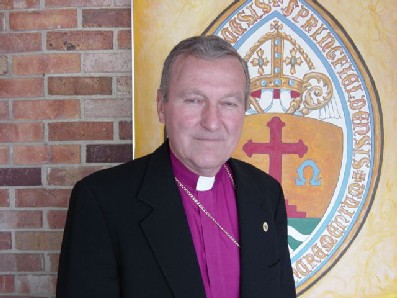
Three cheers for Bishop Beckwith. The church--Episcopal, Baptist, Methodist et al., need more like him.
THE EPISCOPAL CHURCH DIVIDED: ILLINOIS
Conservatives see no compromising
By Manya A. Brachear
Tribune staff reporter
Published November 14, 2006
JACKSONVILLE, Ill. -- On his annual visits to confirm newcomers to Springfield parishes, Bishop Peter Beckwith spares no words to warn his flock that the Episcopal Church is falling apart--succumbing to secular values in the guise of modern faith."There's only one truth, and our challenge is to discover it," he said in a recent homily at Trinity Episcopal Church in Jacksonville, the oldest of the diocese's 40 parishes. "It is revealed to us."
This unwavering view of Scripture divides Beckwith from the majority of the Episcopal Church and its new leader, Bishop Katharine Jefferts Schori.
But Beckwith refuses to sacrifice his integrity to hold together the relationship. He does not compare the possibility of schism to divorce. In fact, he likens it to fidelity.
"I'm married to the gospel, the Anglican Communion, the authority of Scripture--and I've got this prostitute putting the moves on me," he said, intending a reference not to Jefferts Schori but to her theology.
Throughout this rural Illinois diocese covering 60 counties, many parishioners and priests side with their bishop. Others are accustomed to his hard-line position and do what they want anyway. Some say they will discuss differences only with Beckwith, preferring not to air their disagreements."
Episcopal means `of the bishop.' How can you be against the bishop and actually say you're Episcopal?" said Rev. Richard Swan, a priest who oversees six parishes in a predominantly Baptist region where many parishioners have struggled to make ends meet after many area coal mines closed."
We have a bishop who takes his vows very seriously as to the part where a bishop is to guard the historic teachings of the Episcopal Church."
A former military chaplain, Beckwith's experience in the armed forces fuels his ministry.
"The best lesson in the military is you learn it's not about you," he said. "It's about the mission--mission accomplishment whatever it takes. ... To me, that's so close to Christian vocation. It's about the mission of the church."
Beckwith considers homosexuality a form of sinful behavior. He refused to confirm a California bishop in 2003 because the man had been divorced twice. And he refused to confirm New Hampshire Bishop V. Gene Robinson, who lives in a committed relationship with another man.
"The choice and the behavior is the issue," he said. "Sex is not fulfilling except for marriage between a man and a woman. Apart from that it's phony at best. It's about entertainment."
Of course, some priests disagree. Last month, St. Andrew's rector Rev. Virginia Bennett asked for oversight by an alternative bishop, saying she has not been able to overcome differences with Beckwith since she asked him to confirm a lesbian in her Edwardsville congregation in 2004.
Rev. James Cravens, rector of Trinity Episcopal Church in Lincoln, served as a chaplain in the Marine Corps with Beckwith. He voted against Robinson's election three years ago but says he does not like how Beckwith has used the issue to define his tenure."
I think the American religious scene in general is driven by extremists," Cravens said. "I'm afraid the church isn't going to rise above it."
Others welcome the idea of a separation.
"I'm glad you're here," Elisabeth Langford told Beckwith in Jacksonville, where parishioners greeted him with hugs, handshakes, gratitude and a buffet of beans and beef brisket.
"I'm waiting for the split. I think it's necessary," she said. "It's two different religions in the same church. That can't last."
----------mbrachear@tribune.com
Sunday, November 12, 2006
Lost in the Election News...Defense of Historic Marriage Advances
From Baptist Press:
7 states pass marriage amendments., civil unions defeated in Colorado
By Michael Foust — BP News
NASHVILLE, Tenn. — A majority of states in America now have adopted constitutional marriage amendments.
Seven states passed amendments Nov. 7 protecting the natural definition of marriage, bringing to 27 the number of states nationwide that have adopted amendments aimed at prohibiting "gay marriage." An eighth state, Arizona, seemed to be on the verge of becoming the first one to defeat an amendment, although conservatives there still hoped to see the final count yield a victory.
The seven states passed the amendments with an average of 63.6 percent of the vote, ranging from 52 percent in South Dakota to 80 percent in Tennessee. In Colorado, conservatives celebrated a double victory, watching the amendment win easily while also helping defeat Referendum I, which would have granted same-sex couples many of the legal benefits of marriage. It was a somewhat stunning loss for Referendum I after it led in pre-election polls.
"This shows that, nationwide, Americans still support marriage," Glen Lavy, an attorney with the conservative Alliance Defense Fund, told Baptist Press. "They know that marriage is the union of a man and a woman and they're willing to say so by their votes."
A victory in the blue state of Wisconsin may have been the most significant for pro-family groups. It faced stiff opposition in the weeks leading up to the election but passed easily, 59-41 percent. Wisconsin became the third state that voted Democratic in both the 2000 and 2004 presidential elections to adopt a marriage amendment, joining Michigan and Oregon.
"There are a number of things that are not partisan issues, that we can work with people from any party on, and that's protecting marriage, protecting life, protecting religious freedom," Wendy Wright, president of Concerned Women for America and a supporter of the amendments, told Baptist Press.
Tennessee's amendment passed easily despite a high hurdle that all constitutional amendments on the ballot there face. Such amendments must get not only a majority of votes, but also more "yes" votes than half of all the votes cast in the governor's election. Approximately 1,800,000 votes were cast for governor, meaning the amendment needed more than 900,000 votes. On Nov. 7, it garnered more than 1,400,000.
"Perhaps the most encouraging hidden nugget in last night’s results is that 77 percent of 18-29-year-old Tennessee voters voted for the ban on same-sex marriage, confirming social conservative trends among younger voters," said Richard Land, president of the Southern Baptist Ethics & Religious Liberty Commission.
Homosexual activists had hoped to tally a significant victory in Colorado by passing Referendum I, which would have legalized domestic partnerships for same-sex couples. Instead, they suffered a significant loss. With 88 percent of the precincts reporting, Referendum I was losing, 53-47 percent. In the final two weeks of the campaign, it led in separate polls by four and five points, although support had dipped below 50 percent. A September poll has it leading by 20 points.
"We knew from the outset that if we could just let people know what Referendum I was really about that they'd reject it," Jim Pfaff, a spokesperson for Colorado Family Action, told BP. "... Referendum I would have given all the rights and benefits of spouses to same-sex couples. It would have redefined the terms spouse, family and next of kin in all of Colorado law, making more than 1,000 changes in statutes. That's the message we got out to voters, and Colorado voters, once they had an opportunity to hear that, made the right decision."
Lavy said the fact that a majority of states have marriage amendments could impact any future "gay marriage" case before the U.S. Supreme Court.
"It is significant from a perspective of the U.S. Supreme Court's approach to constitutional questions, because in recent years the court has been saying that the trends in the states are significant for whether something is constitutional," he said.
For instance, in the Lawrence v. Texas decision, the court said that "because most of the states no longer had laws prohibiting same-sex relationships, there was no rational basis for the Texas law," Lavy said.
The growing movement to pass marriage amendments further weakens a key argument by homosexual activists, Lavy said.
"Marriage opponents are always trying to relate this battle to the civil rights battle in the ’60s," he said. "There was never a time that there was a significant number of states with constitutional amendments prohibiting interracial marriage.... By 1967 when the U.S. Supreme Court decided Loving v. Virginia [which overturned interracial marriage bans], only 17 states had laws prohibiting interracial marriage. So the consensus was going the other direction."
Arizona's amendment trailed 51-49 percent — by 32,000 votes — with 99 percent of the precincts reporting. Conservatives, though, were still holding out hope that enough absentee and outstanding ballots could help make up the difference. Much like a few other states, opponents of Arizona's amendment focused not on the issue of "gay marriage" but on other issues, such as domestic partner benefits. If the amendment fails, conservatives can try again in 2008 by launching another petition drive.
Vote totals for the seven amendments follow: Colorado (56-44 percent), Idaho (63-37), South
Carolina (78-22), South Dakota (52-48), Tennessee (80-20), Virginia (57-43) and Wisconsin (59-41).
Published by Keener Communications Group, November 2006
All site contents copyright © Christian Examiner™
7 states pass marriage amendments., civil unions defeated in Colorado
By Michael Foust — BP News
NASHVILLE, Tenn. — A majority of states in America now have adopted constitutional marriage amendments.
Seven states passed amendments Nov. 7 protecting the natural definition of marriage, bringing to 27 the number of states nationwide that have adopted amendments aimed at prohibiting "gay marriage." An eighth state, Arizona, seemed to be on the verge of becoming the first one to defeat an amendment, although conservatives there still hoped to see the final count yield a victory.
The seven states passed the amendments with an average of 63.6 percent of the vote, ranging from 52 percent in South Dakota to 80 percent in Tennessee. In Colorado, conservatives celebrated a double victory, watching the amendment win easily while also helping defeat Referendum I, which would have granted same-sex couples many of the legal benefits of marriage. It was a somewhat stunning loss for Referendum I after it led in pre-election polls.
"This shows that, nationwide, Americans still support marriage," Glen Lavy, an attorney with the conservative Alliance Defense Fund, told Baptist Press. "They know that marriage is the union of a man and a woman and they're willing to say so by their votes."
A victory in the blue state of Wisconsin may have been the most significant for pro-family groups. It faced stiff opposition in the weeks leading up to the election but passed easily, 59-41 percent. Wisconsin became the third state that voted Democratic in both the 2000 and 2004 presidential elections to adopt a marriage amendment, joining Michigan and Oregon.
"There are a number of things that are not partisan issues, that we can work with people from any party on, and that's protecting marriage, protecting life, protecting religious freedom," Wendy Wright, president of Concerned Women for America and a supporter of the amendments, told Baptist Press.
Tennessee's amendment passed easily despite a high hurdle that all constitutional amendments on the ballot there face. Such amendments must get not only a majority of votes, but also more "yes" votes than half of all the votes cast in the governor's election. Approximately 1,800,000 votes were cast for governor, meaning the amendment needed more than 900,000 votes. On Nov. 7, it garnered more than 1,400,000.
"Perhaps the most encouraging hidden nugget in last night’s results is that 77 percent of 18-29-year-old Tennessee voters voted for the ban on same-sex marriage, confirming social conservative trends among younger voters," said Richard Land, president of the Southern Baptist Ethics & Religious Liberty Commission.
Homosexual activists had hoped to tally a significant victory in Colorado by passing Referendum I, which would have legalized domestic partnerships for same-sex couples. Instead, they suffered a significant loss. With 88 percent of the precincts reporting, Referendum I was losing, 53-47 percent. In the final two weeks of the campaign, it led in separate polls by four and five points, although support had dipped below 50 percent. A September poll has it leading by 20 points.
"We knew from the outset that if we could just let people know what Referendum I was really about that they'd reject it," Jim Pfaff, a spokesperson for Colorado Family Action, told BP. "... Referendum I would have given all the rights and benefits of spouses to same-sex couples. It would have redefined the terms spouse, family and next of kin in all of Colorado law, making more than 1,000 changes in statutes. That's the message we got out to voters, and Colorado voters, once they had an opportunity to hear that, made the right decision."
Lavy said the fact that a majority of states have marriage amendments could impact any future "gay marriage" case before the U.S. Supreme Court.
"It is significant from a perspective of the U.S. Supreme Court's approach to constitutional questions, because in recent years the court has been saying that the trends in the states are significant for whether something is constitutional," he said.
For instance, in the Lawrence v. Texas decision, the court said that "because most of the states no longer had laws prohibiting same-sex relationships, there was no rational basis for the Texas law," Lavy said.
The growing movement to pass marriage amendments further weakens a key argument by homosexual activists, Lavy said.
"Marriage opponents are always trying to relate this battle to the civil rights battle in the ’60s," he said. "There was never a time that there was a significant number of states with constitutional amendments prohibiting interracial marriage.... By 1967 when the U.S. Supreme Court decided Loving v. Virginia [which overturned interracial marriage bans], only 17 states had laws prohibiting interracial marriage. So the consensus was going the other direction."
Arizona's amendment trailed 51-49 percent — by 32,000 votes — with 99 percent of the precincts reporting. Conservatives, though, were still holding out hope that enough absentee and outstanding ballots could help make up the difference. Much like a few other states, opponents of Arizona's amendment focused not on the issue of "gay marriage" but on other issues, such as domestic partner benefits. If the amendment fails, conservatives can try again in 2008 by launching another petition drive.
Vote totals for the seven amendments follow: Colorado (56-44 percent), Idaho (63-37), South
Carolina (78-22), South Dakota (52-48), Tennessee (80-20), Virginia (57-43) and Wisconsin (59-41).
Published by Keener Communications Group, November 2006
All site contents copyright © Christian Examiner™
Thursday, November 09, 2006
A Letter to Dr. Roy Medley
The following letter leaves today on its way eastward from my congregation:
Dr. Roy A. Medley
General Secretary
American Baptist Churches USA
P.O. Box 851, Valley Forge, PA 19482-0851
November 1, 2006
Dear Dr. Medley:
Pursuant to the congregational vote of our church and the subsequent advisory vote of church delegates meeting at Pomona, California in April of this year, and the decision of the Board of the American Baptist Churches of the Pacific Southwest (now known as Transformation Ministries), we write this day to inform you that as of November 1, 2006, the First Baptist Church of Temple City, California is no longer affiliated with the American Baptist Churches USA. Instead, the membership of First Baptist Church of Temple City has voted to be affiliated with Transformational Ministries.
We depart with a heavy heart. From its inception in 1941, our church has been part of the ABCUSA fellowship. However, in our judgment the ABCUSA has compromised in its upholding of Biblical teachings and priorities.
We also depart in hopes of a reunion the day when the ABCUSA returns to un-compromised Biblical values.
In the meantime, we will continue to relate to missionaries of the American Baptist Foreign Missions Society with whom we have positive and constructive relationships.
God bless you and your endeavors,
(signed)
Dr. Glenn E. Layne
Senior Pastor
(signed)
Mr. Alex Vago
Moderator
CC: Transformation Ministries
Dr. Roy A. Medley
General Secretary
American Baptist Churches USA
P.O. Box 851, Valley Forge, PA 19482-0851
November 1, 2006
Dear Dr. Medley:
Pursuant to the congregational vote of our church and the subsequent advisory vote of church delegates meeting at Pomona, California in April of this year, and the decision of the Board of the American Baptist Churches of the Pacific Southwest (now known as Transformation Ministries), we write this day to inform you that as of November 1, 2006, the First Baptist Church of Temple City, California is no longer affiliated with the American Baptist Churches USA. Instead, the membership of First Baptist Church of Temple City has voted to be affiliated with Transformational Ministries.
We depart with a heavy heart. From its inception in 1941, our church has been part of the ABCUSA fellowship. However, in our judgment the ABCUSA has compromised in its upholding of Biblical teachings and priorities.
We also depart in hopes of a reunion the day when the ABCUSA returns to un-compromised Biblical values.
In the meantime, we will continue to relate to missionaries of the American Baptist Foreign Missions Society with whom we have positive and constructive relationships.
God bless you and your endeavors,
(signed)
Dr. Glenn E. Layne
Senior Pastor
(signed)
Mr. Alex Vago
Moderator
CC: Transformation Ministries
Sunday, November 05, 2006
What Would Martin Do?
Well, not this. But it does show how dire the situation is for the Christian faith in Europe. I highly reccomend America Alone by Mark Steyn for some challenging thoughts on the loss of cultural confidence in Europe, and the decline of the Christian faith in Europe as key to that loss.
Priest burns himself to death over Islam
From David Crossland in Berlin
A retired priest committed suicide by setting himself on fire in a German monastery in protest at the spread of Islam and the Protestant Church’s inability to contain it.
Roland Weisselberg, 73, poured a can of petrol over his head and set light to himself in the grounds of the Augustine monastery in the eastern city of Erfurt, where Martin Luther spent six years as a monk at the beginning of the 16th century.
Witnesses said that Weisselberg climbed into a building site next to the monastery church, where a Reformation Day service was being held. He shouted “Jesus and Oskar” before the flames engulfed him. The latter name was an apparent reference to Oskar Brüsewitz, a priest who burnt himself in 1976 in protest against the Communist regime in East Germany.
Monastery staff tried to put out the flames and Weisselberg was still conscious as a nun prayed with him before he was taken to hospital. He died a day later, on Wednesday.
Media reports said that he had tried to kill himself inside the church but changed his mind when he found the side door was locked.
The Provost of Erfurt, Elfriede Begrich, told reporters that Weisselberg’s widow had said that he killed himself because he was alarmed at the spread of Islam and the Church’s stance on the issue.
She described Weisselberg as an erudite man who had addressed repeatedly the Church’s position on Islam in meetings over the past three to four years. He had written to her, urging her to take the matter more seriously, she said.
The Protestant Bishop of Saxony, Axel Noack, said the suicide had shocked the community and that he hoped it would not hurt relations between Christians and Muslims.
“We in the East are still among ourselves when we discuss Islam,” said Bishop Noack, adding that there were not many Muslims in the area.
Relations with Muslims have been a matter of intense debate in Germany in recent months, stoked by the cancellation of a Mozart opera in Berlin amid fears that it could provoke Muslim violence, and a speech by the Pope in September in which he quoted from a medieval text linking the spread of the Islamic faith to violence.
The Berlin Deutsche Oper has said that it will stage the opera, which has a scene showing the severed heads of the Prophet Muhammad, Jesus and Buddha.
Priest burns himself to death over Islam
From David Crossland in Berlin
A retired priest committed suicide by setting himself on fire in a German monastery in protest at the spread of Islam and the Protestant Church’s inability to contain it.
Roland Weisselberg, 73, poured a can of petrol over his head and set light to himself in the grounds of the Augustine monastery in the eastern city of Erfurt, where Martin Luther spent six years as a monk at the beginning of the 16th century.
Witnesses said that Weisselberg climbed into a building site next to the monastery church, where a Reformation Day service was being held. He shouted “Jesus and Oskar” before the flames engulfed him. The latter name was an apparent reference to Oskar Brüsewitz, a priest who burnt himself in 1976 in protest against the Communist regime in East Germany.
Monastery staff tried to put out the flames and Weisselberg was still conscious as a nun prayed with him before he was taken to hospital. He died a day later, on Wednesday.
Media reports said that he had tried to kill himself inside the church but changed his mind when he found the side door was locked.
The Provost of Erfurt, Elfriede Begrich, told reporters that Weisselberg’s widow had said that he killed himself because he was alarmed at the spread of Islam and the Church’s stance on the issue.
She described Weisselberg as an erudite man who had addressed repeatedly the Church’s position on Islam in meetings over the past three to four years. He had written to her, urging her to take the matter more seriously, she said.
The Protestant Bishop of Saxony, Axel Noack, said the suicide had shocked the community and that he hoped it would not hurt relations between Christians and Muslims.
“We in the East are still among ourselves when we discuss Islam,” said Bishop Noack, adding that there were not many Muslims in the area.
Relations with Muslims have been a matter of intense debate in Germany in recent months, stoked by the cancellation of a Mozart opera in Berlin amid fears that it could provoke Muslim violence, and a speech by the Pope in September in which he quoted from a medieval text linking the spread of the Islamic faith to violence.
The Berlin Deutsche Oper has said that it will stage the opera, which has a scene showing the severed heads of the Prophet Muhammad, Jesus and Buddha.
Subscribe to:
Posts (Atom)