Make Sure You Lose
(Genesis 32-35)
Part Three of the Series Struggling With God—
Lessons from the Life of Jacob
October 8, 2006
There’s a classic bit of comic relief in the original, 1977 “Star Wars” movie. The little trashcan shaped robot, R2D2 is playing 3-D chess with the seven-foot tall ape-like Wookie called Chewbacca—and the little guy is beating the big hairy guy. Han Solo warns R2D2 and his shiny golden robot companion, C-3PO (the one with the English butler accent), that Wookies have bad tempers and have been known to tear apart those who beat them, so C-3PO nervously says to R2D2, “My advice: Let the Wookie win!”
Sometimes, you have to let the Wookie win. Sometimes, you have to know when to “fold ‘em”, to quit, and to say that enough’s enough. No time is that more true than when you find yourself trying to fight with God. There’s a saying: Your arms are too short to box with God. That’s the situation that Jacob has here in Genesis 32-35.
We have to set up the story by looking at Jacob’s life thus far. We saw that while God had His hand on Jacob, Jacob was a schemer. He was always trying to do it his way. He scammed Esau out of both his birthright and his blessing, so he set off for the distant region of Paddan Aram (today, the border region of Syria and Iraq), the ancestral homeland of his people, both to flee from Esau’s rage—his brother was mumbling about killing him—as well as to find an acceptable wife from his clan, just as his own father had done before him. There he meets the family of Laban, who is more of a cheater than even Jacob. He fools him into marrying both of his daughters, Leah and Rachel, and basically makes him his wage slave for 20 years. While Jacob’s family and wealth grows, he is worn down by Laban’s demands and finally flees, going back to the land that one day would be called Israel.
But that means going right back to where Esau lives. That was the brother that 20 years ago wanted to kill Jacob for the way he’d been mistreated and cheated by Jacob.
Now, this is not just a soap opera from the 19th century BC. This is the story of God working in a man’s life. God was at work in Jacob’s life. We saw that back in chapter 28, where Jacob has a dream at a place he would call Bethel, the House of God. God showed him that the promises He’d made to his grandfather Abraham and his father Isaac were for Jacob as well. God said He would make Jacob’s family into a great nation, a nation that would bless the whole world.
But Jacob’s faith was unsteady and uncertain. Again and again he shows an independent, self-sufficient streak that gets him into trouble.
There’s a passage in Proverbs, Proverbs 3:5-6, that tells us God’s intent for our lives:
5Trust in the LORD with all your heart
and lean not on your own understanding;
6in all your ways acknowledge him,
and he will make your paths straight.
That what God wants in your life: trust in Him, not in yourself. God wants you to give Him recognition in all areas of your life, and He promises then to bless you, to “make your path straight.”
Jacob was nowhere near this level of faith and trust. He was scared, and as we’ll see, he does his best to look out for himself until one faithful night.
What happened to change Jacob so much? We’ll find it all in the night Jacob wrestled God.
The mystery begins in the haunting words of Genesis 32:1-2:
1Jacob also went on his way, and the angels of God met him. 2When Jacob saw them, he said, "This is the camp of God!" So he named that place Mahanaim.
Mahanaim means “two camps.” Why does he name the place Two Camps? From Jacob’s point of view, One Camp was what he had: a caravan of servants, flocks and family, now aided by Another Camp, a camp of angels. That must have been a great comfort to Jacob. He was facing his angry brother, so it must be nice to think you have angels on your side.
But Jacob was still immature in his faith. He still thought of God as a Big Helper in the Sky, not as the Lord of Glory who wants to use him and also make him a good and godly man.
Jacob sent messengers ahead to talk with Esau. He was hoping to ease his way back with gifts and servants, but the message came that Esau was on his way—with 400 men! So what does he do? He divides his flocks and family into Two Camps, two groups, and sends another groups with more gifts to try to appease his brother. Two Camps! He was imitating on the earthly level what God had showed him from the spiritual level. Jacob was still trying to do God’s job along with his own. Well, Jacob sent them all on ahead, crossing the Jabbok brook, and he stayed behind—the very last person that Esau would encounter. Look at vs. 22-23:
22That night Jacob got up and took his two wives, his two maidservants and his eleven sons and crossed the ford of the Jabbok. 23After he had sent them across the stream, he sent over all his possessions.
We see Jacob here in a different mode than we have seen him before—panic mode. Esau is a tough guy. Now what?
This was the night God had been preparing Jacob for his whole life. This was the night that God would wound Jacob, for a very good reason. Look at vs. 24-25.
24So Jacob was left alone, and a man wrestled with him till daybreak. 25When the man saw that he could not overpower him, he touched the socket of Jacob's hip so that his hip was wrenched as he wrestled with the man.
Out of the blue—a “man” wrestles with him until daybreak. It seems like a draw until—blink! —He touched Jacob’s hip socket—OUCH!
The “man” is God Himself in human form. (Vs. 28 says he struggled with God, and in vs. 30, Jacob says he saw God face to face. So when we talk about Jacob wrestling an angel, it isn’t quite right. He was in an all-night WWF fight with God Himself, in human form.)
What’s the reason? Why did God mug Jacob? Why does God sometimes wrestle us down? Ever feel like God’s wrestling you?
Many years ago, a prospective student asked A.H. Strong, president of Rochester Theological Seminary, if there wasn’t some way to accelerate his course of study. His response:
“Oh, yes, but it depends on what you want to be. When God wants to make an oak, He takes a hundred years. When God wants to make a squash, He takes a few months.”
Jacob was about 60 years old when he finally wrestled with God. God brought him to this moment with great patience. God has brought you here up to today with great patience as well. We’re all hard cases with God, but remember God’s goal: to make us like His Son Jesus in our love for God and our love for people. This wasn’t Jacob’s character, and it’s not our character by nature. One way or another, God will pursue us.
When God gets us in these moments of desperation, crisis and struggle, I have observed two things:
He has us there to prepare us for something else, something greater. God always has a “next step” for us.
But we cannot see what that purpose is yet—we are in the dark about what His purpose is at the time!
Jacob was literally in the dark when God wrestled him. That’s exactly where God so often meets us to change us—in dark times. Look at vs. 26-28:
26Then the man said, "Let me go, for it is daybreak." But Jacob replied, "I will not let you go unless you bless me." 27The man asked him, "What is your name?" "Jacob," he answered.
28Then the man said, "Your name will no longer be Jacob, but Israel, because you have struggled with God and with men and have overcome."
Do you get the feeling that this all a set up? That the “man” was holding back? Anybody who can turn a hip joint into Jell-O with a touch could have put Jacob away in an instant.
The real point was not to whip Jacob—it was to change him. “You’re name’s Jacob? The Cheater? The King of the Sting? Not anymore. You’re Israel now—God’s Fighter. And this is how you win in a fight with God—by holding on, even in the dark, not by winning. You held on. That’s enough.”
This is how he overcame—he held on to God in the dark. And that’s how it works for us as well—we breakthrough in growth when we simply hold on to God in the dark. Do you want God to do a real work in your life? To take you from where you are to the next step? To see real maturity break out in your life? Then I tell you, you must hold on to God in the dark.
Some of you have been through these times. You know how dark the dark can be. And you know that you overcame not by winning but simply by holding on to God in the dark. When the wound is deepest, make the embrace the tightest. When the night is darkest, then wrestle the mightiest. Hold on to God in the dark.
I think of the McDonough family. They were in the church in worked in when I was in seminary. The dad, Condon, told me that before their son Brandon was born, they were a family that happened to be Christian. But their son’s Down’s syndrome caused them to reassess their lives. They held on to God in the dark. And as Condon puts it, they went from being a family that happened to be Christian to being a Christian family.
What happens in that dark place is that God gives us the blessing of Peniel—the blessing of seeing the face of God.
Read vs. 29-30:
29Jacob said, "Please tell me your name."
But he replied, "Why do you ask my name?" Then he blessed him there.
30So Jacob called the place Peniel, [“Face of God”] saying, "It is because I saw God face to face, and yet my life was spared."
The blessing is this: I have seen God! Peniel is when you and God have a face-off, and you blink. Peniel is when you see God at work in your life. Peniel is almost always discovered in the dark. Peniel happens when you “let the Wookie win.”
That’s when Jacob was a changed man—a permanently changed man. Look at vs. 31-32:
31The sun rose above him as he passed Peniel, and he was limping because of his hip. 32Therefore to this day the Israelites do not eat the tendon attached to the socket of the hip, because the socket of Jacob's hip was touched near the tendon.
That morning, Jacob was dead and Israel was born. He was a changed man. He would never be the same again. His limp was the necessary touch of God marked on his life for the rest of his days. Israel would memorialize this even in their eating habits. More important is the fact that the night by the Jabbok, Jacob learned that he could no longer be the independent, self-sufficient, act now, think later, kind of guy he’d been.
From the wreckage of this battle emerges a new man: a gentle, tender, thoughtful, godly man. A man who confesses his wrong to his brother Esau. A different man.
If you must wrestle with God, be sure to lose! Let God win! There is a beauty in this kind of brokenness. I have know saints who are chronologically mature, but nearly useless to God because they’re never been broken. They may have gone through the dark, but they did not hold on. They ran when the hand of God reached for their hip socket! They tried to win when they were wrestling with God.
But sometimes I meet people, some of whom have walked with God just a few years, some truly seasoned saints, in whom I see the beauty of brokenness.
Let me give you an example. Ravi Zacharias was raised in a Christian family in India—or as he calls his homeland, the land of 330,000,000 gods. Today, Ravi is perhaps the world’s best and best-known apologist for the Christian faith, author of dozens of books and has lectured in over 50 countries. At age 17, he gave his life to Christ. But the pressures put on him by his father, by his poor grades in school, and by the Hindu culture around him caused him to attempt suicide.
Lying in his hospital bed, a friend came in one day and read from the Bible. He frankly didn’t want to hear it; he wasn’t sure anymore what was truth and what wasn’t. They read from John 14. Vs. 6 he knew: “I am the way and the truth and the life; no one comes to the Father except through me.” But what really caught his attention was vs. 19: Because I live, you also will live.
That hospital bed was his Peniel. Listen to his own words:
Again, I wasn’t sure what all that meant. I pieced together God’s love in Christ, the way that was provided because of Christ, and the promise of life through Him—and on that hospital bed I made my commitment to put my life in His hands…
When I was able to leave the hospital, I was a new person. No, I didn’t have everything figured out. But Christ was part of my life, and the change was more dramatic than I could ever have imagined.
Ravi learned what Jacob had: he held on in the dark, and saw a miracle in his life: the hand of God.
Interesting. The next day, Jacob came limping and there was Esau—who just embraced and forgave Jacob for all the wrong he’d done him 20 years before. I love what Jacob says to Esau in Genesis 33:10. “To see your face is to see the face of God.” Jacob’s swagger is gone. His humility is real. He’s a man who’s been touched by God and who is a changed man.
After a while, he makes his way to Bethel, the place where had a dream of a stairway from heaven. It was Jacob who told the others to get rid of all the idols they’d brought with them and who built and altar and sacrificed to the Lord. And God appeared to him, this time in a vision, not a dream, and reaffirmed his new name (35:10):
God said to him, "Your name is Jacob, but you will no longer be called Jacob; your name will be Israel." So he named him Israel.
Today God wants to meet you here and show His face to you. He wants to remind us of the beauty of brokenness. He wants to call us to the next level, the next step.
Today we have two stations for prayer set up. On this side, we have a tent set up to remind us of the Mahanaim—the Two Camps. That stands for being self-sufficient. On the other side we have the cross. That stands for Peniel, the Face of God.
In our closing time, I’d invite you to take action. If you say, “Lord, I know I’m way too self-sufficient for my own good, I don’t trust in you with all my heart, I don’t acknowledge you in all my ways,” then good to Mahanaim and admit that to God. Confess your stubborn independence.
Then move over to Peniel. God wants to show you His face, His love. The cross of Jesus is the greatest demonstration of His love ever. Let Him touch you, wound you and heal you. He wants to transform you. He wants you to enter into the fullness of His will and plan for your life.
Instead of a closing pray, I’ve asked Matt and the worship leaders to sing softly, and give you the time you need—to come up and to let God touch you, heal you and maybe even give you a new name. Let’s worship and pray…
Wednesday, October 25, 2006

Tuesday, October 24, 2006
The Life of Jacob, Part Two
Life Sure Gets Complicated
(Genesis 28-31)
Part Two of the Series Struggling With God—
Lessons from the Life of Jacob
October 1, 2006
“Life sure gets complicated once you get past 18.” I remember a song on the radio with that line when I was a kid. Man, I wanted to get past 18 and on my own so bad, I didn’t believe it. Once I was out on my own, things would get a lot easier—so I thought. I would do what I wanted when I wanted and it would be easy. I would get an education and a job and make a lot of money. It would be simple.
Wrong! Life does get complicated. Jacob’s story unfolds as one thing leads to another. He moves, he marries, he has a family, he realizes that his father-in-law is cheating him, his brothers-in-law want to kill him, so he ends up on the run again, coming back to the land where his brother, Esau also wants to kill him. Sounds like fun. Sounds the like the plot of a telenovella.
Last week we began to look at the life of Jacob because Jacob’s story tells us things that can give us great insight into how God works in us to enable us to grow up spiritually. Last week we saw that while God had His hand on Jacob, Jacob was a schemer. He scammed Esau out of both his birthright and his blessing, so he sets off for the distant region of Paddan Aram, the ancestral homeland of his people, both to flee from Esau’s rage—his brother was mumbling about killing him—as well as to find an acceptable wife from his clan, just as his own father had done before him.
According to Romans 8:29, God’s desire is that we to be “conformed to the likeness of his Son.” That is, that we would love God and love His will and love people the same way that Jesus did when He was among us. God wants to work in us to become a fully formed follower of Jesus. Jesus Himself taught what that fully formed state looks like: it’s when we love God fully and love people truly. So far, Jacob has shown very little interest in God and has shown that he really only loves himself. But God is at work in Jacob’s life.
In the story of Jacob, we see God at work, to change him and woo him and draw him into a deep and real relationship with himself. He does that, so often, in and through the complications of life. Sometimes we think and act as if the Lord is neutral about things like work and love and marriage and family strife—that God only shows up at church. Nothing could be further from the truth. God is at work all the time, and loves to use the complications of life to form us and to shape us into the kind of person who shows His glory and grace and who turns to Him and gives Him the praise for the things He has done.
So God is at work in Jacob’s life. In this section, these four chapters, we’ll see God at work in Jacob’s life in two distinct ways. First, we’ll see how God makes certain promises to Jacob. God has a plan, and he revealed just enough of Jacob’s part in the plan to get his attention and to start him thinking about God’s place in his life. Now, it was only a start, and Jacob had a long way to go, but it was a beginning.
The second way that God went to work in Jacob’s life was through his relationship with his new father-in-law, Laban. I wish I could say it was because Laban was a great mentor to him, but that’s not the case. Instead, Laban is just as much a con man as Jacob. As a matter of fact, he may even be a better con man. Laban tricked, used and abused Jacob until Jacob couldn’t take it anymore.
What happened with Jacob is a perfect illustration of one of the iron laws of life: the law of sowing and reaping. The apostle Paul puts it this way in Galatians 6:7-8:
7Do not be deceived: God cannot be mocked. A man reaps what he sows. 8The one who sows to please his sinful nature, from that nature will reap destruction; the one who sows to please the Spirit, from the Spirit will reap eternal life.
Jacob had sowed deception, so he would be deceived; Jacob had sowed trickery for gain, so he would be ripped off. In Laban, God gave Jacob a taste of his own medicine.
First, let’s see how God meets and makes some key promises to Jacob. That’s in chapter 28. First, before he takes off for Paddan Aram, his father Isaac gives him a blessing (vs. 3-4):
3May God Almighty bless you and make you fruitful and increase your numbers until you become a community of peoples. 4May he give you and your descendants the blessing given to Abraham, so that you may take possession of the land where you now live as an alien, the land God gave to Abraham.
Abraham was Jacob’s grandfather, and the memory of God’s promises to Abraham was becoming more of a family tradition than a living reality for Jacob. Still, these were the words were ringing in Jacob’s ear when he left.
He left from Beersheba, in the far south of the land on his journey to Paddan Aram, about 300 miles away. 30 miles was considered about the most you could go in one day. I want you to imagine Jacob leading a donkey laden with supplies. He pushes hard that first day, probably leaving before dawn and going into the night, until he’s so tired he has to stop. Instead of 30 miles, he’s walked almost 40 miles that day—a long, long way for a guy who had been a homebody. That’s when God speaks to him a second time—this time, not through his father’s blessing, but in a dream.
Look at Genesis 28:10-18:
10Jacob left Beersheba and set out for Haran. 11When he reached a certain place, he stopped for the night because the sun had set. Taking one of the stones there, he put it under his head and lay down to sleep. 12He had a dream in which he saw a stairway resting on the earth, with its top reaching to heaven, and the angels of God were ascending and descending on it. 13There above it stood the LORD, and he said: "I am the LORD, the God of your father Abraham and the God of Isaac. I will give you and your descendants the land on which you are lying. 14Your descendants will be like the dust of the earth, and you will spread out to the west and to the east, to the north and to the south. All peoples on earth will be blessed through you and your offspring. 15I am with you and will watch over you wherever you go, and I will bring you back to this land. I will not leave you until I have done what I have promised you."
16When Jacob awoke from his sleep, he thought, "Surely the LORD is in this place, and I was not aware of it." 17He was afraid and said, "How awesome is this place! This is none other than the house of God; this is the gate of heaven."
18Early the next morning Jacob took the stone he had placed under his head and set it up as a pillar and poured oil on top of it. 19He called that place Bethel, though the city used to be called Luz.
This has been called the vision of “Jacob’s Ladder”, though the NIV is right to translate what Jacob saw as a “stairway.” (More about the “stairway” later.) Above this stairway, he sees the Lord who makes the same promises to him that He’d made in years past to Abraham and his father Isaac—just like the blessing Isaac had given him.
Now there’s an upside and a downside to this vision. The upside is that the reality of God and His promises have been stamped on Jacob’s heart to a greater extent than ever before. The downside is that Jacob reacts in a way that shows that he still has a primitive, almost pagan, idea of God Himself.
Look at what he says. First, he think that’s he’s kind of stumbled on a heavenly gateway. (Kind of like the TV show “Stargate SG-1”.) So he ends up giving the village a new name, Bethel, which means The House of God.
Second, he makes a vow to God that has all the marks of a pagan vow. Look at vs. 20-22:
20Then Jacob made a vow, saying, "If God will be with me and will watch over me on this journey I am taking and will give me food to eat and clothes to wear 21so that I return safely to my father's house, then the LORD will be my God 22and this stone that I have set up as a pillar will be God's house, and of all that you give me I will give you a tenth."
God, IF you go with me, watch over me, give me food and clothes, enable to come back THEN you’ll be my God and I will be a tither! Isn’t that nice of Jacob!
What Jacob experienced here isn’t all that different from what a middle school student may experience at camp. It’s a spiritual high. It has a huge impact. But that high isn’t matched by a deep knowledge of God and His ways. So we play “Let’s Make a Deal” with God. If you give me this, then I’ll do that for you.
But this is not God’s way. It may be the way of the pagan gods, but not the one true God. Again: he tells Jacob that He has a plan, and that Jacob has a role to play in that plan. This was not an offer; it was God’s sovereign plan. Jacob didn’t get that yet, and it would be a long while before he would.
Onward, to the north, Jacob journeys. In chapter 29, he reaches Paddan Aram. He meets a woman from his clan named Rachel, and he falls in love at first sight.
Rachel’s father is Laban, who is also Rebekah’s brother. This Laban is a cunning character. Look in Genesis 28:14-15:
14Then Laban said to him, "You are my own flesh and blood."
After Jacob had stayed with him for a whole month, 15Laban said to him, "Just because you are a relative of mine, should you work for me for nothing? Tell me what your wages should be."
OK, a month’s enough; you can’t stay here for free, boy. He was a son in Isaac’s house, but in Laban’s house, he becomes a servant.
Jacob says, OK, that’s reasonable. Wages? What I really want is that cute daughter of yours, the young one, Rachel (not Leah, the older one, one the one with the bad eyes). So I’ll work for you for seven years, then I get her. Deal?
Laban agrees. Seven years pass. They have a big wedding feast. They have a big wedding night. And then in the morning, who does Jacob wake up in bed with? With bad-eyes Leah! Spitting mad, Jacob goes to Laban who calmly says, “It’s not our custom to marry off the younger before the older, so it’s a package deal. In another week, you can have Rachel as your wife as well. Oh, and by the way, that means you owe me seven more years of work.”
Now if I’d been Jacob, I think I would have said, “I’ve been here for SEVEN YEARS. Don’t you think you should have mentioned this little custom before now?”
But this is Jacob reaping what he’d sown. He tricked his own father, pretending to be the older son, Esau; now Laban tricked Jacob by having Leah pretend to be the younger daughter, Rachel. And he ends up being Laban’s virtual slave for 14 long years.
Laban wasn’t doing this for Jacob’s spiritual development, but God was. Laban was unloading an undesirable daughter and getting Jacob’s labor in return. But God was behind the scenes. God was using Laban’s greed and lack of character to build Jacob’s character. Hardship has the potential to make us better people. Jacob was learning that actions have consequences. He was learning patience. He was learning responsibility. He was learning self-control. Think about that when you think of the Labans in your life.
Now in chapter 29 and 30, we’re told of the births of many of Jacob’s children. And even as his family increases, his flocks increase. The 14 years are up, but Laban manages to keep Jacob around for about six more years. His flocks grow to be more numerous and healthier than Laban’s.
So it’s no surprise to read in chapter 31 than Laban’s own sons are resenting Jacob. Look in Genesis 31:1:
Jacob heard that Laban's sons were saying, "Jacob has taken everything our father owned and has gained all this wealth from what belonged to our father."
He must have had a flashback to his brother, Esau. These guys are seeing their own inheritance winding up in Jacob’s sheep pens. So he brings Leah and Rachel together and they form a bold plan: to flee with the children, the servants and the flocks to Canaan, back to the land Jacob had come from. And so they do.
When Laban found out, he pursued them. He wanted to keep Jacob as his slave and good luck charm. He knew that God had prospered Jacob, and that through Jacob, Laban had prospered as well. But just before they caught up with Jacob and the whole caravan God warned Laban in a dream not to mess with Jacob—not harm him or even to say anything about him. When he saw Jacob, Laban said he was just there to say good-bye to his daughters and grandkids, and he and Jacob made a covenant not to harm one another.
Laban was also looking for some missing idols, little household “gods” as they are called in 30, that Rachel had taken without Jacob’s knowledge. She was still pretty pagan in her beliefs and she probably took them because she believed they would guarantee her fertility (she’d had only one child, Joseph, as compared to Leah’s five sons and one daughter). She cleverly managed to keep them idols hidden until Laban gave up looking for them.
So Jacob and family are safely away from Laban and his sons. They are rich by ancient standards. But they are now on the outskirts of Canaan, and that meant Esau was nearby. The central event in the life of Jacob was yet to come. He will wrestle with God and his life will be revolutionized. But that’s next week. You don’t want to miss that!
Is God at work in your life? There is no question that He is. The only question is what you’re doing with His work—how you’re responding to His work.
Over the years, maybe you sensed God’s hand on you. You have a sense that God’s been there at some crucial points in your life. You’ve had your own “Bethel” times, times when you’ve sensed him near.
But at the same time, you’ve also run into your Labans—people and circumstances that have made you wonder if God even cares at all for you. Like Jacob, you didn’t realize that God sent the Labans as well. God uses the hard times, and hard people, to draw us near to Him.
But God’s been there the whole time. Jesus Himself has been there the whole time. Interesting—Jesus once mentioned the story of Jacob’s dream and He said something amazing about it. In John 1 He tells Nathaniel that before they’d even met, He’d seen him, like in a vision, reading under the fig tree. He was so amazed that he said to Jesus, "Rabbi, you are the Son of God; you are the King of Israel!”
Then Jesus says, in John 1:50-51:
50Jesus said, "You believe because I told you I saw you under the fig tree. You shall see greater things than that." 51He then added, "I tell you the truth, you shall see heaven open, and the angels of God ascending and descending on the Son of Man."
Did you catch that? Jesus is saying that He is the stairway between heaven and earth, the stairway that Jacob saw in his dream, the One with the angels going up and down. He is the way, the one mediator between God and mankind.
And Jesus is the connection, the stairway, the mediator for you today. God wants you to know His best. He gave His best when He sent His Son. He is watching over every aspect of your life. He wants you to know Him as loving Lord and as Heavenly Father. God has a plan just for you. Don’t miss it!
(Genesis 28-31)
Part Two of the Series Struggling With God—
Lessons from the Life of Jacob
October 1, 2006
“Life sure gets complicated once you get past 18.” I remember a song on the radio with that line when I was a kid. Man, I wanted to get past 18 and on my own so bad, I didn’t believe it. Once I was out on my own, things would get a lot easier—so I thought. I would do what I wanted when I wanted and it would be easy. I would get an education and a job and make a lot of money. It would be simple.
Wrong! Life does get complicated. Jacob’s story unfolds as one thing leads to another. He moves, he marries, he has a family, he realizes that his father-in-law is cheating him, his brothers-in-law want to kill him, so he ends up on the run again, coming back to the land where his brother, Esau also wants to kill him. Sounds like fun. Sounds the like the plot of a telenovella.
Last week we began to look at the life of Jacob because Jacob’s story tells us things that can give us great insight into how God works in us to enable us to grow up spiritually. Last week we saw that while God had His hand on Jacob, Jacob was a schemer. He scammed Esau out of both his birthright and his blessing, so he sets off for the distant region of Paddan Aram, the ancestral homeland of his people, both to flee from Esau’s rage—his brother was mumbling about killing him—as well as to find an acceptable wife from his clan, just as his own father had done before him.
According to Romans 8:29, God’s desire is that we to be “conformed to the likeness of his Son.” That is, that we would love God and love His will and love people the same way that Jesus did when He was among us. God wants to work in us to become a fully formed follower of Jesus. Jesus Himself taught what that fully formed state looks like: it’s when we love God fully and love people truly. So far, Jacob has shown very little interest in God and has shown that he really only loves himself. But God is at work in Jacob’s life.
In the story of Jacob, we see God at work, to change him and woo him and draw him into a deep and real relationship with himself. He does that, so often, in and through the complications of life. Sometimes we think and act as if the Lord is neutral about things like work and love and marriage and family strife—that God only shows up at church. Nothing could be further from the truth. God is at work all the time, and loves to use the complications of life to form us and to shape us into the kind of person who shows His glory and grace and who turns to Him and gives Him the praise for the things He has done.
So God is at work in Jacob’s life. In this section, these four chapters, we’ll see God at work in Jacob’s life in two distinct ways. First, we’ll see how God makes certain promises to Jacob. God has a plan, and he revealed just enough of Jacob’s part in the plan to get his attention and to start him thinking about God’s place in his life. Now, it was only a start, and Jacob had a long way to go, but it was a beginning.
The second way that God went to work in Jacob’s life was through his relationship with his new father-in-law, Laban. I wish I could say it was because Laban was a great mentor to him, but that’s not the case. Instead, Laban is just as much a con man as Jacob. As a matter of fact, he may even be a better con man. Laban tricked, used and abused Jacob until Jacob couldn’t take it anymore.
What happened with Jacob is a perfect illustration of one of the iron laws of life: the law of sowing and reaping. The apostle Paul puts it this way in Galatians 6:7-8:
7Do not be deceived: God cannot be mocked. A man reaps what he sows. 8The one who sows to please his sinful nature, from that nature will reap destruction; the one who sows to please the Spirit, from the Spirit will reap eternal life.
Jacob had sowed deception, so he would be deceived; Jacob had sowed trickery for gain, so he would be ripped off. In Laban, God gave Jacob a taste of his own medicine.
First, let’s see how God meets and makes some key promises to Jacob. That’s in chapter 28. First, before he takes off for Paddan Aram, his father Isaac gives him a blessing (vs. 3-4):
3May God Almighty bless you and make you fruitful and increase your numbers until you become a community of peoples. 4May he give you and your descendants the blessing given to Abraham, so that you may take possession of the land where you now live as an alien, the land God gave to Abraham.
Abraham was Jacob’s grandfather, and the memory of God’s promises to Abraham was becoming more of a family tradition than a living reality for Jacob. Still, these were the words were ringing in Jacob’s ear when he left.
He left from Beersheba, in the far south of the land on his journey to Paddan Aram, about 300 miles away. 30 miles was considered about the most you could go in one day. I want you to imagine Jacob leading a donkey laden with supplies. He pushes hard that first day, probably leaving before dawn and going into the night, until he’s so tired he has to stop. Instead of 30 miles, he’s walked almost 40 miles that day—a long, long way for a guy who had been a homebody. That’s when God speaks to him a second time—this time, not through his father’s blessing, but in a dream.
Look at Genesis 28:10-18:
10Jacob left Beersheba and set out for Haran. 11When he reached a certain place, he stopped for the night because the sun had set. Taking one of the stones there, he put it under his head and lay down to sleep. 12He had a dream in which he saw a stairway resting on the earth, with its top reaching to heaven, and the angels of God were ascending and descending on it. 13There above it stood the LORD, and he said: "I am the LORD, the God of your father Abraham and the God of Isaac. I will give you and your descendants the land on which you are lying. 14Your descendants will be like the dust of the earth, and you will spread out to the west and to the east, to the north and to the south. All peoples on earth will be blessed through you and your offspring. 15I am with you and will watch over you wherever you go, and I will bring you back to this land. I will not leave you until I have done what I have promised you."
16When Jacob awoke from his sleep, he thought, "Surely the LORD is in this place, and I was not aware of it." 17He was afraid and said, "How awesome is this place! This is none other than the house of God; this is the gate of heaven."
18Early the next morning Jacob took the stone he had placed under his head and set it up as a pillar and poured oil on top of it. 19He called that place Bethel, though the city used to be called Luz.
This has been called the vision of “Jacob’s Ladder”, though the NIV is right to translate what Jacob saw as a “stairway.” (More about the “stairway” later.) Above this stairway, he sees the Lord who makes the same promises to him that He’d made in years past to Abraham and his father Isaac—just like the blessing Isaac had given him.
Now there’s an upside and a downside to this vision. The upside is that the reality of God and His promises have been stamped on Jacob’s heart to a greater extent than ever before. The downside is that Jacob reacts in a way that shows that he still has a primitive, almost pagan, idea of God Himself.
Look at what he says. First, he think that’s he’s kind of stumbled on a heavenly gateway. (Kind of like the TV show “Stargate SG-1”.) So he ends up giving the village a new name, Bethel, which means The House of God.
Second, he makes a vow to God that has all the marks of a pagan vow. Look at vs. 20-22:
20Then Jacob made a vow, saying, "If God will be with me and will watch over me on this journey I am taking and will give me food to eat and clothes to wear 21so that I return safely to my father's house, then the LORD will be my God 22and this stone that I have set up as a pillar will be God's house, and of all that you give me I will give you a tenth."
God, IF you go with me, watch over me, give me food and clothes, enable to come back THEN you’ll be my God and I will be a tither! Isn’t that nice of Jacob!
What Jacob experienced here isn’t all that different from what a middle school student may experience at camp. It’s a spiritual high. It has a huge impact. But that high isn’t matched by a deep knowledge of God and His ways. So we play “Let’s Make a Deal” with God. If you give me this, then I’ll do that for you.
But this is not God’s way. It may be the way of the pagan gods, but not the one true God. Again: he tells Jacob that He has a plan, and that Jacob has a role to play in that plan. This was not an offer; it was God’s sovereign plan. Jacob didn’t get that yet, and it would be a long while before he would.
Onward, to the north, Jacob journeys. In chapter 29, he reaches Paddan Aram. He meets a woman from his clan named Rachel, and he falls in love at first sight.
Rachel’s father is Laban, who is also Rebekah’s brother. This Laban is a cunning character. Look in Genesis 28:14-15:
14Then Laban said to him, "You are my own flesh and blood."
After Jacob had stayed with him for a whole month, 15Laban said to him, "Just because you are a relative of mine, should you work for me for nothing? Tell me what your wages should be."
OK, a month’s enough; you can’t stay here for free, boy. He was a son in Isaac’s house, but in Laban’s house, he becomes a servant.
Jacob says, OK, that’s reasonable. Wages? What I really want is that cute daughter of yours, the young one, Rachel (not Leah, the older one, one the one with the bad eyes). So I’ll work for you for seven years, then I get her. Deal?
Laban agrees. Seven years pass. They have a big wedding feast. They have a big wedding night. And then in the morning, who does Jacob wake up in bed with? With bad-eyes Leah! Spitting mad, Jacob goes to Laban who calmly says, “It’s not our custom to marry off the younger before the older, so it’s a package deal. In another week, you can have Rachel as your wife as well. Oh, and by the way, that means you owe me seven more years of work.”
Now if I’d been Jacob, I think I would have said, “I’ve been here for SEVEN YEARS. Don’t you think you should have mentioned this little custom before now?”
But this is Jacob reaping what he’d sown. He tricked his own father, pretending to be the older son, Esau; now Laban tricked Jacob by having Leah pretend to be the younger daughter, Rachel. And he ends up being Laban’s virtual slave for 14 long years.
Laban wasn’t doing this for Jacob’s spiritual development, but God was. Laban was unloading an undesirable daughter and getting Jacob’s labor in return. But God was behind the scenes. God was using Laban’s greed and lack of character to build Jacob’s character. Hardship has the potential to make us better people. Jacob was learning that actions have consequences. He was learning patience. He was learning responsibility. He was learning self-control. Think about that when you think of the Labans in your life.
Now in chapter 29 and 30, we’re told of the births of many of Jacob’s children. And even as his family increases, his flocks increase. The 14 years are up, but Laban manages to keep Jacob around for about six more years. His flocks grow to be more numerous and healthier than Laban’s.
So it’s no surprise to read in chapter 31 than Laban’s own sons are resenting Jacob. Look in Genesis 31:1:
Jacob heard that Laban's sons were saying, "Jacob has taken everything our father owned and has gained all this wealth from what belonged to our father."
He must have had a flashback to his brother, Esau. These guys are seeing their own inheritance winding up in Jacob’s sheep pens. So he brings Leah and Rachel together and they form a bold plan: to flee with the children, the servants and the flocks to Canaan, back to the land Jacob had come from. And so they do.
When Laban found out, he pursued them. He wanted to keep Jacob as his slave and good luck charm. He knew that God had prospered Jacob, and that through Jacob, Laban had prospered as well. But just before they caught up with Jacob and the whole caravan God warned Laban in a dream not to mess with Jacob—not harm him or even to say anything about him. When he saw Jacob, Laban said he was just there to say good-bye to his daughters and grandkids, and he and Jacob made a covenant not to harm one another.
Laban was also looking for some missing idols, little household “gods” as they are called in 30, that Rachel had taken without Jacob’s knowledge. She was still pretty pagan in her beliefs and she probably took them because she believed they would guarantee her fertility (she’d had only one child, Joseph, as compared to Leah’s five sons and one daughter). She cleverly managed to keep them idols hidden until Laban gave up looking for them.
So Jacob and family are safely away from Laban and his sons. They are rich by ancient standards. But they are now on the outskirts of Canaan, and that meant Esau was nearby. The central event in the life of Jacob was yet to come. He will wrestle with God and his life will be revolutionized. But that’s next week. You don’t want to miss that!
Is God at work in your life? There is no question that He is. The only question is what you’re doing with His work—how you’re responding to His work.
Over the years, maybe you sensed God’s hand on you. You have a sense that God’s been there at some crucial points in your life. You’ve had your own “Bethel” times, times when you’ve sensed him near.
But at the same time, you’ve also run into your Labans—people and circumstances that have made you wonder if God even cares at all for you. Like Jacob, you didn’t realize that God sent the Labans as well. God uses the hard times, and hard people, to draw us near to Him.
But God’s been there the whole time. Jesus Himself has been there the whole time. Interesting—Jesus once mentioned the story of Jacob’s dream and He said something amazing about it. In John 1 He tells Nathaniel that before they’d even met, He’d seen him, like in a vision, reading under the fig tree. He was so amazed that he said to Jesus, "Rabbi, you are the Son of God; you are the King of Israel!”
Then Jesus says, in John 1:50-51:
50Jesus said, "You believe because I told you I saw you under the fig tree. You shall see greater things than that." 51He then added, "I tell you the truth, you shall see heaven open, and the angels of God ascending and descending on the Son of Man."
Did you catch that? Jesus is saying that He is the stairway between heaven and earth, the stairway that Jacob saw in his dream, the One with the angels going up and down. He is the way, the one mediator between God and mankind.
And Jesus is the connection, the stairway, the mediator for you today. God wants you to know His best. He gave His best when He sent His Son. He is watching over every aspect of your life. He wants you to know Him as loving Lord and as Heavenly Father. God has a plan just for you. Don’t miss it!
Monday, October 23, 2006
The Life of Jacob, Part One
I recently did a series on the life of Jacob, which I'll share here. Use as you see fit, to God be the glory!
The Gambler
(Genesis 25-27)
Part One of the Series Struggling With God—
Lessons from the Life of Jacob
September 24, 2006
Today we start a five-week look at the life of Jacob, the man whom God renamed Israel and who gave that name to the nation and the people who are so much at the center of the plan of God in the Scriptures.
Now, why would we take five weeks to look at Jacob’s life? I could give you a lot of answers. One is that we have his whole life story told us, from before he was born till death. Another is that he is the last of the three great patriarchs of the Bible, after Abraham and Isaac.
But real reason I want to look at Jacob is the lessons we can learn from his life. You see, nobody so tricky and miserable has such a life change as that of Jacob; nobody so deceptive ends up as such a truth teller. Nobody as self-centered ends up so giving. That’s the lesson of Jacob, and it’s as contemporary as can be. It speaks to us today as followers of Jesus.
Through Jacob’s story we can gain great insight into how God works in us to enable us to grow up spiritually. When you come to God, when you give your life to Jesus as Lord, Jesus as the one who went to the cross for you and then rose up from the dead for you, God is just getting started with you. According to Romans 8:29, God’s desire is that we to be “conformed to the likeness of his Son.” That is, that we would love God and love His will and love people the same way that Jesus did when He was among us.
That’s not the way we come out of the box, though. That’s not the way we are by nature.
We start out as self-centered and self-consumed. We are, as Martin Luther said, curved inward toward ourselves.
God isn’t content to leave us like that. He is at work in the lives of all His children to become more and more like His firstborn, Jesus. And we can see how God works on display in the life of Jacob.
Now, the whole story of Jacob is scattered over 25 chapters of the book of Genesis, so there’s no way we can do that in detail in five weeks. We have to do a lot of picking from here and there. What I want to do this week is just show the character of Jacob as is—his human nature without a bit of God’s work in the man’s heart. If I had to give him a name, it would be The Gambler. You see, Jacob was a con man, a trickster, a grifter.
Genesis 25 tells of the death of Jacob’s grandfather, Abraham. Then we’re told about the descendants of his son Ismael, the father of today’s Arabic peoples. Then we go to the birth of the twin sons of Isaac, the favored son of Abraham. In vs. 19-26, we read:
19This is the account of Abraham's son Isaac.
Abraham became the father of Isaac, 20and Isaac was forty years old when he married Rebekah daughter of Bethuel the Aramean from Paddan Aram and sister of Laban the Aramean.
21Isaac prayed to the LORD on behalf of his wife, because she was barren. The LORD answered his prayer, and his wife Rebekah became pregnant. 22The babies jostled each other within her, and she said, "Why is this happening to me?" So she went to inquire of the LORD.
23The LORD said to her,
"Two nations are in your womb,
and two peoples from within you will be separated;
one people will be stronger than the other,
and the older will serve the younger."
24When the time came for her to give birth, there were twin boys in her womb. 25The first to come out was red, and his whole body was like a hairy garment; so they named him Esau. 26 After this, his brother came out, with his hand grasping Esau's heel; so he was named Jacob. Isaac was sixty years old when Rebekah gave birth to them.
What a strange story! It’s helpful to know the meaning of the names Isaac gave to the two baby boys. Esau means “Hairy.” He also got the nickname “Edom” which means “red.” But what’s really odd is his brother. Here’s a newborn with his hand clutching his brother’s heel, so he gets the name Jacob, which means “heel-grabber.” And in the Hebrew of the time, “heel-grabber” has the idea of “Schemer” or “Tripper.” He was born to scheme, to gamble and to trick. And he did.
The first scam Jacob pulled is recorded right away, in Genesis 25:27-34. Let me sum it up for you. We’re told that Esau was an outdoorsman, and a hunter. On the other hand, Jacob was a homebody. We’re also told that while mom liked Jacob, dad liked Esau, which will set everybody up for a world of hurt. Anyway, we’re told that Esau came in one day hungry and saw that Jacob, who’d spent all morning watching the Food Network, was trying out a new recipe for a savory red stew. (Red lentil bean and lamb stew is still a favorite among the Arabs of the area.) Esau took one sniff and said, “Man, lemme have some of that stuff! I’m starving!”
Ever seen those commercials, “What would you do for a Klondike Bar?” Jacob asks Esau, so what would you do for my creamy red stew? Would you, for example, sign over your rights as firstborn son to me for this delicious delight? And incredibly, Esau does.
You may think that couldn’t happen, or that Esau would never part with something so valuable. But according to Genesis 25:34, he “despised his birthright.” Ever know somebody who did everything they could to irritate their parents for no other reason than knowing that it would bother them? This seems to be a pattern with Esau. Over in Genesis 26:34-35, we read about Esau’s wives, and it’s interesting:
34When Esau was forty years old, he married Judith daughter of Beeri the Hittite, and also Basemath daughter of Elon the Hittite. 35They were a source of grief to Isaac and Rebekah.
So Esau’s no innocent bystander here. He could be a real jerk. The difference between him and Jacob was that Jacob was a very smart jerk. He cheated Esau out of his birthright, which meant that Jacob would be the head of the family and would receive at least twice the inheritance of his brother, even though Esau was the older brother.
But Jacob wasn’t finished with Esau, and here’s where the fact that dad (Isaac) favored Esau while mom (Rebekah) favored Jacob led to a second scam that would have even longer lasting implications.
Before we get into that story, though, take a moment and consider. God had already told Rebekah that “the older will serve the younger.” God had a plan, and part of that plan was to choose Jacob to be the leader. The plan was to proceed through Jacob and his descendants.
In the New Testament, in Romans 9, Paul uses the story of Jacob and Esau to illustrate the fact that God is free to makes His choices anyway we wants to. It had nothing to do with who did what; it had everything to do with God’s sovereign choices, or what the Bible sometimes calls, God’s election.
You may think that you’re a difficult person for God to work with. If so, you’re in very good company with Jacob. For some people, following God seems fairly easy. John, the apostle who wrote the gospel, seems kind of that way. Yet there was a time that Jesus nicknamed John and his brother James the “sons of thunder”—and it wasn’t because of their easy-going nature. They could be angry and resentful, and Jesus gently teased them about it through the nickname he gave them. This was the same John, the only apostle to stay faithful to Jesus by being there when he was dying on the cross; the same John who saw the visions of the book of Revelation, the same John who wrote again and again, “God is love.” No, even for John, there was something bent in him that God wanted to straighten, and that God did straighten. That’s the way it really is with all of us, to one degree or another. We’re all in need of being transformed by the presence of Jesus Christ in our lives.
So back to Jacob and his second great scam, there in Genesis 27. It was mom’s idea. It seems like all the women of Genesis are pretty tough-minded gals. Again, remember that the Lord had told Rebekah that Jacob was the one favored by God in the big plan. But like so many before and after, she wondered if God’s plan couldn’t use a little human help.
Here’s the story. Isaac is old, really old, about 137, and his eyesight’s pretty much gone. (Remember, this is before things like cataract surgery.)
So he’s stuck inside the tent and he calls for Esau. Here’s what it says in Genesis 27:1-4:
1When Isaac was old and his eyes were so weak that he could no longer see, he called for Esau his older son and said to him, "My son."
"Here I am," he answered.
2Isaac said, "I am now an old man and don't know the day of my death. 3Now then, get your weapons--your quiver and bow--and go out to the open country to hunt some wild game for me. 4Prepare me the kind of tasty food I like and bring it to me to eat, so that I may give you my blessing before I die."
Isaac knew two things. The first was that he was old, blind, and he didn’t know how long he would live. After all, 137 is OLD! (That, by the way, was the same age his half-brother Ishmael had died at, so maybe that was on his mind.) The second was that Esau had given up his birthright. But there was something he could still do for Esau: he could give him his blessing. So he tells him to go out and hunt down some wild game, prepare it for him, and he would give Esau his blessing.
This may seem kind of strange until you understand some things about the culture of the time. A blessing had the same force as a “last will and testament.” A blessing of that kind was also considered a covenant, and covenants were almost always conducted as part of a meal. What would be more fitting than a meal of game taken by Esau for Esau’s covenant blessing?
Now, here’s where things get interesting. Rebekah overheard what Isaac said to Esau, so she went to Jacob and told him. She hatched a plot to steal even the blessing from Esau. She would fix a meal from the flock they already had; Jacob would dress in Esau’s clothes so the old man would catch the smell of a hunter on him. And when Jacob pointed out that unlike his hairy brother, he was pretty smooth, so Rebekah covered Jacob’s hands and neck with goatskins.
So in comes Jacob pretending to be Esau. “Back so soon?” asks Isaac. Then Jacob tells a whopper: “The Lord your God gave me success.” The old guy was suspicious: this kid sounds like Jacob! But he smelled Esau’s clothes, and felt his hairy hands, so he must have figured his hearing was going along with his eyesight, so he blessed him.
The blessing is recorded in Genesis 27:27-29:
"Ah, the smell of my son
is like the smell of a field
that the LORD has blessed.
28May God give you of heaven's dew
and of earth's richness--
an abundance of grain and new wine.
29May nations serve you
and peoples bow down to you.
Be lord over your brothers,
and may the sons of your mother bow down to you.
May those who curse you be cursed
and those who bless you be blessed."
The blessing Isaac extended was designed to basically reverse the loss he’d experienced by selling his birthright. But it went to Jacob instead. And later, when Esau did show up, the real Esau, then he could not, under the laws and the customs of the time, reverse the blessing. Instead, Isaac told Esau that he and his descendants would experience harshness and oppression.
You can imagine the anger in Esau as he realizes he’s been cheated again. And in vs. 41 we’re told what Esau was saying: "The days of mourning for my father are near; then I will kill my brother Jacob." Both Isaac and Rebekah agree that Jacob should flee from the land. They send him off to the ancestral homeland of their family, to an area called Paddan Aram. In modern times, this is the border region between Syria and Iraq. This is the same region in which Rebekah was born and from which Abraham had come before coming into the Promised Land. Jacob would go there to find a wife from their clan and to marry her there.
Sadly, while Rebekah thought that Esau would cool off after “a while”, he ended up being there for 20 years. And ironically, during that time, Rebekah would die—and Isaac would still be alive, all those years later.
So that’s where we’ll pick up Jacob’s story next week: running for his life, because his trickery had caught up with him.
So let’s think application to us here. What are you like, and what in you does God want to change, and to straighten out? If you’re alive and breathing, I guarantee you that God wants to do some spiritual surgery on your life. How does that happen?
Well, I think that we can identify two main ways God works in us to become more and more the fully formed follower of Jesus He wants us to be, and to be more and more like Jesus, with the family resemblance of the family of God. The first is responding to the circumstances of life in a way that exercises dependence on God as opposed to self-reliance. That’s what so much of the story of Jacob is about, and we’ll come back to it in the weeks to come.
The second is described in 2 Corinthians 3:18:
And we, who with unveiled faces all reflect the Lord's glory, are being transformed into his likeness with ever-increasing glory, which comes from the Lord, who is the Spirit.
Paul is referring to another Old Testament story: the story of Moses. I won’t go into detail on that, I just want to make one point: it’s contact with God that transforms us. We shine with God’s light when we take off our mask, our veil, and God’s presence changes us.
That will be the next step for Jacob. God will meet him and begin the process of transforming him.
God as well wants to touch you today at the point of your deepest need. Look inside: you know the things in you that are broken, bent and in need of healing. And God knows them too, and better than we do.
As we close, I’m going to ask us all to come quietly before the Lord and to listen to His call. To listen to the Spirit as He shows us our need, the bent and broken things in you, the things we all have that need to be changed, and ask Him to shows us God’s solution. Let’s come quietly before the Lord before we close in prayer.
The Gambler
(Genesis 25-27)
Part One of the Series Struggling With God—
Lessons from the Life of Jacob
September 24, 2006
Today we start a five-week look at the life of Jacob, the man whom God renamed Israel and who gave that name to the nation and the people who are so much at the center of the plan of God in the Scriptures.
Now, why would we take five weeks to look at Jacob’s life? I could give you a lot of answers. One is that we have his whole life story told us, from before he was born till death. Another is that he is the last of the three great patriarchs of the Bible, after Abraham and Isaac.
But real reason I want to look at Jacob is the lessons we can learn from his life. You see, nobody so tricky and miserable has such a life change as that of Jacob; nobody so deceptive ends up as such a truth teller. Nobody as self-centered ends up so giving. That’s the lesson of Jacob, and it’s as contemporary as can be. It speaks to us today as followers of Jesus.
Through Jacob’s story we can gain great insight into how God works in us to enable us to grow up spiritually. When you come to God, when you give your life to Jesus as Lord, Jesus as the one who went to the cross for you and then rose up from the dead for you, God is just getting started with you. According to Romans 8:29, God’s desire is that we to be “conformed to the likeness of his Son.” That is, that we would love God and love His will and love people the same way that Jesus did when He was among us.
That’s not the way we come out of the box, though. That’s not the way we are by nature.
We start out as self-centered and self-consumed. We are, as Martin Luther said, curved inward toward ourselves.
God isn’t content to leave us like that. He is at work in the lives of all His children to become more and more like His firstborn, Jesus. And we can see how God works on display in the life of Jacob.
Now, the whole story of Jacob is scattered over 25 chapters of the book of Genesis, so there’s no way we can do that in detail in five weeks. We have to do a lot of picking from here and there. What I want to do this week is just show the character of Jacob as is—his human nature without a bit of God’s work in the man’s heart. If I had to give him a name, it would be The Gambler. You see, Jacob was a con man, a trickster, a grifter.
Genesis 25 tells of the death of Jacob’s grandfather, Abraham. Then we’re told about the descendants of his son Ismael, the father of today’s Arabic peoples. Then we go to the birth of the twin sons of Isaac, the favored son of Abraham. In vs. 19-26, we read:
19This is the account of Abraham's son Isaac.
Abraham became the father of Isaac, 20and Isaac was forty years old when he married Rebekah daughter of Bethuel the Aramean from Paddan Aram and sister of Laban the Aramean.
21Isaac prayed to the LORD on behalf of his wife, because she was barren. The LORD answered his prayer, and his wife Rebekah became pregnant. 22The babies jostled each other within her, and she said, "Why is this happening to me?" So she went to inquire of the LORD.
23The LORD said to her,
"Two nations are in your womb,
and two peoples from within you will be separated;
one people will be stronger than the other,
and the older will serve the younger."
24When the time came for her to give birth, there were twin boys in her womb. 25The first to come out was red, and his whole body was like a hairy garment; so they named him Esau. 26 After this, his brother came out, with his hand grasping Esau's heel; so he was named Jacob. Isaac was sixty years old when Rebekah gave birth to them.
What a strange story! It’s helpful to know the meaning of the names Isaac gave to the two baby boys. Esau means “Hairy.” He also got the nickname “Edom” which means “red.” But what’s really odd is his brother. Here’s a newborn with his hand clutching his brother’s heel, so he gets the name Jacob, which means “heel-grabber.” And in the Hebrew of the time, “heel-grabber” has the idea of “Schemer” or “Tripper.” He was born to scheme, to gamble and to trick. And he did.
The first scam Jacob pulled is recorded right away, in Genesis 25:27-34. Let me sum it up for you. We’re told that Esau was an outdoorsman, and a hunter. On the other hand, Jacob was a homebody. We’re also told that while mom liked Jacob, dad liked Esau, which will set everybody up for a world of hurt. Anyway, we’re told that Esau came in one day hungry and saw that Jacob, who’d spent all morning watching the Food Network, was trying out a new recipe for a savory red stew. (Red lentil bean and lamb stew is still a favorite among the Arabs of the area.) Esau took one sniff and said, “Man, lemme have some of that stuff! I’m starving!”
Ever seen those commercials, “What would you do for a Klondike Bar?” Jacob asks Esau, so what would you do for my creamy red stew? Would you, for example, sign over your rights as firstborn son to me for this delicious delight? And incredibly, Esau does.
You may think that couldn’t happen, or that Esau would never part with something so valuable. But according to Genesis 25:34, he “despised his birthright.” Ever know somebody who did everything they could to irritate their parents for no other reason than knowing that it would bother them? This seems to be a pattern with Esau. Over in Genesis 26:34-35, we read about Esau’s wives, and it’s interesting:
34When Esau was forty years old, he married Judith daughter of Beeri the Hittite, and also Basemath daughter of Elon the Hittite. 35They were a source of grief to Isaac and Rebekah.
So Esau’s no innocent bystander here. He could be a real jerk. The difference between him and Jacob was that Jacob was a very smart jerk. He cheated Esau out of his birthright, which meant that Jacob would be the head of the family and would receive at least twice the inheritance of his brother, even though Esau was the older brother.
But Jacob wasn’t finished with Esau, and here’s where the fact that dad (Isaac) favored Esau while mom (Rebekah) favored Jacob led to a second scam that would have even longer lasting implications.
Before we get into that story, though, take a moment and consider. God had already told Rebekah that “the older will serve the younger.” God had a plan, and part of that plan was to choose Jacob to be the leader. The plan was to proceed through Jacob and his descendants.
In the New Testament, in Romans 9, Paul uses the story of Jacob and Esau to illustrate the fact that God is free to makes His choices anyway we wants to. It had nothing to do with who did what; it had everything to do with God’s sovereign choices, or what the Bible sometimes calls, God’s election.
You may think that you’re a difficult person for God to work with. If so, you’re in very good company with Jacob. For some people, following God seems fairly easy. John, the apostle who wrote the gospel, seems kind of that way. Yet there was a time that Jesus nicknamed John and his brother James the “sons of thunder”—and it wasn’t because of their easy-going nature. They could be angry and resentful, and Jesus gently teased them about it through the nickname he gave them. This was the same John, the only apostle to stay faithful to Jesus by being there when he was dying on the cross; the same John who saw the visions of the book of Revelation, the same John who wrote again and again, “God is love.” No, even for John, there was something bent in him that God wanted to straighten, and that God did straighten. That’s the way it really is with all of us, to one degree or another. We’re all in need of being transformed by the presence of Jesus Christ in our lives.
So back to Jacob and his second great scam, there in Genesis 27. It was mom’s idea. It seems like all the women of Genesis are pretty tough-minded gals. Again, remember that the Lord had told Rebekah that Jacob was the one favored by God in the big plan. But like so many before and after, she wondered if God’s plan couldn’t use a little human help.
Here’s the story. Isaac is old, really old, about 137, and his eyesight’s pretty much gone. (Remember, this is before things like cataract surgery.)
So he’s stuck inside the tent and he calls for Esau. Here’s what it says in Genesis 27:1-4:
1When Isaac was old and his eyes were so weak that he could no longer see, he called for Esau his older son and said to him, "My son."
"Here I am," he answered.
2Isaac said, "I am now an old man and don't know the day of my death. 3Now then, get your weapons--your quiver and bow--and go out to the open country to hunt some wild game for me. 4Prepare me the kind of tasty food I like and bring it to me to eat, so that I may give you my blessing before I die."
Isaac knew two things. The first was that he was old, blind, and he didn’t know how long he would live. After all, 137 is OLD! (That, by the way, was the same age his half-brother Ishmael had died at, so maybe that was on his mind.) The second was that Esau had given up his birthright. But there was something he could still do for Esau: he could give him his blessing. So he tells him to go out and hunt down some wild game, prepare it for him, and he would give Esau his blessing.
This may seem kind of strange until you understand some things about the culture of the time. A blessing had the same force as a “last will and testament.” A blessing of that kind was also considered a covenant, and covenants were almost always conducted as part of a meal. What would be more fitting than a meal of game taken by Esau for Esau’s covenant blessing?
Now, here’s where things get interesting. Rebekah overheard what Isaac said to Esau, so she went to Jacob and told him. She hatched a plot to steal even the blessing from Esau. She would fix a meal from the flock they already had; Jacob would dress in Esau’s clothes so the old man would catch the smell of a hunter on him. And when Jacob pointed out that unlike his hairy brother, he was pretty smooth, so Rebekah covered Jacob’s hands and neck with goatskins.
So in comes Jacob pretending to be Esau. “Back so soon?” asks Isaac. Then Jacob tells a whopper: “The Lord your God gave me success.” The old guy was suspicious: this kid sounds like Jacob! But he smelled Esau’s clothes, and felt his hairy hands, so he must have figured his hearing was going along with his eyesight, so he blessed him.
The blessing is recorded in Genesis 27:27-29:
"Ah, the smell of my son
is like the smell of a field
that the LORD has blessed.
28May God give you of heaven's dew
and of earth's richness--
an abundance of grain and new wine.
29May nations serve you
and peoples bow down to you.
Be lord over your brothers,
and may the sons of your mother bow down to you.
May those who curse you be cursed
and those who bless you be blessed."
The blessing Isaac extended was designed to basically reverse the loss he’d experienced by selling his birthright. But it went to Jacob instead. And later, when Esau did show up, the real Esau, then he could not, under the laws and the customs of the time, reverse the blessing. Instead, Isaac told Esau that he and his descendants would experience harshness and oppression.
You can imagine the anger in Esau as he realizes he’s been cheated again. And in vs. 41 we’re told what Esau was saying: "The days of mourning for my father are near; then I will kill my brother Jacob." Both Isaac and Rebekah agree that Jacob should flee from the land. They send him off to the ancestral homeland of their family, to an area called Paddan Aram. In modern times, this is the border region between Syria and Iraq. This is the same region in which Rebekah was born and from which Abraham had come before coming into the Promised Land. Jacob would go there to find a wife from their clan and to marry her there.
Sadly, while Rebekah thought that Esau would cool off after “a while”, he ended up being there for 20 years. And ironically, during that time, Rebekah would die—and Isaac would still be alive, all those years later.
So that’s where we’ll pick up Jacob’s story next week: running for his life, because his trickery had caught up with him.
So let’s think application to us here. What are you like, and what in you does God want to change, and to straighten out? If you’re alive and breathing, I guarantee you that God wants to do some spiritual surgery on your life. How does that happen?
Well, I think that we can identify two main ways God works in us to become more and more the fully formed follower of Jesus He wants us to be, and to be more and more like Jesus, with the family resemblance of the family of God. The first is responding to the circumstances of life in a way that exercises dependence on God as opposed to self-reliance. That’s what so much of the story of Jacob is about, and we’ll come back to it in the weeks to come.
The second is described in 2 Corinthians 3:18:
And we, who with unveiled faces all reflect the Lord's glory, are being transformed into his likeness with ever-increasing glory, which comes from the Lord, who is the Spirit.
Paul is referring to another Old Testament story: the story of Moses. I won’t go into detail on that, I just want to make one point: it’s contact with God that transforms us. We shine with God’s light when we take off our mask, our veil, and God’s presence changes us.
That will be the next step for Jacob. God will meet him and begin the process of transforming him.
God as well wants to touch you today at the point of your deepest need. Look inside: you know the things in you that are broken, bent and in need of healing. And God knows them too, and better than we do.
As we close, I’m going to ask us all to come quietly before the Lord and to listen to His call. To listen to the Spirit as He shows us our need, the bent and broken things in you, the things we all have that need to be changed, and ask Him to shows us God’s solution. Let’s come quietly before the Lord before we close in prayer.
Sunday, October 22, 2006
More Than a Reasonable Truce in the Worship Wars
I write a column for the Temple City News, the local monthly paper circulated by the Chamber of Commerce. Here's my November column.
The last twenty years may go down in church history as the era of the worship wars. No shots were fired, but plenty of shouts were. Basically, in the worship wars, the traditionalists were lined up against the contemporarists. One faction saw worship being degraded into performance, while the other saw worship being rescued from irrelevance.
I thought I’d lay forth some propositions that hopefully lay this misguided war to rest. I write as someone who is worship ambidextrous. What I mean is that I can really worship in a highly liturgical setting as well as something that’s as free-flowing as a Friends meeting or a Pentecostal service.
1. We don’t understand worship if we think it’s about us. It’s not. It’s about God. It’s not a show.
2. The essence of worship is expressed love to God. That’s the heart of worship. Love of God is the Great Commandment, Part 1 (see Mark 12:28-30). In worship, believers express that love. Real worship should be occurring all the time. Gathered worship has its own unique place and power.
3. We all develop our worship language, and can learn new words. “Worship language” is a term my old friend Mark Hamilton introduced to me. By that we mean that patterns of worship we have become accustomed to. For some, that’s a diet of Fanny Crosby songs, for others it’s Bach, for others, it’s Maranatha Praise Band.
Just as we can learn a new language by a combination of effort, practice and desire, so we can learn a new worship language as well. It’s just lazy to refuse to grow because, “That’s what I was raised with.”
4. There is no virtue in worship that raises unnecessary walls for non-believers. When I teach our new member class at First Baptist, I actually show a picture of the “culture gap” that God has called the church to bridge. It’s interesting how much the book of Acts describes the importance of cross-cultural communication. In Acts, Jewish believers in Jesus first have to struggle with communicating the faith to Samaritans and then to utterly pagan Gentiles. If you follow the story carefully, new cultural clusters are brought into the fold: in the northern Levant area, then in what is now central Turkey, then the western Aegean area, then Macedonia-Greece, then Rome. Each new area required a contextualization of the Jesus message that was appropriate to the area without compromising His message.
Part of that must have included worship and musical style. Jewish styles had to yield to Greek and Roman styles, or the style would have gotten in the way of the message. The message was too important to compromise or to block by mere style.
5. I don’t have to have worship my way—as a matter of fact, it’s good that I don’t. If worship is about God and not me, and if worship style should not be a barrier to worship, then it follows that I don’t have to have to have worship my way—as a matter of fact, it’s good that I don’t! If it were always to my liking, then I would be saying that it is all about me!
But there’s another reason. According to Philippians 2:3, believers should “in humility consider others better than yourselves.” The needs of others, including the need to worship in their “native worship language”, comes before my need (or preference) every time! Always having things “my way” breeds selfishness and arrogance on my part. Sacrificing my preferences for others breeds humility and tender-heartedness instead.
So, when you worship, and it’s not your preferred worship language, praise God for the ones who are worshipping, and in a sense, worship through their worship. And when worship is in your worship language, pray for the forbearance of others. And that is not only a truce in the worship wars—it’s real worship!
The last twenty years may go down in church history as the era of the worship wars. No shots were fired, but plenty of shouts were. Basically, in the worship wars, the traditionalists were lined up against the contemporarists. One faction saw worship being degraded into performance, while the other saw worship being rescued from irrelevance.
I thought I’d lay forth some propositions that hopefully lay this misguided war to rest. I write as someone who is worship ambidextrous. What I mean is that I can really worship in a highly liturgical setting as well as something that’s as free-flowing as a Friends meeting or a Pentecostal service.
1. We don’t understand worship if we think it’s about us. It’s not. It’s about God. It’s not a show.
2. The essence of worship is expressed love to God. That’s the heart of worship. Love of God is the Great Commandment, Part 1 (see Mark 12:28-30). In worship, believers express that love. Real worship should be occurring all the time. Gathered worship has its own unique place and power.
3. We all develop our worship language, and can learn new words. “Worship language” is a term my old friend Mark Hamilton introduced to me. By that we mean that patterns of worship we have become accustomed to. For some, that’s a diet of Fanny Crosby songs, for others it’s Bach, for others, it’s Maranatha Praise Band.
Just as we can learn a new language by a combination of effort, practice and desire, so we can learn a new worship language as well. It’s just lazy to refuse to grow because, “That’s what I was raised with.”
4. There is no virtue in worship that raises unnecessary walls for non-believers. When I teach our new member class at First Baptist, I actually show a picture of the “culture gap” that God has called the church to bridge. It’s interesting how much the book of Acts describes the importance of cross-cultural communication. In Acts, Jewish believers in Jesus first have to struggle with communicating the faith to Samaritans and then to utterly pagan Gentiles. If you follow the story carefully, new cultural clusters are brought into the fold: in the northern Levant area, then in what is now central Turkey, then the western Aegean area, then Macedonia-Greece, then Rome. Each new area required a contextualization of the Jesus message that was appropriate to the area without compromising His message.
Part of that must have included worship and musical style. Jewish styles had to yield to Greek and Roman styles, or the style would have gotten in the way of the message. The message was too important to compromise or to block by mere style.
5. I don’t have to have worship my way—as a matter of fact, it’s good that I don’t. If worship is about God and not me, and if worship style should not be a barrier to worship, then it follows that I don’t have to have to have worship my way—as a matter of fact, it’s good that I don’t! If it were always to my liking, then I would be saying that it is all about me!
But there’s another reason. According to Philippians 2:3, believers should “in humility consider others better than yourselves.” The needs of others, including the need to worship in their “native worship language”, comes before my need (or preference) every time! Always having things “my way” breeds selfishness and arrogance on my part. Sacrificing my preferences for others breeds humility and tender-heartedness instead.
So, when you worship, and it’s not your preferred worship language, praise God for the ones who are worshipping, and in a sense, worship through their worship. And when worship is in your worship language, pray for the forbearance of others. And that is not only a truce in the worship wars—it’s real worship!
Saturday, October 21, 2006
TransMin Conference Ends on Hopeful, Even Triumphant, Note

The first annual conference of Transformation Ministries ended today on an upbeat and united note. This year's conference in Alhambra, the first since the pro forma break between the former ABC of the Pacific Southwest and the ABCUSA, was nearly twice the size of last year's conference in Bakersfield.
Yesterday I reported that the selection of Ken Hutcherson was part of the effort to draw a clear "line in the sand" between the old and new order. That line was made even clearer when delegates overwhelming approved the preliminary changes in bylaws needed to effect the legal separation of TransMin from Valley Forge. That, despite the churlish attempt of an retired attorney-delegate from FBC Claremont, CA, who tried to hijack and filibuster proceedings with a (his words) "laundry list" of objections. In essence, he wanted his church to have the ability to buy influence in an organization which he despises. (See more under SIMONY in your dictionary.)
The real line in the sand is that TransMin is building a truly missional fellowship of Baptist churches. No more mainline club member, be careful what you say, you may offend somebody, let's appoint a study group claptrap.
We heard an enthusiastic presentation on the National Association of Evangelicals as well as a (typical for Dale) well-reasoned and Biblically-based study on the NT roots of associationalism.
Near the very end, Tom Mercer of the mega-church High Desert Church of Victorville, CA, spoke briefly. "There's a lot I don't know," he said. But there were three things he did know:
1. The ABC was headed in the wrong direction: "...appointing tasks forces to discuss what God has already decided."
2. Doing a few things well was essential, and,
3. Right direction requires the right leadership, and that Dale Salico had his full confidence.
A grand conference, and my kudos to all involved.
PS. A note to my ABC readers across the country. Don't you wish your conferences where like this? I've served in four regions, and hosted a state confernece when I was in Ohio. Get this clear: you can't have this when you wallow in theological compromise and accomodation with the world. You work out the implications...
Friday, October 20, 2006
A Line in the Sand

TransMin Conference #2: October 20, 2006
For some pathetic reason, Dennis, the Barking Dog, McFadden felt the need to post this afternoon. To save myself from carpel tunnel, I quote:
On the second day of the first Annual Meeting for the newly formed Transformation Ministries, standing room only conferees heard keynote speaker Ken Huthcherson call for “unity without compromise” and exhort listeners to take church discipline seriously. Employing the incident of Jesus’ cursing of the fig tree he explained that to advertise the wares without the fruit was the basis for Christ’s condemnation.

Applying the text to today, he reminded the church leaders that if you have the trappings of religion such as congregations, organization, infra-structure and the like, you better deliver the goods as well. One listener told me that he saw the application as being one comparing the ABC to the barren fig tree cursed by God and reminding those of us in TM of the danger of following this fruitless pattern.
In the afternoon, Dr. Dale Salico, preached on 1 Peter 2:4-7. He asked who is the “living stone” and who are the “living stones” mentioned in the text. Contrary to his former understanding of this text, he found that Peter refers to the churches in the area, not to the individuals in the congregation. A proper understanding of the text assails the “heresy of the utter independence and absolute autonomy of the local church,” Salico declared.
According to the executive of Transformation Ministries, an over emphasis upon congregational autonomy is wrong because . . .
* It is contrary to the clear teaching of the Bible
* It debilitates the church’s mission
* It destroys pastors
In illustration of the final point, he screened a video clip from the movie Spider Man where the discouraged hero discards his outfit and abandons his mission. He encouraged those who were feeling like Spider Man to take comfort from 1 Peter 2:4-7 and to “come and let yourself be placed in the building among other churches as a spiritual house.
And now, the (say it like Paul Harvey) rest of the story.
After the session with Dale Salico, churches were grouped together either by size of ethnicity to discuss a proposed new covenant of relationships among TransMin churches--one that is very much within the stream of Baptist history and practice.
The PM program included Ken Hutcherson's last message, on the faith of the Canaanite woman entitled, "How Many Ouches Can You Take?" (In short, she got ouch after ouch from Jesus and His disciples until Jesus granted her request. This was to build her faith. How many ouches can you take?) A great conclusion to a great day.
But now a bit of hallway chatter significa. I learned that one reason Ken Hutcherson was invited was to (this is a quote) "draw a line in the sand" between the old ABC/PSW order and the new order. "Hutch" did do some of his own line drawing (see McFadden's comments in his second paragraph.) A quick Google search on Ken Hutcherson reveals the bare-knucked hatred that that his opponents (mostly gay activitists) have for Ken. He says he doesn't care and my impression is that...he really doesn't care. What he does very much is care passionately about what God thinks. Thanks, Hutch. And thanks to Dale and the crew for such a fine conference.
I will post again in mid-afternoon, Pacific time.
Thursday, October 19, 2006
TransMin Conference Starts on Inspiring Note

Report #1: October 19, 2006
The first night of the first conference of Transformation Ministries, the continuation of the American Baptist Churches of the Pacific Southwest in its post Valley Forge life, started on a high note with a message by Dr. Ken Hutcherson, pastor of the Antioch Bible Church of Kirkland, WA. Ken challenged conferees to an immediate obedience to the command of Jesus.
Only the most indirect references were made to the protracted ABC/PSW crisis, which led the region to functionally separate from the national body earlier this year (the date the separation takes legal effect is Nov. 1). One reference came about spontaneously. When Executive Minister Dr. Dale Salico arose to welcome delegates and to introduce Ken Hutcherson (whom he has known since 1986), he said, "Welcome to the first conference of Transformation Ministries!" Normally that would be a throw away line, but instead conferees rose to their feet and delivered a three-minute standing ovation. Dale was obviously moved, but as befits his normal exercise of class, he did not milk the moment and proceeded with his introductions.
Stay tuned. Expect another report to be posted around 10 PM Pacific Friday night. More on conference happenings and hallway chatter.
Tuesday, October 17, 2006
First Transformation Ministries Conference to Begin Thursday in Alhambra, California
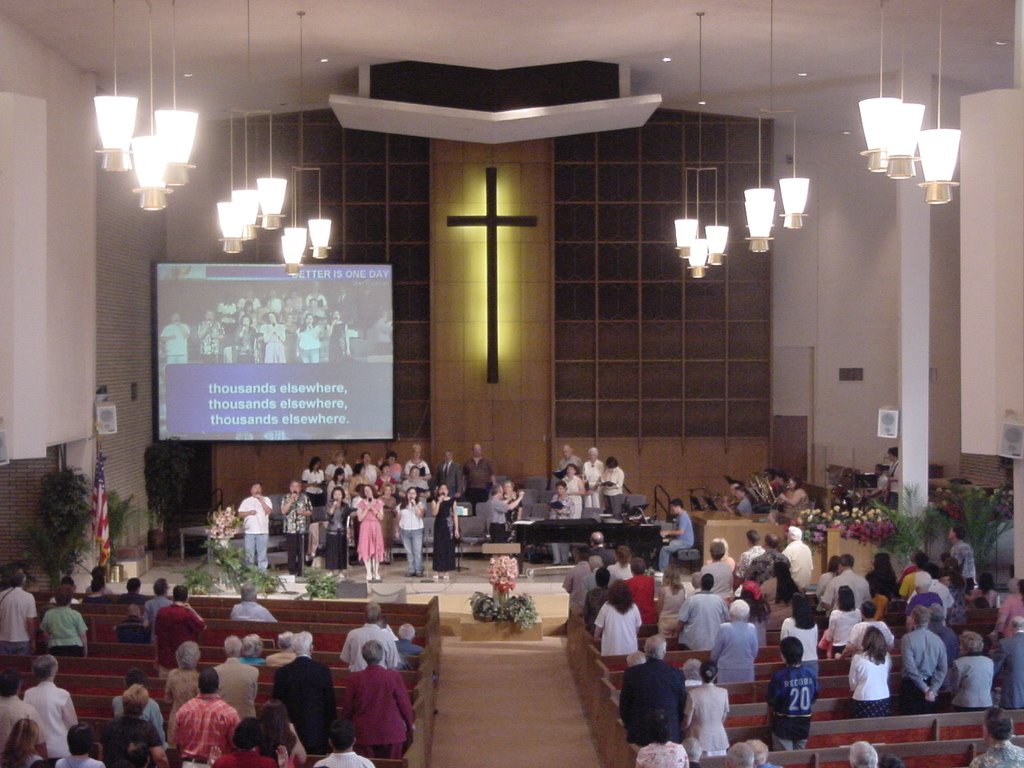
Under the theme, "Extreme Makeover: Church Edition", the first conference of Transformation Ministries will begin Thursday, October 19 at the First Baptist Church of Alhambra, California.
[Readers of DD may need to be reminded that FBC Alhambra is Dennis ("His Barking Dog") McFadden's home church. His wife, Jeanette, is Children's pastor there. My friend and traveling companion to Israel, Dr. Lee Hamby is Senior Pastor. FBC Alhambra is literally across the street from Atherton Baptist Homes and is a grand total of five miles from where I type.]
Readers can check out more on the conference on the new website. The conference, in many ways, is no great departure from the PSW conferences in the past. For example ABFMS* missionaries Mike and Lori Mann will be featured.
I will try to report each evening after the conference (I get to sleep at home!) and will especially report on the Saturday business session (see relevant info here.)
*American Baptist Foreign Missions Society. DD does not use the Board of International Ministries nomenclature, nor refer to these as "American Baptist missionaries."
Sunday, October 15, 2006
Not Anti-Gay, but Pro-Marriage--in Boston
It's great to see Ray Pendleton, whom I had at Gordon-Conwell for counseling, involved in this. Call Tremont Temple a "small" church is also interesting; it, along with Park Street Church, are the two great lights of the gospel in downtown Boston. I wonder if we'll see our AWAB loving leaders in VF dropping in at Tremont Temple.
Group to rally opposition to gay marriage
Romney to speak at event targeting evangelical voters
The Rev. Ray Pendleton of Tremont Temple Baptist Church said ‘‘Liberty Sunday’’ hopes to strengthen a Biblical view of marriage. (Bill Brett for the Boston Globe)
By Michael Paulson, Globe Staff October 15, 2006
In an attempt to motivate religious conservatives to go to the polls next month, a national organization of family values activists will join Governor Mitt Romney and more than 1,000 local churchgoers today to argue to evangelicals that the legalization of same-sex marriage here is threatening religious liberty throughout the country.
The event, dubbed ``Liberty Sunday" by its organizer, the Family Research Council, will be simulcast from the Tremont Temple Baptist Church , near Boston Common, to hundreds of churches. It will also be broadcast on several Christian television and radio networks as well as over the Internet. The council, which over the last two years has staged six similar events at other sites around the country, estimates a potential audience of 79 million, but says it is impossible to measure exactly how many people really tune in.
The council-sponsored broadcasts have become influential enough that Romney, a Republican who is exploring a run for the presidency in 2008, on Friday added the event to his schedule.
``The governor recognizes that this event is an important milestone in the effort to preserve traditional marriage in Massachusetts," said Romney's spokesman, Eric Fehrnstrom . ``The governor will talk about the importance of marriage, and the fact that the debate over gay marriage is not so much a debate about adult rights as it is about the rights of children to be raised in a home with a mother and a father."
The event is timed with a little more than three weeks to go before the Nov. 7 mid term congressional elections, in which control of both the House and Senate is up for grabs and a new governor of Massachusetts will be elected. Republican strategists have become increasingly worried that conservative evangelicals, frustrated by a number of recent congressional scandals and a lack of progress on issues they care about, may not turn out to vote this fall in the same numbers as they have in recent elections.
Eight states -- Arizona, Colorado, Idaho, South Carolina, South Dakota, Tennessee, Virginia, and Wisconsin -- will be voting on constitutional amendments that would bar same-sex marriage. And two days later, on Beacon Hill, the Legislature is to vote on whether to advance toward the ballot a measure that would overturn same-sex marriage in Massachusetts, the only state where it is legal.
``The governor is committed to doing what he can to get this issue on the ballot, so that people can be heard," Fehrnstrom said.
The Liberty Sunday event is provoking opposition from more liberal religious groups. The vicar of Old North Church, an Episcopal parish, is objecting to the use of an image of his church's steeple in the Family Research Council's promotional materials. A gay and lesbian group at Arlington Street Church , a Unitarian Universalist parish, will be sponsoring a candlelight vigil outside the Tremont Temple during the broadcast
And at Trinity Church, an Episcopal parish, a previously scheduled gathering to discuss religious support of gay marriage will now include a critique of the Family Research Council, arguing that conservative religious interests are threatening religious liberty by trying to prevent the government from recognizing marriages that are sanctioned by liberal religious denominations.
"`This is part of this year's crusade to get out the vote for the most conservative Republican candidates possible, and to use the imagery of religion to do so," said the Rev. Barry W. Lynn , a United Church of Christ minister who is the executive director of Americans United for Separation of Church and State. ``The rhetoric at their past events has been so inflammatory, it should be an embarrassment to anyone even if they're anti-gay marriage. The event is a common scare tactic to advance their anti gay agenda."
Several other groups, including the National Gay and Lesbian Task Force, the American Civil Liberties Union of Massachusetts, and the Jewish Alliance for Law and Social Action, are calling on Romney to distance himself from what they describe as bigoted statements by speakers at a previous Family Research Council event.
The council, formerly a part of Focus on the Family, lobbies Congress through an affiliate, called FRC Action. Among its policy positions are supporting measures that define marriage as a heterosexual institution, opposing abortion, and promoting the confirmation of conservative nominees to the federal judiciary. According to its website, the organization also supports ``a renewal of ethical monotheism and traditional Judeo-Christian standards of morality."
``The Family Research Council is an important focus for conservative Christians, and these events are really effective at rallying their base," said Brett Clifton , assistant director of the Taubman Center for Public Policy at Brown University. ``They are trying to rally people around the idea that religious people have rights too, and that government and society have grown increasingly secular and anti religious."
At today's event in Boston, the speakers are planning to make the case that a homosexual agenda poses a threat to religious liberty. They will cite as examples the inability of Catholic Charities in the Archdiocese of Boston to retain a state license to provide adoption services unless it was willing to place children with gay and lesbian couples, and the experience of parents in Lexington who have been battling the local school district over its decision to read to second-graders a fairy tale in which two princes fall in love.
``The bottom line is that the religious liberties of this country, which were birthed in Boston, are now at stake of dying as a result of the advancement of same-sex marriage," said Tony Perkins , president of the Family Research Council.
``We're going to highlight particular cases about the rights of parents to determine what their children are taught, about people who hold positions in public but have had to resign or have been fired because of opposition to same-sex marriage, and about how Catholic Charities was put out of the adoption business because they refused to go along with same-sex marriage."
The three Boston pastors featured in the simulcast are the Rev. Roberto Miranda , senior pastor of Congregation Lion of Judah, a large, predominantly Hispanic church in the South End; Bishop Gilbert A. Thompson , senior pastor of Jubilee Christian Church, a large, predominantly African-American congregation in Mattapan; and the Rev. Ray Pendleton , pastor of Tremont Temple, which is a small American Baptist congregation.
``Our goal is to strengthen people in their stand about a traditional, Biblical view of marriage," Pendleton said. ``The Christian voice is somehow feared for some reason, which I don't understand. It's been marginalized and seen as right-wing ranting, but that's just what the liberal press has done as a way of loading the issue. If the people are allowed to vote, the traditionalist view will win the day -- I don't think there's a question on that."
Scholars said that the Family Research Council simulcasts are not likely to persuade people to change their minds on issues such as same-sex marriage, but are effective at motivating religious conservatives to political action.
``They're largely preaching to the choir, sending their message into congregations of people who already think gay marriage is something that ought to be stopped and is, in the word they often use, an abomination," said Nancy T. Ammerman , a professor of the sociology of religion at Boston University's School of Theology. ``It seems pretty clear that the politicized evangelical operatives recognize that if people are worried about gay marriage, they're likely to go to the polls."
Michael Paulson can be reached at mpaulson@globe.com.
Group to rally opposition to gay marriage
Romney to speak at event targeting evangelical voters
The Rev. Ray Pendleton of Tremont Temple Baptist Church said ‘‘Liberty Sunday’’ hopes to strengthen a Biblical view of marriage. (Bill Brett for the Boston Globe)
By Michael Paulson, Globe Staff October 15, 2006
In an attempt to motivate religious conservatives to go to the polls next month, a national organization of family values activists will join Governor Mitt Romney and more than 1,000 local churchgoers today to argue to evangelicals that the legalization of same-sex marriage here is threatening religious liberty throughout the country.
The event, dubbed ``Liberty Sunday" by its organizer, the Family Research Council, will be simulcast from the Tremont Temple Baptist Church , near Boston Common, to hundreds of churches. It will also be broadcast on several Christian television and radio networks as well as over the Internet. The council, which over the last two years has staged six similar events at other sites around the country, estimates a potential audience of 79 million, but says it is impossible to measure exactly how many people really tune in.
The council-sponsored broadcasts have become influential enough that Romney, a Republican who is exploring a run for the presidency in 2008, on Friday added the event to his schedule.
``The governor recognizes that this event is an important milestone in the effort to preserve traditional marriage in Massachusetts," said Romney's spokesman, Eric Fehrnstrom . ``The governor will talk about the importance of marriage, and the fact that the debate over gay marriage is not so much a debate about adult rights as it is about the rights of children to be raised in a home with a mother and a father."
The event is timed with a little more than three weeks to go before the Nov. 7 mid term congressional elections, in which control of both the House and Senate is up for grabs and a new governor of Massachusetts will be elected. Republican strategists have become increasingly worried that conservative evangelicals, frustrated by a number of recent congressional scandals and a lack of progress on issues they care about, may not turn out to vote this fall in the same numbers as they have in recent elections.
Eight states -- Arizona, Colorado, Idaho, South Carolina, South Dakota, Tennessee, Virginia, and Wisconsin -- will be voting on constitutional amendments that would bar same-sex marriage. And two days later, on Beacon Hill, the Legislature is to vote on whether to advance toward the ballot a measure that would overturn same-sex marriage in Massachusetts, the only state where it is legal.
``The governor is committed to doing what he can to get this issue on the ballot, so that people can be heard," Fehrnstrom said.
The Liberty Sunday event is provoking opposition from more liberal religious groups. The vicar of Old North Church, an Episcopal parish, is objecting to the use of an image of his church's steeple in the Family Research Council's promotional materials. A gay and lesbian group at Arlington Street Church , a Unitarian Universalist parish, will be sponsoring a candlelight vigil outside the Tremont Temple during the broadcast
And at Trinity Church, an Episcopal parish, a previously scheduled gathering to discuss religious support of gay marriage will now include a critique of the Family Research Council, arguing that conservative religious interests are threatening religious liberty by trying to prevent the government from recognizing marriages that are sanctioned by liberal religious denominations.
"`This is part of this year's crusade to get out the vote for the most conservative Republican candidates possible, and to use the imagery of religion to do so," said the Rev. Barry W. Lynn , a United Church of Christ minister who is the executive director of Americans United for Separation of Church and State. ``The rhetoric at their past events has been so inflammatory, it should be an embarrassment to anyone even if they're anti-gay marriage. The event is a common scare tactic to advance their anti gay agenda."
Several other groups, including the National Gay and Lesbian Task Force, the American Civil Liberties Union of Massachusetts, and the Jewish Alliance for Law and Social Action, are calling on Romney to distance himself from what they describe as bigoted statements by speakers at a previous Family Research Council event.
The council, formerly a part of Focus on the Family, lobbies Congress through an affiliate, called FRC Action. Among its policy positions are supporting measures that define marriage as a heterosexual institution, opposing abortion, and promoting the confirmation of conservative nominees to the federal judiciary. According to its website, the organization also supports ``a renewal of ethical monotheism and traditional Judeo-Christian standards of morality."
``The Family Research Council is an important focus for conservative Christians, and these events are really effective at rallying their base," said Brett Clifton , assistant director of the Taubman Center for Public Policy at Brown University. ``They are trying to rally people around the idea that religious people have rights too, and that government and society have grown increasingly secular and anti religious."
At today's event in Boston, the speakers are planning to make the case that a homosexual agenda poses a threat to religious liberty. They will cite as examples the inability of Catholic Charities in the Archdiocese of Boston to retain a state license to provide adoption services unless it was willing to place children with gay and lesbian couples, and the experience of parents in Lexington who have been battling the local school district over its decision to read to second-graders a fairy tale in which two princes fall in love.
``The bottom line is that the religious liberties of this country, which were birthed in Boston, are now at stake of dying as a result of the advancement of same-sex marriage," said Tony Perkins , president of the Family Research Council.
``We're going to highlight particular cases about the rights of parents to determine what their children are taught, about people who hold positions in public but have had to resign or have been fired because of opposition to same-sex marriage, and about how Catholic Charities was put out of the adoption business because they refused to go along with same-sex marriage."
The three Boston pastors featured in the simulcast are the Rev. Roberto Miranda , senior pastor of Congregation Lion of Judah, a large, predominantly Hispanic church in the South End; Bishop Gilbert A. Thompson , senior pastor of Jubilee Christian Church, a large, predominantly African-American congregation in Mattapan; and the Rev. Ray Pendleton , pastor of Tremont Temple, which is a small American Baptist congregation.
``Our goal is to strengthen people in their stand about a traditional, Biblical view of marriage," Pendleton said. ``The Christian voice is somehow feared for some reason, which I don't understand. It's been marginalized and seen as right-wing ranting, but that's just what the liberal press has done as a way of loading the issue. If the people are allowed to vote, the traditionalist view will win the day -- I don't think there's a question on that."
Scholars said that the Family Research Council simulcasts are not likely to persuade people to change their minds on issues such as same-sex marriage, but are effective at motivating religious conservatives to political action.
``They're largely preaching to the choir, sending their message into congregations of people who already think gay marriage is something that ought to be stopped and is, in the word they often use, an abomination," said Nancy T. Ammerman , a professor of the sociology of religion at Boston University's School of Theology. ``It seems pretty clear that the politicized evangelical operatives recognize that if people are worried about gay marriage, they're likely to go to the polls."
Michael Paulson can be reached at mpaulson@globe.com.
Saturday, October 14, 2006
Most Likely Coming to an Employer Near You

Do you buy BA's explanation? I don't for one second. Tell a Muslim they can't do something, they might blow you up. Tell a Christian, well, this is the most that will happen.
This has to be seen first and foremost as a human rights issue. On the scale of things, trivial. But even trivial things can be harbingers of the future.
British Airways worker sues over cross
Sat Oct 14, 6:24 AM ET
LONDON - A British Airways employee was suspended from work for refusing to remove a necklace bearing a Christian cross, a British newspaper reported Saturday.
Nadia Eweida, a check-in worker at Heathrow Airport, told the Daily Mail she was suing the airline for religious discrimination after being sent home for breaching BA's dress code.
"British Airways permits Muslims to wear a headscarf, Sikhs to wear a turban and other faiths religious apparel. Only Christians are forbidden to express their faith," Eweida was quoted as saying.
British Airways said company policy said employees must wear jewelry, including religious symbols, under their uniforms.
"This rule applies for all jewelry and religious symbols on chains and is not specific to the cross," the airline said in a statement.
"Other items such as turbans, hijabs and bangles can be worn as it is not practical for staff to conceal them beneath their uniforms."
Liberal Democrat lawmaker Vincent Cable, who represents Eweida's home area of Twickenham in west London, said it was "absolutely mind-boggling that Britain's flag-carrying airline could treat its employees in such a disgraceful and petty manner."
"Nadia is a devout Christian who was displaying her faith, but in a modest and totally unprovocative manner," he said.
"It is absolutely right that other religious minorities be allowed exemption from the dress code, but why can't a Christian be treated in the same way?"
Religious symbols and dress have been a hot topic of debate in Britain since former Foreign Secretary Jack Straw sparked controversy last week by saying he asks veiled Muslim women to uncover their faces when he meets with them.
Friday, October 13, 2006
CSI and the Moral Compass

Last night's CSI: Crime Scene Investigation provided a surprising and moving reminder of the role of private belief and public well-being. CSI Greg nearly dies breaking up a "fannysmackin'" attack, a random attack "for the fun of it." There are shades of the cross as Greg (nearly) dies in the beating to save a man he doesn't know.
As we discover, the attackers are mostly young, affluent middle class teens for whom "fannysmackin'" is a game, a sport. After several attacks, and one death, the whole gang is caught.
The end of the show is back at the lab. Nick, Warrick and Sara pack up for the night, deciding to head over and see Greg at the hospital. Catherine tells them that except for "Pig", the leader of the gang, none of the other killers are adults. They are teenagers committing murder because they had nothing better to do, and they don't have a conscience. While Nick sees the Vegas lifestyle as the culprit, Sara puts the blame on the kids.
Gil Grissom, the leader of the team, believes the current culture of shamelessness is at least part of the problem. "We say, do what makes you feel good. We say, what happens in Vegas stays in Vegas. They-these kids--could even kill without a conscience. They don't even feel bad about it." (Sounds like we--American society--is reaping what we've sown. But back to Grissom.) He concludes, "A moral compass can only point you in the right direction. It can't make you go there."
Gil nailed it. What's ironic is that Gil Grissom (played so well by William Petersen) has stated that he is an atheist. (A very nice atheist, who can quote Shakespere, Buddha and Jesus with ease.) (I am tempted to get into the famous, "Is it possible to be a saint without God?" question from Sartre's The Plague. The answer, by the way, is no. For proof, look under the subject of 2oth century Marxism.)
A fascinating bit of moral philosophy from what is still the best show on television.
Thursday, October 12, 2006
Marblehead, Massachusetts Church is a Testimony of the Gospel in a Rocky Soil Environment
Attention, reformed-minded evangelical ABC churches trapped in heterodox regions: have a look at the story of FBC Marblehead, MA (now Grace Community Church). I worshipped a few times at this church when I was in seminary, and remember Bob Dibbs. A friend of mine did his internship under Bob. Hey come to think of it, someone should tell Bill Nicoson to sign 'em up from Cornerstone. Oh, I guess I just did.
Rev. Dibbs, wife to be honored
Thursday, October 12, 2006 The Rev. Robert Dibbs is not only the longest serving pastor in his congregation's history, he also has filled his pulpit longer than any current member of the clergy in Marblehead or Swampscott.
Dibbs has served 27 years, most in the 196-year history of Grace Community Church, formerly First Baptist, an interdenominational church inviting all to step over the threshold and meet its church family.
The church will honor Dibbs and his wife Elaine during the Oct. 15 service and a luncheon afterward. The public is invited.
Asked the key to his longevity, Dibbs paused, never wanting the attention on himself. Yet after a moment's reflection, it was clear to him.
"My longevity is due to God's faithfulness and His strength," he said, "When I've wanted to throw in the towel, God has reminded me that He is the one who called me."
He added, "Second, I have a very supportive wife. I don't see how I could do ministry without Elaine."
Many things have changed at Grace Community. The spirit of the people has changed, Dibbs offered. The New England "woodenness" is gone, and members, especially older ones, have been "extraordinarily gracious" in embracing changes in the way the church performs ministry and music. Twenty-five years ago, no one would have dreamed of a worship band in the church's sanctuary; now it is a permanent fixture.
"We also made organizational changes," said Dibbs. "We left the denomination (American Baptist), changed our constitution, changed our polity - that's our leadership structure - and finally changed our name to match everything we are doing and who we really are."
He added, "It's exciting that we have become truly interdenominational, as reflected in our diverse congregation who worships together, appreciates and loves one another."
Over 27 years, much has also changed in the Dibbs' lives. The couple says they have experienced many blessings, such as the gift of two wonderful daughters, Sarah and Kristina. But they have also been through personal crises, especially the past six years. Elaine had a bout with cancer, Bob's brother died in a fire, their daughter Kristina was diagnosed with a terminal disease, Huntington's chorea, just three months before her wedding, many key members moved after the 9-11 attack and Bob's mother died of cancer. But the Dibbs readily testify how God shepherded them through.
"There is a difference between saying God will get you through a crisis and saying it after you have personally experienced God's strength and faithfulness in getting you through times of crisis," he said.
"We have actually seen, and see now, blessings come out of these crises. They have forced us to assess whether we truly believe what we say we believe. In fact, we believe what God says," he concluded.
Many things have not changed. The congregation functioning as family is a constant.
"God and his Word have not changed," he said. "God and his Word are alive and relevant, and I am more convinced of that than I was 27 years ago."
Rev. Dibbs, wife to be honored
Thursday, October 12, 2006 The Rev. Robert Dibbs is not only the longest serving pastor in his congregation's history, he also has filled his pulpit longer than any current member of the clergy in Marblehead or Swampscott.
Dibbs has served 27 years, most in the 196-year history of Grace Community Church, formerly First Baptist, an interdenominational church inviting all to step over the threshold and meet its church family.
The church will honor Dibbs and his wife Elaine during the Oct. 15 service and a luncheon afterward. The public is invited.
Asked the key to his longevity, Dibbs paused, never wanting the attention on himself. Yet after a moment's reflection, it was clear to him.
"My longevity is due to God's faithfulness and His strength," he said, "When I've wanted to throw in the towel, God has reminded me that He is the one who called me."
He added, "Second, I have a very supportive wife. I don't see how I could do ministry without Elaine."
Many things have changed at Grace Community. The spirit of the people has changed, Dibbs offered. The New England "woodenness" is gone, and members, especially older ones, have been "extraordinarily gracious" in embracing changes in the way the church performs ministry and music. Twenty-five years ago, no one would have dreamed of a worship band in the church's sanctuary; now it is a permanent fixture.
"We also made organizational changes," said Dibbs. "We left the denomination (American Baptist), changed our constitution, changed our polity - that's our leadership structure - and finally changed our name to match everything we are doing and who we really are."
He added, "It's exciting that we have become truly interdenominational, as reflected in our diverse congregation who worships together, appreciates and loves one another."
Over 27 years, much has also changed in the Dibbs' lives. The couple says they have experienced many blessings, such as the gift of two wonderful daughters, Sarah and Kristina. But they have also been through personal crises, especially the past six years. Elaine had a bout with cancer, Bob's brother died in a fire, their daughter Kristina was diagnosed with a terminal disease, Huntington's chorea, just three months before her wedding, many key members moved after the 9-11 attack and Bob's mother died of cancer. But the Dibbs readily testify how God shepherded them through.
"There is a difference between saying God will get you through a crisis and saying it after you have personally experienced God's strength and faithfulness in getting you through times of crisis," he said.
"We have actually seen, and see now, blessings come out of these crises. They have forced us to assess whether we truly believe what we say we believe. In fact, we believe what God says," he concluded.
Many things have not changed. The congregation functioning as family is a constant.
"God and his Word have not changed," he said. "God and his Word are alive and relevant, and I am more convinced of that than I was 27 years ago."
Tuesday, October 10, 2006
RETRACTION
In a previous post, I wrote that the new head of BIM, Reid Trulson, is a "supporter of AWAB." This was based on the remarks of a usually reliable source. Checking again, I have no basis to make that statement and thus the posting has been altered. My apologies.
Saturday, October 07, 2006
ABC Insider Selected to Lead International Ministries
Reid Trulson is an ABC insider, and therefore a poor for BIM leadership. (Actually BIM should be referred to by its real name, the American Baptist Foreign Missions Society, and it should be liberated from the Valley Forge yoke if it desires to be effective.) Transformational leadership, not insider leadership is needed for the times, and to assure the conservative majority of the ABC that they would have a voice in the ABC. Here is the announcement of his selection.
ABCUSA: Search Committee Nominates Trulson To Lead International Ministries
From "Jayne, Andy" <Ajayne@ABC-USA.org>Date Fri, 6 Oct 2006 14:05:27 -0400
VALLEY FORGE, PA (ABNS 10/6/06)-The committee formed to conduct the search for the next Executive Director of American Baptist International Ministries has unanimously chosen Rev. Dr. Reid S. Trulson as its nominee. The announcement of the committee's decision was made today by the Rev. Dr. A. Roy Medley, General Secretary of American Baptist Churches USA (ABCUSA), and the Rev. Ray Schooler, President of the Board of International Ministries (IM).
The action of the committee culminates a six-month search process, which will bring Trulson's nomination to the full ABC General Board and the IM board for election on November 15, 2006. Schooler expressed gratitude for the work of the committee, saying, "The search committee members really gave themselves to this effort. We had a very solid process and a great outcome. We are deeply grateful for God's leading throughout our work, and also very appreciative of the selfless service Roy Medley graciously rendered to the committee."
Medley expressed his own enthusiasm for the nomination of Trulson, saying, "Reid has won the respect of Baptists throughout Europe and the Middle East with whom he has worked closely as a missionary and staff person, as well as the respect of our American Baptist family. He will provide strong leadership to our international mission."
Trulson brings to the executive directorship a great depth and breadth of experience in the life of ABCUSA and IM, having served over twenty years in local church ministry and over eleven years with IM in international mission (five years as a missionary in Europe and six years as a member of the home office staff). During his years in local church ministry, Trulson served on both region and national boards: he was President of the ABC of Wisconsin region board and, during his eight years on the ABC General Board and the Board of IM, Trulson served two terms as the President of the Board of IM.
The grandson of Norwegian immigrants to the U.S., Trulson's interest in cross-cultural mission came early. While a student at Fuller Seminary, he interrupted his studies to spend a year serving with Scripture Union in Ghana, West Africa. Upon returning to seminary, he became deeply involved in the life of Friendship Baptist Church, the oldest African American Baptist church in Pasadena, California. Trulson was ordained at Friendship, and served there as Minister of Christian Education. As the Rev. Dr. James Stinespring, Vice President of the IM Board put it, "Trulson's passion for cross-cultural ministry positions him to make a significant contribution to the internationally diverse mission of the ABCUSA."
Trulson comes to IM at an important time of transition in the life of IM and of the ABCUSA as a whole. For over 192 years, the agency currently known as IM has served as the ABC's instrument for international mission outreach, continually adapting its strategies to changing circumstances. The strategic plan guiding IM's work during the first decade of the twenty-first century, Go Global, combines classic commitments to evangelism, leadership development and holistic ministry to human need, with innovative commitments to partnering with local churches and ABC regions.
Trulson served both on the task force that crafted Go Global in 1998-1999 and on a smaller task force that in 2003 made significant mid-course adjustments to IM's way of pursuing Go Global. Chief among those adjustments has been the introduction of IM's Missionary Partnership Networks (MPN), a highly relational approach to providing for the various elements of missionary support.
Schooler summed up the feelings of the search committee, saying that "Reid has a depth of knowledge and historical perspective not only regarding IM, but the whole ABC. He knows who we are, knows where we've been and has a great vision for our future."
Trulson himself commented that, "The World Mission Conferences that IM conducted this year in West Virginia and Wisconsin reminded us how often we are surprised by God's work in the world and by God's call for us to be part of that work. It is both exciting and a bit overwhelming to see how God is calling IM to serve American Baptists to make a difference in the midst of cultures that are clashing and rapidly changing. The challenges before us in the U.S., Puerto Rico and elsewhere in the world are immense. To be called into service as Executive Director of American Baptist International Ministries at such a time is very humbling. I ask you to join me in prayer that together, empowered by the Holy Spirit, we may be found faithful in making disciples of Jesus Christ and meeting human need to the glory of God...and embracing God's surprises along the way."
The search committee included: Ray Schooler (IM President), Lloyd Beachy, Sampson Birdinground, Rachel Cocar, Manuel Hernandez, Betty Long, James Pollard, James Ratliff and James Stinespring (IM Vice President), assisted by A. Roy Medley (ABC General Secretary), Wendy Rothenberger (Director of Human Resources) and C. Jeff Woods (Associate General Secretary and affirmative action officer to the committee).
ABCUSA: Search Committee Nominates Trulson To Lead International Ministries
From "Jayne, Andy" <Ajayne@ABC-USA.org>Date Fri, 6 Oct 2006 14:05:27 -0400
VALLEY FORGE, PA (ABNS 10/6/06)-The committee formed to conduct the search for the next Executive Director of American Baptist International Ministries has unanimously chosen Rev. Dr. Reid S. Trulson as its nominee. The announcement of the committee's decision was made today by the Rev. Dr. A. Roy Medley, General Secretary of American Baptist Churches USA (ABCUSA), and the Rev. Ray Schooler, President of the Board of International Ministries (IM).
The action of the committee culminates a six-month search process, which will bring Trulson's nomination to the full ABC General Board and the IM board for election on November 15, 2006. Schooler expressed gratitude for the work of the committee, saying, "The search committee members really gave themselves to this effort. We had a very solid process and a great outcome. We are deeply grateful for God's leading throughout our work, and also very appreciative of the selfless service Roy Medley graciously rendered to the committee."
Medley expressed his own enthusiasm for the nomination of Trulson, saying, "Reid has won the respect of Baptists throughout Europe and the Middle East with whom he has worked closely as a missionary and staff person, as well as the respect of our American Baptist family. He will provide strong leadership to our international mission."
Trulson brings to the executive directorship a great depth and breadth of experience in the life of ABCUSA and IM, having served over twenty years in local church ministry and over eleven years with IM in international mission (five years as a missionary in Europe and six years as a member of the home office staff). During his years in local church ministry, Trulson served on both region and national boards: he was President of the ABC of Wisconsin region board and, during his eight years on the ABC General Board and the Board of IM, Trulson served two terms as the President of the Board of IM.
The grandson of Norwegian immigrants to the U.S., Trulson's interest in cross-cultural mission came early. While a student at Fuller Seminary, he interrupted his studies to spend a year serving with Scripture Union in Ghana, West Africa. Upon returning to seminary, he became deeply involved in the life of Friendship Baptist Church, the oldest African American Baptist church in Pasadena, California. Trulson was ordained at Friendship, and served there as Minister of Christian Education. As the Rev. Dr. James Stinespring, Vice President of the IM Board put it, "Trulson's passion for cross-cultural ministry positions him to make a significant contribution to the internationally diverse mission of the ABCUSA."
Trulson comes to IM at an important time of transition in the life of IM and of the ABCUSA as a whole. For over 192 years, the agency currently known as IM has served as the ABC's instrument for international mission outreach, continually adapting its strategies to changing circumstances. The strategic plan guiding IM's work during the first decade of the twenty-first century, Go Global, combines classic commitments to evangelism, leadership development and holistic ministry to human need, with innovative commitments to partnering with local churches and ABC regions.
Trulson served both on the task force that crafted Go Global in 1998-1999 and on a smaller task force that in 2003 made significant mid-course adjustments to IM's way of pursuing Go Global. Chief among those adjustments has been the introduction of IM's Missionary Partnership Networks (MPN), a highly relational approach to providing for the various elements of missionary support.
Schooler summed up the feelings of the search committee, saying that "Reid has a depth of knowledge and historical perspective not only regarding IM, but the whole ABC. He knows who we are, knows where we've been and has a great vision for our future."
Trulson himself commented that, "The World Mission Conferences that IM conducted this year in West Virginia and Wisconsin reminded us how often we are surprised by God's work in the world and by God's call for us to be part of that work. It is both exciting and a bit overwhelming to see how God is calling IM to serve American Baptists to make a difference in the midst of cultures that are clashing and rapidly changing. The challenges before us in the U.S., Puerto Rico and elsewhere in the world are immense. To be called into service as Executive Director of American Baptist International Ministries at such a time is very humbling. I ask you to join me in prayer that together, empowered by the Holy Spirit, we may be found faithful in making disciples of Jesus Christ and meeting human need to the glory of God...and embracing God's surprises along the way."
The search committee included: Ray Schooler (IM President), Lloyd Beachy, Sampson Birdinground, Rachel Cocar, Manuel Hernandez, Betty Long, James Pollard, James Ratliff and James Stinespring (IM Vice President), assisted by A. Roy Medley (ABC General Secretary), Wendy Rothenberger (Director of Human Resources) and C. Jeff Woods (Associate General Secretary and affirmative action officer to the committee).
Wednesday, October 04, 2006
The Abraham-Christ-Connection
How about a change of pace? This is modified from a Sunday morning message I shared last fall.
The Abraham-Christ Connection
(Genesis 12:1-3; Galatians 3:15-29)
See this Bible? The way we bind books, everything comes together here at the back. That’s where the pages and the cover meet and it’s no surprise that bookbinders call this the spine of the book.
Not only do books have spines, but the story inside also has a spine. What I want to do today is show you the very spine of the story of the Bible. A few weeks ago, we saw that three words tell us the basic pattern of the Bible. Those three words were:
CREATION
FALL
REDEMPTION.
Now that’s a pattern, but it’s not a story. It gives a hint of the story, but it’s not the whole
story by any means. I want to do is show that the whole Bible tells one basic story.
We’re used to hearing about Bible stories. You know, Adam and Eve and Noah’s ark and David and Goliath and Daniel in the Lion’s Den and Jesus born in Bethlehem and so on. All these
stories are little pieces in the puzzle of the One Big Story of the Bible. And that One Big Story
can be summed up as the Abraham-Christ connection.
There are two passages of the Scripture that bookend this story: one from the Old Testament, and a crucial passage from the New Testament that interprets that Old Testament event and shows how it all works together.
First, turn to Genesis 12:1-3:
1The LORD had said to Abram, "Leave your country, your people and your father's household and go to the land I will show you.
2"I will make you into a great nation and I will bless you; I will make your name great, and you will be a blessing.
3I will bless those who bless you, and whoever curses you I will curse; and all peoples on earth will be blessed through you."
Sometime between 1800 and 1600 BC, God had spoken to Abram (later to be known as Abraham) about leaving the land of his father and going to a land of promise. God said that there, in that new land, he would make Abram’s descendants into a great nation, making them in a worldwide blessing. Those who bless that nation would be blessed; those who curse that nation would be cursed, and, very significantly, "all peoples on earth will be blessed through you."
Now we could talk about all kinds of things about the promises God made to Abraham. But we can do way better than that! God’s own word talks about it. In his letter to the
believers in the province of Galatia, Paul speaks at length about the promises to
Abraham and shows how this is beginning of the blessings we now enjoy and celebrate in
and through Jesus Christ. Turn to Galatians 3. We’re going to work our way from Galatians
3:15-29.
There are three key ideas in this passage. Let’s list them and them work back through them.
1. The promises God made to Abraham lead straight to Jesus Christ (15-18)
2. The law of Moses came later to teach us just how bad sin is and how much we need a Savior, a spiritual rescuer (19-25)
3. God’s family now is a family based on faith, not a blood descent from Abraham. We become part of that forever family through faith in Jesus (26-29)
OK, one at a time:
The promises God made to Abraham lead straight to Jesus Christ (15-18):
15Brothers, let me take an example from everyday life. Just as no one can set aside or add to a human covenant that has been duly established, so it is in this case. 16The promises were spoken to Abraham and to his seed. The Scripture does not say "and to seeds," meaning many people, but "and to your seed," meaning one person, who is Christ. 17What I mean is this: The law, introduced 430 years later, does not set aside the covenant previously established by God and thus do away with the promise. 18For if the inheritance depends on the law, then it no longer depends on a promise; but God in his grace gave it to Abraham through a promise.
OK, this is going to be a whole lot easier to understand knowing what the problem is Galatia that Paul is writing about. The church in Galatia had made a huge mistake and was in crisis for it. After Paul had come through the area preaching the Good News about Jesus, others came after him and told them that in order to please God, they had to observe the whole Law of Moses. In effect, they were saying that to be a good Christian, you needed to be a good Jew first. So they said that the men needed to be circumcised, they all needed to keep a kosher table, and they needed to keep the Sabbath and the calendar of Jewish holy days.
When Paul about this, he was ripped! He knew that if they fell for this, it would be like taking the whole Good News of Jesus and throwing it out. It would just be eating a Moses burger with just a dash of Jesus sauce! What they were doing was turning the whole gospel of Jesus upside down.
What Paul does is show that the whole Law of Moses was a temporary thing. There was a man before Moses whose faith is way more relevant to a New Covenant Jesus-follower than Moses and his Law. His name was Abraham.
What God did was make a special set of promises to Abraham. We call these promises a covenant. It’s kind of like a contract or an agreement except for this: God gave Abraham this covenant; He didn’t negotiate it! It’s not like God and Abraham haggled over the terms and them shook hands. God set forth the covenant and gave it to Abraham. And then God bound Himself to fulfill this covenant, with all its promises.
Paul wants us to think about two things in these verses. First, beyond Abraham, who was
the Abraham covenant for? Second, did the coming of the Law of Moses cancel the Abraham covenant?
Look at what Paul says in Galatians 3:16:
The promises were spoken to Abraham and to his seed. The Scripture does not say "and to
seeds," meaning many people, but "and to your seed," meaning one person, who is Christ.
Three times in Genesis, God made Abraham a promise that his "seed" (his descendant) would be the one who received all the promises. Paul makes a big deal out of the fact that the promise was to a single descendant—not to "many people." And that single descendant was none other
than Jesus Christ. So all the promises made to Abraham comes to Jesus and, as we’ll see, to Jesus’ people (that’s us). But there’s a second point that Paul wants to make sure we get.
God made a covenant with Abraham. But 430 years later He made another covenant, this
time with Moses—that covenant established the whole system of laws and sacrifices that
we find all over the Old Testament. Here’s the question: did the Moses covenant cancel the
Abraham covenant?
Here’s the answer, according to Paul (Galatians 3:17-18):
17What I mean is this: The law, introduced 430 years later, does not set aside the covenant previously established by God and thus do away with the promise. 18For if the inheritance depends on the law, then it no longer depends on a promise; but God in his grace gave it to Abraham through a promise.
The Moses covenant involves a lot of work. It was designed for a variety of purposes: to teach us how badly we needed a Savior, a Messiah. But it was also for a nation for a brief period of time: from Moses (say around 1300 BC) to the death and resurrection of Jesus (30 AD). The Moses covenant is kaput, done, over, finito. It’s run its course. But the New Covenant in Jesus is the extension and fulfillment of the Abraham covenant. It’s a matter of what God has promised. And it’s received by simple faith.
In Galatians 3:6, Paul quotes Genesis 15:6, saying this about Abraham: "He believed God, and it was credited to him as righteousness." Abraham wasn’t made right before God by any law-keeping, but by simple faith in the promises of God—exactly the way we are made right with God through Jesus Christ. In Abraham’s case, his faith looked to the future, to the coming of the Savior; in our case, our faith looks first to the past, to the Savior, Jesus, who has already come, and forward to the return of Jesus to finish His work in our lives and in our world.
Now on to the next part here in Galatians (3:19-25):
The Law of Moses came later to teach us just how bad sin is and how much we need a Savior, a spiritual rescuer Paul is going to say something amazing: the reason God added the Moses covenant after the Abraham covenant was to trap us, to corner us—to make it clear how much we need Jesus:
19What, then, was the purpose of the law? It was added because of transgressions until the Seed to whom the promise referred had come. The law was put into effect through angels by a mediator. 20A mediator, however, does not represent just one party; but God is one.
21Is the law, therefore, opposed to the promises of God [as seen in the Abraham covenant] ? Absolutely not! For if a law had been given that could impart life, then righteousness would certainly have come by the law. 22But the Scripture declares that the whole world is a prisoner of sin, so that what was promised, being given through faith in Jesus Christ, might be given to those who believe. 23Before this faith came, we were held prisoners by the law, locked up until faith should be revealed. 24So the law was put in charge to lead us to Christ that we might be justified by faith. 25 Now that faith has come, we are no longer under the supervision of the law.
Get the picture: we human beings learn slowly. The Law was added to make us learn just how
bad our situation is apart from God’s grace. But it moves us onward to the point of embracing Jesus, the Messiah-Savior, when He comes.
Let’s put it this way: God added the Law, and created the people of Israel so that there would be one country on earth that fully understood these things:
1. God is holy. He doesn’t compromise when it comes to sin. He is high and exalted and won’t have anything to do with sin.
2. People are sinners. We don’t meet God’s standards. That was made clear with all those laws of holiness, all those laws of sacrifice, and the constant reminder of how separated we are, in our nature, from God.
3. Therefore, we need a Savior, a Rescuer, a Redeemer—someone to bridge the gap
Holy God and Sinful People.
So when Jesus is born smack dab in the middle of Israel, His arrival isn’t exactly a surprise. As a matter of fact, His coming met the crying need of the hearts of the devout Jewish men and women who knew how holy God is, and how bad sin is, and how much we need a spiritual rescuer. And the words of the angels we hear at Christmas time point us right in that direction (Luke 2:11):
Today in the town of David a Savior (rescuer, redeemer) has been born to you; he is Christ
(Messiah) the Lord.
Now, because He has come, everything is settled, and we can have full peace with God. What started out for Abraham has been passed through the experience of the nation of Israel and now has exploded outward for the whole world through Jesus, the Son of God.
That brings us to the last part of the "spine" of the story of the Bible: the coming of Jesus.
Galatians 3:26-29 tells us that God’s family now is a family based on faith, not a blood descent from Abraham. We become part of that forever family through faith in Jesus.
Read Galatians 3:26-29:
26You are all sons of God through faith in Christ Jesus, 27for all of you who were baptized into Christ have clothed yourselves with Christ. 28There is neither Jew nor Greek, slave nor free, male nor female, for you are all one in Christ Jesus. 29If you belong to Christ, then you are Abraham's seed, and heirs according to the promise.
Paul tells us that the promises God gave to Abraham goes right to Jesus, that He’s the "seed" (descendant) that gets all the promises.
It zips right by the Moses covenant, which was after all, just a temporary thing, a step in the
unfolding plan of God. Now a revolutionary thing has happened. Being a blood descendant of Abraham is no longer important. What matters is being a faith descendant of Abraham. It doesn’t matter if you’re Jewish or German or Chinese or Mexican or Egyptian or Greek or American. What matters is that you have that "Abraham faith" in God’s Rescuer, Jesus the Messiah. And when we have that faith, we become God’s children. We actually become you might say, "spiritual Jews." We become "Abraham’s seed" become when we put our faith in Christ, we are said to be "in Christ." So now, all the promises are ours as well. We now become that nation promised to Abraham that blesses the whole world. We become the promised children of Abraham.
And that’s story the Bible was telling from the beginning.
There’s a large portion of Romans that deals with the same issues Paul addresses here in
Galatians—all about Abraham’s faith and how God’s promises now flow all to all who have
the faith of Abraham through Jesus the Messiah. In Romans 2:28-29, Paul writes,
28A man is not a Jew if he is only one outwardly, nor is circumcision merely outward
and physical. 29No, a man is a Jew if he is one inwardly; and circumcision is circumcision of
the heart, by the Spirit, not by the written code. Such a man's praise is not from men, but
from God.
The old, physical Israel is not the center of God’s plan. Old Israel is not the "spine" of the Bible! Jesus and the New Israel is the "spine" of the Bible! The whole book is about Him and His people. And His people, the New Israel, are those who put their trust in Him no matter what their bloodline is. No wonder Paul concludes Galatians (6:14-16) by saying,
14 May I never boast except in the cross of our Lord Jesus Christ, through which the world has been crucified to me, and I to the world. 15 Neither circumcision nor uncircumcision means anything; what counts is a new creation. 16 Peace and mercy to all who follow this rule, even to the Israel of God.
The Israel of God; that’s the real family of God! So often we end up again looking at the fact that God’s intention from all eternity was to make a family for Himself. That’s what you were created for. That’s what God’s been doing for thousands of years here on earth. That’s what the Bible is all about.
Are you a part of God’s family? Have you put your trust in God—in what He did through His
Son Jesus, to rescue you from your sins and forgive you and to make you part of His
family? There’s no day like today to do that!
Let’s pray.
Dear God, I realize that if it weren’t for you, I wouldn’t be alive. And I thank you so much that You did so much to make me a part of Your family. I admit that I focused on my plans for my life, not yours. Thank you for showing me Your plan in the Bible. Thank you that you cared for me even when I didn’t know you or even want to know You. I want a life filled with meaning. I want to start by getting to know you better. So as best as I understand, I ask you, Jesus Christ, to come into my life and help me to understand your purposes for me. I want to take the first step today. In your name I pray, Amen.
The Abraham-Christ Connection
(Genesis 12:1-3; Galatians 3:15-29)
See this Bible? The way we bind books, everything comes together here at the back. That’s where the pages and the cover meet and it’s no surprise that bookbinders call this the spine of the book.
Not only do books have spines, but the story inside also has a spine. What I want to do today is show you the very spine of the story of the Bible. A few weeks ago, we saw that three words tell us the basic pattern of the Bible. Those three words were:
CREATION
FALL
REDEMPTION.
Now that’s a pattern, but it’s not a story. It gives a hint of the story, but it’s not the whole
story by any means. I want to do is show that the whole Bible tells one basic story.
We’re used to hearing about Bible stories. You know, Adam and Eve and Noah’s ark and David and Goliath and Daniel in the Lion’s Den and Jesus born in Bethlehem and so on. All these
stories are little pieces in the puzzle of the One Big Story of the Bible. And that One Big Story
can be summed up as the Abraham-Christ connection.
There are two passages of the Scripture that bookend this story: one from the Old Testament, and a crucial passage from the New Testament that interprets that Old Testament event and shows how it all works together.
First, turn to Genesis 12:1-3:
1The LORD had said to Abram, "Leave your country, your people and your father's household and go to the land I will show you.
2"I will make you into a great nation and I will bless you; I will make your name great, and you will be a blessing.
3I will bless those who bless you, and whoever curses you I will curse; and all peoples on earth will be blessed through you."
Sometime between 1800 and 1600 BC, God had spoken to Abram (later to be known as Abraham) about leaving the land of his father and going to a land of promise. God said that there, in that new land, he would make Abram’s descendants into a great nation, making them in a worldwide blessing. Those who bless that nation would be blessed; those who curse that nation would be cursed, and, very significantly, "all peoples on earth will be blessed through you."
Now we could talk about all kinds of things about the promises God made to Abraham. But we can do way better than that! God’s own word talks about it. In his letter to the
believers in the province of Galatia, Paul speaks at length about the promises to
Abraham and shows how this is beginning of the blessings we now enjoy and celebrate in
and through Jesus Christ. Turn to Galatians 3. We’re going to work our way from Galatians
3:15-29.
There are three key ideas in this passage. Let’s list them and them work back through them.
1. The promises God made to Abraham lead straight to Jesus Christ (15-18)
2. The law of Moses came later to teach us just how bad sin is and how much we need a Savior, a spiritual rescuer (19-25)
3. God’s family now is a family based on faith, not a blood descent from Abraham. We become part of that forever family through faith in Jesus (26-29)
OK, one at a time:
The promises God made to Abraham lead straight to Jesus Christ (15-18):
15Brothers, let me take an example from everyday life. Just as no one can set aside or add to a human covenant that has been duly established, so it is in this case. 16The promises were spoken to Abraham and to his seed. The Scripture does not say "and to seeds," meaning many people, but "and to your seed," meaning one person, who is Christ. 17What I mean is this: The law, introduced 430 years later, does not set aside the covenant previously established by God and thus do away with the promise. 18For if the inheritance depends on the law, then it no longer depends on a promise; but God in his grace gave it to Abraham through a promise.
OK, this is going to be a whole lot easier to understand knowing what the problem is Galatia that Paul is writing about. The church in Galatia had made a huge mistake and was in crisis for it. After Paul had come through the area preaching the Good News about Jesus, others came after him and told them that in order to please God, they had to observe the whole Law of Moses. In effect, they were saying that to be a good Christian, you needed to be a good Jew first. So they said that the men needed to be circumcised, they all needed to keep a kosher table, and they needed to keep the Sabbath and the calendar of Jewish holy days.
When Paul about this, he was ripped! He knew that if they fell for this, it would be like taking the whole Good News of Jesus and throwing it out. It would just be eating a Moses burger with just a dash of Jesus sauce! What they were doing was turning the whole gospel of Jesus upside down.
What Paul does is show that the whole Law of Moses was a temporary thing. There was a man before Moses whose faith is way more relevant to a New Covenant Jesus-follower than Moses and his Law. His name was Abraham.
What God did was make a special set of promises to Abraham. We call these promises a covenant. It’s kind of like a contract or an agreement except for this: God gave Abraham this covenant; He didn’t negotiate it! It’s not like God and Abraham haggled over the terms and them shook hands. God set forth the covenant and gave it to Abraham. And then God bound Himself to fulfill this covenant, with all its promises.
Paul wants us to think about two things in these verses. First, beyond Abraham, who was
the Abraham covenant for? Second, did the coming of the Law of Moses cancel the Abraham covenant?
Look at what Paul says in Galatians 3:16:
The promises were spoken to Abraham and to his seed. The Scripture does not say "and to
seeds," meaning many people, but "and to your seed," meaning one person, who is Christ.
Three times in Genesis, God made Abraham a promise that his "seed" (his descendant) would be the one who received all the promises. Paul makes a big deal out of the fact that the promise was to a single descendant—not to "many people." And that single descendant was none other
than Jesus Christ. So all the promises made to Abraham comes to Jesus and, as we’ll see, to Jesus’ people (that’s us). But there’s a second point that Paul wants to make sure we get.
God made a covenant with Abraham. But 430 years later He made another covenant, this
time with Moses—that covenant established the whole system of laws and sacrifices that
we find all over the Old Testament. Here’s the question: did the Moses covenant cancel the
Abraham covenant?
Here’s the answer, according to Paul (Galatians 3:17-18):
17What I mean is this: The law, introduced 430 years later, does not set aside the covenant previously established by God and thus do away with the promise. 18For if the inheritance depends on the law, then it no longer depends on a promise; but God in his grace gave it to Abraham through a promise.
The Moses covenant involves a lot of work. It was designed for a variety of purposes: to teach us how badly we needed a Savior, a Messiah. But it was also for a nation for a brief period of time: from Moses (say around 1300 BC) to the death and resurrection of Jesus (30 AD). The Moses covenant is kaput, done, over, finito. It’s run its course. But the New Covenant in Jesus is the extension and fulfillment of the Abraham covenant. It’s a matter of what God has promised. And it’s received by simple faith.
In Galatians 3:6, Paul quotes Genesis 15:6, saying this about Abraham: "He believed God, and it was credited to him as righteousness." Abraham wasn’t made right before God by any law-keeping, but by simple faith in the promises of God—exactly the way we are made right with God through Jesus Christ. In Abraham’s case, his faith looked to the future, to the coming of the Savior; in our case, our faith looks first to the past, to the Savior, Jesus, who has already come, and forward to the return of Jesus to finish His work in our lives and in our world.
Now on to the next part here in Galatians (3:19-25):
The Law of Moses came later to teach us just how bad sin is and how much we need a Savior, a spiritual rescuer Paul is going to say something amazing: the reason God added the Moses covenant after the Abraham covenant was to trap us, to corner us—to make it clear how much we need Jesus:
19What, then, was the purpose of the law? It was added because of transgressions until the Seed to whom the promise referred had come. The law was put into effect through angels by a mediator. 20A mediator, however, does not represent just one party; but God is one.
21Is the law, therefore, opposed to the promises of God [as seen in the Abraham covenant] ? Absolutely not! For if a law had been given that could impart life, then righteousness would certainly have come by the law. 22But the Scripture declares that the whole world is a prisoner of sin, so that what was promised, being given through faith in Jesus Christ, might be given to those who believe. 23Before this faith came, we were held prisoners by the law, locked up until faith should be revealed. 24So the law was put in charge to lead us to Christ that we might be justified by faith. 25 Now that faith has come, we are no longer under the supervision of the law.
Get the picture: we human beings learn slowly. The Law was added to make us learn just how
bad our situation is apart from God’s grace. But it moves us onward to the point of embracing Jesus, the Messiah-Savior, when He comes.
Let’s put it this way: God added the Law, and created the people of Israel so that there would be one country on earth that fully understood these things:
1. God is holy. He doesn’t compromise when it comes to sin. He is high and exalted and won’t have anything to do with sin.
2. People are sinners. We don’t meet God’s standards. That was made clear with all those laws of holiness, all those laws of sacrifice, and the constant reminder of how separated we are, in our nature, from God.
3. Therefore, we need a Savior, a Rescuer, a Redeemer—someone to bridge the gap
Holy God and Sinful People.
So when Jesus is born smack dab in the middle of Israel, His arrival isn’t exactly a surprise. As a matter of fact, His coming met the crying need of the hearts of the devout Jewish men and women who knew how holy God is, and how bad sin is, and how much we need a spiritual rescuer. And the words of the angels we hear at Christmas time point us right in that direction (Luke 2:11):
Today in the town of David a Savior (rescuer, redeemer) has been born to you; he is Christ
(Messiah) the Lord.
Now, because He has come, everything is settled, and we can have full peace with God. What started out for Abraham has been passed through the experience of the nation of Israel and now has exploded outward for the whole world through Jesus, the Son of God.
That brings us to the last part of the "spine" of the story of the Bible: the coming of Jesus.
Galatians 3:26-29 tells us that God’s family now is a family based on faith, not a blood descent from Abraham. We become part of that forever family through faith in Jesus.
Read Galatians 3:26-29:
26You are all sons of God through faith in Christ Jesus, 27for all of you who were baptized into Christ have clothed yourselves with Christ. 28There is neither Jew nor Greek, slave nor free, male nor female, for you are all one in Christ Jesus. 29If you belong to Christ, then you are Abraham's seed, and heirs according to the promise.
Paul tells us that the promises God gave to Abraham goes right to Jesus, that He’s the "seed" (descendant) that gets all the promises.
It zips right by the Moses covenant, which was after all, just a temporary thing, a step in the
unfolding plan of God. Now a revolutionary thing has happened. Being a blood descendant of Abraham is no longer important. What matters is being a faith descendant of Abraham. It doesn’t matter if you’re Jewish or German or Chinese or Mexican or Egyptian or Greek or American. What matters is that you have that "Abraham faith" in God’s Rescuer, Jesus the Messiah. And when we have that faith, we become God’s children. We actually become you might say, "spiritual Jews." We become "Abraham’s seed" become when we put our faith in Christ, we are said to be "in Christ." So now, all the promises are ours as well. We now become that nation promised to Abraham that blesses the whole world. We become the promised children of Abraham.
And that’s story the Bible was telling from the beginning.
There’s a large portion of Romans that deals with the same issues Paul addresses here in
Galatians—all about Abraham’s faith and how God’s promises now flow all to all who have
the faith of Abraham through Jesus the Messiah. In Romans 2:28-29, Paul writes,
28A man is not a Jew if he is only one outwardly, nor is circumcision merely outward
and physical. 29No, a man is a Jew if he is one inwardly; and circumcision is circumcision of
the heart, by the Spirit, not by the written code. Such a man's praise is not from men, but
from God.
The old, physical Israel is not the center of God’s plan. Old Israel is not the "spine" of the Bible! Jesus and the New Israel is the "spine" of the Bible! The whole book is about Him and His people. And His people, the New Israel, are those who put their trust in Him no matter what their bloodline is. No wonder Paul concludes Galatians (6:14-16) by saying,
14 May I never boast except in the cross of our Lord Jesus Christ, through which the world has been crucified to me, and I to the world. 15 Neither circumcision nor uncircumcision means anything; what counts is a new creation. 16 Peace and mercy to all who follow this rule, even to the Israel of God.
The Israel of God; that’s the real family of God! So often we end up again looking at the fact that God’s intention from all eternity was to make a family for Himself. That’s what you were created for. That’s what God’s been doing for thousands of years here on earth. That’s what the Bible is all about.
Are you a part of God’s family? Have you put your trust in God—in what He did through His
Son Jesus, to rescue you from your sins and forgive you and to make you part of His
family? There’s no day like today to do that!
Let’s pray.
Dear God, I realize that if it weren’t for you, I wouldn’t be alive. And I thank you so much that You did so much to make me a part of Your family. I admit that I focused on my plans for my life, not yours. Thank you for showing me Your plan in the Bible. Thank you that you cared for me even when I didn’t know you or even want to know You. I want a life filled with meaning. I want to start by getting to know you better. So as best as I understand, I ask you, Jesus Christ, to come into my life and help me to understand your purposes for me. I want to take the first step today. In your name I pray, Amen.
Monday, October 02, 2006
Presbyterian Renewal Leader Mulls the Meaning of Missional
Bumbling 'round the net tonight, I came across this excellant item written by Michael Walker, who until very recently was Executive Director of Presbyterians for Renewal.
September 15, 2006
Missional Identity: Some Initial Reflections
Tons of folks have been asking me recently to describe what it means to be a “missional church” or to be a “missional leader.” So I’ll try to start offering my thoughts on those critical questions….If you’re interested in a bibliography, I’ve put together some suggestions and I'll post a link to it here in just a bit.
Today I’ve been thinking about “identity issues,” our assumptions about who we are and why our churches exist, which in turn inform why we choose to do the various activities, programs, etc., that busy our calendars. One of the most important and difficult challenges facing our congregations is their need to develop a new missional identity. For most of us, becoming missional will require a deep re-orientation of personal life and a transformation of the leadership style, foci, and even structures of our congregations.
In my recent forays into literature on life in the church I’ve found some fascinating statistics that get at why becoming missional is first and foremost about identity issues. Someone’s figured out that on average it takes about eighty-nine members of an established church to bring in one unchurched could be follower of Jesus. Yet in a “church plant” it takes only eight members. The reason for this is obvious. New churches know without a doubt that they exist by definition to reach out. They know they exist to live the gospel of Jesus Christ so that those who have yet to experience his forgiving and healing power may come to know him. That’s why God has put them where they are. It’s an identity issue.
New churches by default pay close attention to their context. They are eager to be good neighbors, to find and get to know those who need Jesus. The focus of a church plant is to make a new space where the Gospel of Jesus Christ can be heard, believed, celebrated and lived out; a place where beggars can tell other beggars where to find bread, bread from heaven. New churches take risks, they cross boundaries, they are forced to do ministry in ways that often push them far outside their comfort zone.
Most of our congregations, however, were initially formed with a different sort of identity. Most of our churches came to life in a time when they could assume they’d serve a certain indispensable maintenance role in the life of the community, where the world would come to the church and the church need not go to the world in order to survive or even thrive. A culture with largely Christian assumptions would need the church’s facilities, its professionals (“clergy”) and on occasion the rest of the community of believers in order to get through life in a manner that seemed normal and acceptable to the surrounding culture.
It seems obvious to many of us now that we never should’ve assumed that we existed to serve certain special needs of a culture that we thought was by and large “Christian.” We should have always been a “contrast community” sent into our own culture to proclaim and embody the life-transforming Gospel of Jesus Christ. But we often settled for the role of chaplains to a culture we tacitly assumed already had the substance of life. And when the “Christian” culture needed chaplains, our congregations survived.
But now that we live in an increasingly “Post-Christian” culture, many if not most of our churches are dying (I'm thinking of mainline churches in particular). The world is not coming to us anymore; and we are only now beginning to face the deeper identity issues by which I hope we come to understand anew that we exist to go into the world as agents of the Gospel called by God to join him in his work of redeeming and restoring the world. Our congregations exist to be mission communities. Our calling is to bring the whole Gospel to the ends of the earth, and we recognize that every human culture, perhaps now especially our own western culture, needs the church to engage it with a different way of life shaped by the power of the Gospel of Jesus Christ.
How can congregations go through a change in self-identity so that they understand themselves to be God’s sent people? How would it change the way they spend their time, what activities they do and how they do them? Is it possible to really step out in faith and become outwardly focused, even if that means taking great institutional risks? And what kind of leadership is needed to catalyze this kind of change?
These are the questions we've really just begun to wrestle through. And as far as I can tell, the future of mainline churches depends upon how we answer these questions, and for most of us it will mean making some major changes by the grace of God.
September 15, 2006
Missional Identity: Some Initial Reflections
Tons of folks have been asking me recently to describe what it means to be a “missional church” or to be a “missional leader.” So I’ll try to start offering my thoughts on those critical questions….If you’re interested in a bibliography, I’ve put together some suggestions and I'll post a link to it here in just a bit.
Today I’ve been thinking about “identity issues,” our assumptions about who we are and why our churches exist, which in turn inform why we choose to do the various activities, programs, etc., that busy our calendars. One of the most important and difficult challenges facing our congregations is their need to develop a new missional identity. For most of us, becoming missional will require a deep re-orientation of personal life and a transformation of the leadership style, foci, and even structures of our congregations.
In my recent forays into literature on life in the church I’ve found some fascinating statistics that get at why becoming missional is first and foremost about identity issues. Someone’s figured out that on average it takes about eighty-nine members of an established church to bring in one unchurched could be follower of Jesus. Yet in a “church plant” it takes only eight members. The reason for this is obvious. New churches know without a doubt that they exist by definition to reach out. They know they exist to live the gospel of Jesus Christ so that those who have yet to experience his forgiving and healing power may come to know him. That’s why God has put them where they are. It’s an identity issue.
New churches by default pay close attention to their context. They are eager to be good neighbors, to find and get to know those who need Jesus. The focus of a church plant is to make a new space where the Gospel of Jesus Christ can be heard, believed, celebrated and lived out; a place where beggars can tell other beggars where to find bread, bread from heaven. New churches take risks, they cross boundaries, they are forced to do ministry in ways that often push them far outside their comfort zone.
Most of our congregations, however, were initially formed with a different sort of identity. Most of our churches came to life in a time when they could assume they’d serve a certain indispensable maintenance role in the life of the community, where the world would come to the church and the church need not go to the world in order to survive or even thrive. A culture with largely Christian assumptions would need the church’s facilities, its professionals (“clergy”) and on occasion the rest of the community of believers in order to get through life in a manner that seemed normal and acceptable to the surrounding culture.
It seems obvious to many of us now that we never should’ve assumed that we existed to serve certain special needs of a culture that we thought was by and large “Christian.” We should have always been a “contrast community” sent into our own culture to proclaim and embody the life-transforming Gospel of Jesus Christ. But we often settled for the role of chaplains to a culture we tacitly assumed already had the substance of life. And when the “Christian” culture needed chaplains, our congregations survived.
But now that we live in an increasingly “Post-Christian” culture, many if not most of our churches are dying (I'm thinking of mainline churches in particular). The world is not coming to us anymore; and we are only now beginning to face the deeper identity issues by which I hope we come to understand anew that we exist to go into the world as agents of the Gospel called by God to join him in his work of redeeming and restoring the world. Our congregations exist to be mission communities. Our calling is to bring the whole Gospel to the ends of the earth, and we recognize that every human culture, perhaps now especially our own western culture, needs the church to engage it with a different way of life shaped by the power of the Gospel of Jesus Christ.
How can congregations go through a change in self-identity so that they understand themselves to be God’s sent people? How would it change the way they spend their time, what activities they do and how they do them? Is it possible to really step out in faith and become outwardly focused, even if that means taking great institutional risks? And what kind of leadership is needed to catalyze this kind of change?
These are the questions we've really just begun to wrestle through. And as far as I can tell, the future of mainline churches depends upon how we answer these questions, and for most of us it will mean making some major changes by the grace of God.
Subscribe to:
Posts (Atom)