Wednesday, September 07, 2005

MEDLEY STUMBLES IN PSW GATHERING; MOMENTUM BUILDS FOR PSW SEPARATION


Dr. Roy Medley
General Secretary ABCUSA


As reported by Dennis McFadden from www.abeonline.org:

Today Dr. A. Roy Medley met with several hundred pastoral and lay leaders from the PSW in a specially called meeting at Christ First Baptist Church of Covina. He was accompanied by the current ABCUSA president, Mrs. Peggy Johnson . Together the President of the ABCUSA and the General Secretary fielded questions for more than two hours after a devotional on Biblical principles for dealing with conflict and controversial issues lead by Dr. Dale Salico, PSW Executive Minister. The crowd was comprised of pastoral and lay leaders from PSW congregations (the pastor and two leaders were invited from each of the PSW churches).

Most of the questions dealt with dissatisfaction with the lack of enforcement of the “homosexuality is incompatible with biblical teaching” resolution (the stated reason for the meeting). Of the two dozen or so questioners, one offered his services for any who “need to talk” because they feel out of sync with the majority in the room and one asked how we can repair the rupture in our relationship so that PSW won’t feel the need to leave the ABCUSA. Virtually all of the other questioners either asked questions related to the lack of enforcement of the homosexuality resolution, challenged the perceived elevation of soul competency over biblical authority, or dealt with technical aspects of Baptist polity and discipline.

Dr. Medley’s responses stayed fairly close to the answer that the genius of Baptist polity is the lack of hierarchy and the emphasis upon individuals coming to terms with Scripture as they feel led by the Holy Spirit. He opined that there were few if any mechanisms for enforcing conformity, even if he wanted to do so. He also averred that he has consistently spoken the ABCUSA position as being that of the “homosexuality is incompatible” resolution while affirming the right of congregations and individuals to dissent from that position.

The ABCUSA representatives were unfailingly gracious and essentially non-defensive. Roy listened carefully and never interrupted a speaker. The audience members frequently broke into applause at the comments by the questioners. No one became belligerant or showed obvious disrespect for the guests or the other members of the audience.

One might safely characterize the spoken comments, questions, and audience response as indicating a large majority favoring some determinate decision by VF. One pastor of a mega church thanked the guests, sympathized with their discomfort being in the "hot seat" and asked if we hadn't finally reached a point where we should simply "bless one another and move on with our separate ministries." He noted that while we have been wrangling endlessly over the issue of human sexuality, thousands of persons have slipped into a Christless eternity within driving distance of our churches.

A comment to Dennis:

Hmmm....

Dennis, that was an accurate description of the meeting.But in some ways it is like a chemist clinically describing an explosion.

For example, when the megachurch pastor suggested it was time to part ways, the applause was thunderous and kept going and going and going.

At times the tension was overwhelming. Men next to me shifted and groaned with agony as they listened to Medley's replies. Elderly pastors, after recounting their years of service to the ABC, declared in crackling voices that they could no longer be a part of the demonimation.

At one key moment, one person dropped the equivalent of a verbal nuclear bomb, eliciting numerous gasps and sounds of shock. But then, you could probably give a better account of that one.

Something big is brewing.

Dennis responds:

What nuclear bomb??? It was a comment attached to the end of a two minute mini lecture on Baptist polity.

All I did was to declare that after more than 50 years of ABC life and 25 years on the PSW ordination standards committee, the Biennial was utterly discouraging and depressing. The experienced radicalized me (particularly Dr. Herzog's invective laded diatribe and Dr. Medley's endorsement of tolerance at any price). I simply shared that I was ordained by another group last week, one that believes in biblical authority without embarrassment. While Dr. Medley is a good and decent man, he no longer captures my willingness to follow his lead.
As to Mike's question . . . the May action by PSW was described by Dale Salico in detail. Dr. Medley only responded when directly asked by a questioner. The pastor asked why Medley was willing to use the Covenant of Relationships to deal with financial support since he answered most questions with a "Baptists cannot enforce conformity" type response? "If you don't have any power . . . if you can't enforce the resolution on homosexuality . . . if your office is limited by our polity so that you can't do much of anything, then where did you get all this power to use against PSW all of a sudden?" This brought a good deal of laughter, partially due to the manner in which the question was asked.

GWGWGW correctly captures the emotional tone of the event. Hey, I tried to write a bit more objectively about it. However, it was an amazing experience. There were people in the audience who may have agreed with Dr. Medley, but they did not speak. All but two comments (and one of them was difficult to decipher) were solidly opposed to the position of the GS (albeit quite respectfully stated).

Ironically, if the Biennial applause lines for Dr. Medley's message were all at the expense of the evangelicals, all of the applause lines (MANY of them thunderous) in Covina were in favor of separation. Dr. Medley himself acknowledged this by gently chiding the group at the end of the meeting. He indicated in response to the final question that if separation occurs it will be a grief-filled day for him, for ABCUSA, and for the Lord. Then, he noted wryly that all of the loudest applause lines were in favor of a denominational split. We should be grieving not clapping he observed sadly.

Dennis E. McFadden

My comment: as one present, I can speak for myself. I applauded when Biblical truth was stated well. The schism has already occcured, and the sexual revisionists did it, and Dr. Medley, a good and well-meaning man, was complict in the schism.

Next comment from ABE Online:

So, since the two of you were there, what is your sense of the PSW's next move??? Obviously, the GS is betting the region will back away from the PSW Board's contingency plan. It sounds as though he laid the theatrics on thick at the end... "grieving the Lord", for goodness sake! He probably wanted to add "and quenching the Holy Spirit, too", but thought better of it... there were too many in the audience who would have taken him to task about who was REALLY doing the grieving and quenching!

Mike
Mike EdwardsLaymanFBC-Everett, WA

Watch this space. Key developments will occur in the next few days...

Thursday, July 14, 2005

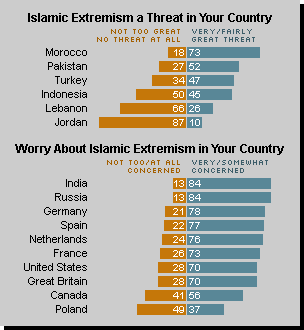
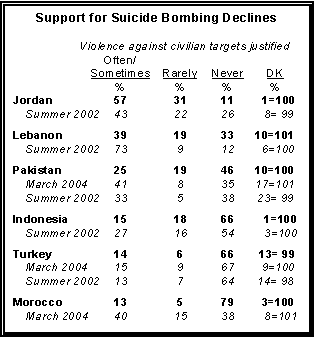
Support for Terror Declines in Muslim Lands


See the link for the whole story. A Pew study shows an overall decline in support for Muslim terror in Muslim countries. Nothing succeeds like success, and nothing crashes like failure. In this case, failure has a big American boot on its posterior. Another dividend to W's decisive intervention in Afghanistan and Iraq.

Monday, July 11, 2005

Our New Ally in the Mideast


Let's get it clear: a firm Arab ally in the Mideast is a great side benefit of total victory in Iraq.

The surest way to a lasting peace is overwhelming a decisive victory!

Just Last January


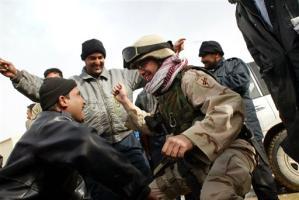
Just a reminder of why we fight and why Dems are dumb: the universal joy of freedom. Here's some great pics from last January's Iraqi elections. Never forget the Purple Finger of Freedom

Thursday, July 07, 2005


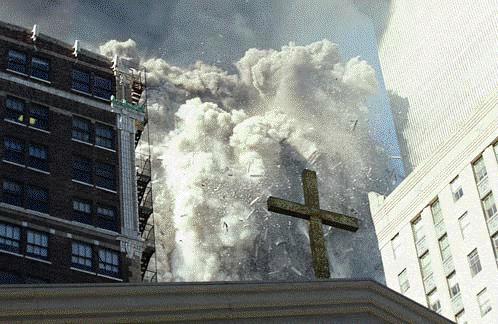
This has always been my favorite 911 picture. It's also a depiction of the endurance of the cross in the face of terror times.

MORAL CLARITY

What can we say but thank God for the moral clarity shown by President Bush in the War on Terrorism as opposed to the moral confusion and self-blaming of the left. Thanks, W.

LONDON ATTACKED

Hugh Hewitt has this interview posted from Al Franken's Air America show today regarding the London terror attack. By the way, Drudge as of 6:21 PM Pacific is still linking a discredited story about Ben Netanyahu being warned in advance about the attack; see www.drudgereport.com and http://powerlineblog.com/ for the correct account. Here's my commentary on Al Franken's mental meltdown:

Oliphant: We'll I'll tell you something, Porter Goss, at the CIA right now, is probably scared to death that there might be a revelation in the next few days that some of the people involved in this had moved across international borders. Because if this wasn't a completely home grown thing, the question arises, given the logistics of arranging horrific attacks like this, after four years, how could we have picked up nothing again?

Franken: This is where I am going to disagree with you, because this seems to be your thrust about what happened today. And I think that, and I buy this, and maybe I am naive, that you gotta bat 1,000 and they just got to bat 1. You know, and I don't know what's been stopped and I don't know any way we can know what's been stopped. We don't know. We had Jane Mayer on talking about the abuse at Gitmo, and there's no way to know because they are so secretive, this is the most secretive Adminsitration, we don't know, they say, they've saved American lives from their interrogations there. We don't know that. We don't know if it has cost us in terms of getting information, because it is the wrong way to get information.

Well, duh, Al, Gitmo's supposed to be secret. If anything, we aren't squeezing these guys enough. See the last issue of Weekly Standard.

Oliphant: That's right, and because of Congress now we have no way to really rigorously oversee what the intelligence community does so we can come to an evaluation about its effectiveness.

The last time we had such "rigorous oversight" we shot ourselves in the foot when nitwits like Pat Leahy intentionally leaked things he didn't like. I wouldn't trust Leahy with taking care of goldfish.

But all you have to do is look at the pictures from London, imagine the logisitical work that was necessary to arrange four coordinated attacks within an hour, imagine that a few of these people might have come into Britain in recent weeks or months, and you wonder, what use has this allegedly smooth functioning system, erected over the past four years, what, what's its value? That's the short term consideration. And then you look at the longer term political and diplomatic issues that involve the sea from which these people come, and you ask, are we making enough progress on the basic issues that create the environment out of which terrorism emerges...

Franken: Or have we made things worse...

This is called the Blame America First syndrome. We got hit, must be our fault. Wonder if they apply that logic to rape victims.

Oliphant: Or have they gone in the wrong direction...

Franken: Right

Oliphant: In other words, imagine whoever did this, let's assume for a second that the authroties are correct, that it appears to be jihadists, um, were they inspired by the American occupation in Iraq? The middle east situation? What was it?

What dummies. These guys are inspired by grievances 1000 plus years old.

Franken: I mean, Rumsfeld himself said, openly, a couple years ago, we don't know if we are creating more or less in Iraq.

Oliphant: Not only that, he's begun to acknowledge that our very presence in Iraq, ah, ah, one reason that he doesn't want to increase the force level is to increase the magnitude of the American occupation and its impact in Iraq.

Franken: And, on the other hand, they just killed, you know, Zarqawi's people just killed the Egyptian envoy.

Oliphant: Yes they did, and they just missed on a couple of other hits.

Franken: So these are monsters. We are dealing with monsters.

A rare moment of clarity for Al.

Oliphant: Yes we are, but not very well in my opinion. And, um, what I think is so awful, in the short term, is that we don't see, is this culture that lacks acountability in the United States, just fascinates me.

Franken: You are talking about the Administration?

Oliphant: Yes! And Congress is complicit in this. And I don't care whether you are talking about 9/11 itself, the run-up to the war in Iraq, or the insurgency since then.

Franken: And that's why the [president's] speech [last week] just fried me, because there was not one acknowledgement of a mistake that they've ever made, and it was the same old crap.

In the real world, we call that consistency, Al.

Oliphant: If that fries you, then get get ready, because there is going to be a blitz, you watch, from here, ah, about how, despite what happened today, we're in fact making great progress in the international war on terror, to which I say, bunkum."

Al and Oli are the bunkum kings. As Lileks says, the Achilles heel of the western world is on the left foot.

Tuesday, May 03, 2005

VATICAN REFELCTIONS

REGARDING the death of Pope John Paul II and the accession of Benedict XVI:
1. JPII will be remembered with Ronald Reagan as one of two men most responsible for the fall of communism in Europe. That's what the history books will say 40 years from now. You heard it hear first.
2. JPII was also a medieval mystic. I don't mean that as a slam. We need more medieval mystics. They are better than a lot of other things.
3. JPII was a conservative. He was conservative in two ways: matters of morals and in matters of traditional Catholicism. There was no "paradox" in him in that way.
4. JPII reminds Protestants of two things: (1) we can and should make strategic alliances with all those with whom we have common interests in matters of morals and public policy. That includes conservative Catholics, observant Jews and Mormons. (2) There is still a reason we had a Reformation! JPII's devotion to Mary and other Catholic distortions of theology means that there is still a VAST gulf of doctrine which separates us.
5. JPII and B XVI are both children of Vatican II. That great conclave is widely misunderstood. Because it introduced the mass in the vernacular, many (both Protestant and Catholic) interpreted Vatican II as making the Catholic church more Protestant. That exactly half right. It made Catholicism more like liberal Protestantisn, not evangelical Protestantism.
Before Vatican II, the Catholic church saw itself as the only way to God. It was as if there was a dot marked GOD surrounded only by the Holy Roman Catholic Church. Elsewhere there was another dot marked DEVIL. Atheists were the closest to that dot, while non-Catholic Christians occupied the place farthest from the dot, but still they would be in Satan's orbit, along with all other religions.
Post Vatican II, the Catholic church revisualized itself as the planet in closest orbit to God, followed by non-Catholic Christians, then non-Christian monotheists, then all other religions, then non-religious, even atheists. (Although atheists are out at the distance of Pluto.) The devil dot simply ceased to exist in Vatican II theology.
That's why JP II could visit synagogues. Jews are just Catholics in a more distant orbit.
6. JP II cemented the Catholic church as functionally pacifist. Yes, the Just War theory was still official doctrine, but it's hard to imagine a war the Vatican could sign off on. This is the legacy of paying the debt of the Crusades as well as the liberal Protestant infusion, which is stridently, militantly pacifist.
7. Finally, on Benedict XVI. In hindsight, it seems so inevitable. I thought the smart move would have been a Latin American. I'm glad they didn't do the smart move; I want to see the Protestantization of Latin America accelerate. Maybe B XVI is the last European pope.

Tuesday, March 22, 2005

The Incredible Mr. Schiavo

One thing, it strikes me, that's being lost in the Terri Schiavo matter is the fact that Michael Schiavo's adulterous relationship is being entirely glossed over. Put it in these terms: transpose the case to the year, say, 1920. A husband so anxious to see his legal wife die while he carries on a long-term dalliance would be widely regarded as not credible. No matter what he says Terri may or may not have said would have been given no credance whatsoever because of his unwillingness to honor "in sickness and in health, till death do us part." He is indeed the incredible Mr. Schiavo.

Friday, March 11, 2005

EVALUATING PUBLIC ISSUES BY MEANS OF THE CHRISTIAN WORLDVIEW

This is my church newsletter column for April, 2005. Our church newsletter is available online via our Yahoo Group. To subscribe, email: beacononbaldwin-sunscribe@yahoogroups.com.

WORLDVIEWS MATTER IN REAL-LIFE ISSUES

by Glenn Layne

Part of Christian maturity in thinking is understanding what the Christian worldview is, and applying that worldview consistently when it comes to the issues that we are called upon to make judgments on daily—in our personal lives, as well as in the public arena.

Currently, Terry Sciavo lays in a Florida skilled nursing facility. Due to an injury sustained a number of years ago; she is in a state of extreme mental and physical incapacity. Her husband says he recalls her stating that she would not want to live in this state, although there is no other witness to such statements. Mr. Sciavo has gone to court to have her feeding tube removed. In essence, he is seeking that she be starved to death, with the sanction of the state of Florida.

On the other hand, Terry’s parents say that want her to live and to have a shot, no matter how long a shot, at recovery.

The courts have bounced around on the Sciavo case, but seem (at the time of this writing) to be inclined to allow the feeding tube to be removed. This is despite repeated attempts to intervene from the Governor of Florida, Jeb Bush, and the state legislature. (This is an example of the Judicial Aristocracy problem we face as a nation, but that one will wait to another time.)

What we need to do as Christians is grapple with cases like that of Terry Sciavo in a “worldview-ish” way. Rather than react emotionally to either the plight of Terry, or her husband, or her parents, let’s apply the grid of the Christian worldview to the case.

A few of the key elements of the Christian are especially relevant. First, the nature of human beings in the Christian worldview is that we are not animals (even though we have bodies, are born, die, and engage in sexual activities, as animals do). We may be physical beings, but we are firstly spiritual beings.

But more than that: we bear God’s image. Genesis 1:27 says, “So God created man in his own image, in the image of God he created him; male and female he created them.” The Bible makes repeated reference to the fact that human beings are more than animals. Murder is specifically banned on that ground (Genesis 9:6).

This affirmation is rejected by most other worldviews, especially naturalism (the worldview behind the mood we call “secular humanism”). That worldview views human beings as simply the cleverest animal that has evolved on planet earth. Extra-ordinary efforts to maintain the life of woman like Terry Sciavo make no sense to the naturalist.

Another element of worldview to check with is the nature of morality. Part of the Christian worldview is that God has chosen to make Himself known, and that His character is the foundation of morals and ethics. Further, the Christian worldview says that human existence is not ended by death; eternity may be with God or eternally separated from Him, based on our response to the work of Christ.

So what can we conclude about the Sciavo case based on this quick look at the Christian worldview, in our attempt to “think Christianly”?

1. Whoever has the legal right to act as Terry’s advocate has the moral duty to stand for her right not to be killed by starvation, based on her human dignity as more than an animal—as a human being created in the image of God.
2. A separate but related issue is the matter of public advocacy. Facing the reality that at least certain elements of public policy favors the state-sanctioned killing of chronically ill and mentally incapacitated patients (especial via judicial activism), what is the proper stance of God’s people? Do we demand that the greater society conform to Christian values, or do we surrender to the “lowest common denominator” of the society, and simply teach our own the way we should go?

That second item is the one that has divided believing Christians over the generations. Essentially, we have taken two different paths: one might be described as the Redeem and Reform path; the other the Retreat and Reform path.

The Redeem approach takes on the society and engages it with a view toward changing it in a God-honoring way. Augustine, Luther, Calvin and Abraham Kuyper in the past and James Dobson or Jerry Falwell would fit the mold in the present.

The Retreat approach says that society at large is beyond redemption. Authentic Christian community standing apart from the greater society is the best we can hope for. The Monastics, Anabaptists, Menno Simmons (founder of the Mennonites) represent this view in the past. To a certain extent, Ron Sider (author of the classic Rich Christians in an Age of Hunger), Richard Mouw and John Howard Yoder (author of The Politics of Jesus) would represent this view today.

Anyone who knows me would probably say that I am more in the Redeem and Reform Camp, and they’d be right. At the same time, I have great respect for people like Sider (who’ve I’ve met and had a great conversation with) and John Yoder.

What I think Sider and Yoder underestimate is the power of democratic institutions. We are blessed to live in a democracy, where we all are supposed to have a say. While we live in a fallen world (another element of the Christian worldview), there is enough in society that’s redeemable to see a “substantial recovery” (as Francis Schaeffer said) of righteousness in society. It was this truth that impelled the abolitionists a hundred years ago.
This excellant article appeared on www.pastors.com.

Do we trust the Bible to tell us the truth about homosexuality?by R. Albert Mohler

LOUISVILLE, Ky. (BP)--With the movement toward same-sex “marriage” and the normalization of homosexuality gaining momentum, some churches are running for cover. Yet, our Christian responsibility is clear -- we are to tell the truth about what God has revealed concerning human sexuality, gender and marriage. No one said it was going to be easy.

The confessing and believing church, at every point, runs counter to the cultural tidal wave. Even to raise the issue of gender is to offend those who wish to eradicate any gender distinctions, arguing that these are merely "socially constructed realities" and vestiges of an ancient past.
Scripture will not allow this attempt to deny the structures of creation. Romans 1 must be read in light of Genesis 1 and 2. As Genesis 1:27 makes apparent, God intended from the beginning to create human beings in two genders or sexes -- "male and female He created them." Both man and woman were created in the image of God. They were and are distinct and, yet, inseparably linked by God's design. The genders really are different, and the distinction goes far beyond mere physical differences, but the man recognized the woman as "bone of my bone and flesh of my flesh."

The bond between man and woman is marriage, which is not an historical accident or the result of socialization and cultural evolution. To the contrary, marriage and the establishment of the heterosexual covenant union is central to God's intention -- before and after the fall in the Garden of Eden. Immediately following the creation of man and woman come the instructive words: "For this cause a man shall leave his father and his mother, and shall cleave to his wife; and they shall become one flesh. And the man and his wife were both naked and were not ashamed."

Evangelical Christians have often failed to present this biblical truth straightforwardly, and thus many of our churches and members are unarmed for the ideological, political and cultural conflicts which mark the modern landscape. The fundamental axiom upon which evangelical Christians must base any response to homosexuality is this: God alone is sovereign, and He has created the universe and all within by His own design and to His own good pleasure.

Furthermore, He has revealed to us His creative intention through Holy Scripture -- and that intention was clearly to create and establish two distinct but complementary genders or sexes. The Genesis narratives demonstrate that this distinction of genders is neither accidental nor inconsequential to the divine design. "It is not good that the man should be alone; I will make for him a helper suitable for him," determined God. And God created woman.

God's creative intention is further revealed in the cleaving of man to the woman ["his wife"] and their new identity as "one flesh." This biblical assertion -- which no contorted interpretation can escape -- clearly places marriage and sexual relations within God's creative act and design.

The sexual union of a man and a woman united in covenant marriage is thus not only allowed but is commanded as God's intention and decree. Sexual expression is limited to this heterosexual covenant, which in its clearest biblical expression is one man and one woman united for as long as they both shall live.

Therefore, any sexual expression outside of that heterosexual marriage relationship is contrary to God's explicit command and the nature of his creation. That fundamental truth runs counter not only to the homosexual agenda but to the rampant sexual immorality of the age. Indeed, the Bible has much more to say about illicit heterosexual activity than about homosexual acts. Adultery, rape, bestiality, pornography and fornication, for example, are expressly forbidden.

As E. Michael Jones argues, most modern ideologies are, at base, efforts to rationalize sexual behavior. In fact, he identifies modernity itself as "rationalized lust." We should expect the secular world, which is at war with God's truth, to be eager in its efforts to rationalize lust and to seek legitimacy and social sanction for its sexual sins. We should be shocked, however, that many within the church now seek to accomplish the same purpose and to join in common cause with those openly at war with God's truth.

The Apostle Paul's classic statement in Romans 1 sets the issues squarely before us. Homosexuality is linked directly to idolatry, for it is on the basis of their idolatry that God gave them up to their own lusts. Their hearts were committed to impurity and they were degrading their own bodies by their illicit lusts.

Their idolatry -- exchanging the truth of God for a lie and worshiping the creature rather than the Creator -- led God to give them over to their degrading passions. From here, those given over to their degraded passions exchanged the natural use of sexual intercourse for that which God declared to be unnatural (literally, against nature). At this point Paul explicitly deals with female homosexuality or lesbianism as well as male homosexuality. This is one of the very few references in all ancient literature to female homosexuality, and Paul's message is clear: All forms of homosexual eroticism and sexual behavior fall short of God's glory, violate God's revealed law and are inherently unnatural.

But the women involved in lesbianism were not and are not alone. Men, too, have given up natural intercourse with women and have been consumed with passion for other men. The acts they commit, they commit without shame. As a result, they have received within their own bodies the penalty of their error.

Beyond this, God has given them up to their own depraved minds, and they do those things which are not proper. The message could not be more candid and clear, but there are those who seek to deny the obvious. Some have claimed that Paul is here dealing only with those heterosexual persons who commit homosexual acts. The imaginative folly of this approach is undone by Scripture, which allows no understanding that any human beings are born anything other than heterosexual. The modern -- and highly political -- notion of homosexual "orientation" as a natural human condition cannot be squared with the Bible. The only orientation indicated by Scripture is the universal human orientation to sin.

In other letters, Paul indicates that homosexuals -- along with those who persist in other sins -- will not inherit the Kingdom of God. The word Paul uses in 1 Corinthians 6:9-10 and 1 Timothy 1:10 is “arsenokoites,” a word with a graphic etymology. Some modern revisionists have attempted to suggest that this refers only to homosexual rapists or child abusers. This argument will not stand even the slightest scholarly consideration. The word does not appear in any Greek literature of the period. As New Testament scholar David Wright has demonstrated, the word was taken by Paul directly from Leviticus 18:22 and 20:13, and its meaning is homosexuality itself.

The biblical witness is clear: Homosexuality is a grievous sin against God and is a direct rejection of God's intention and command in creation. All sin is a matter of eternal consequence, and the only hope for any sinner is the redemption accomplished by Jesus Christ, who on the cross paid the price for our sin, serving as the substitute for the redeemed.

Our response to persons involved in homosexuality must be marked by genuine compassion. But a central task of genuine compassion is telling the truth, and the Bible reveals a true message we must convey. Those seeking to contort and subvert the Bible's message are not responding to homosexuals with compassion. To lie is never compassionate -- and their lie leads unto death.

In the end, the church will either declare the truth of God's Word or find a way to run away from it. It really comes down to trust. Do we trust the Bible to tell us truthfully what God desires and commands about our sexuality? If so, we really do know where we stand and we really do know what to say. If not, let's just admit to the world that we really haven't a clue.
-Pastors.com®-

Monday, March 07, 2005

Senate Races in 2006

Here are the Senate Races for 2006 and my preliminary projections:

Senate Races (33)
State
Republicans (15)
State
Democrats (17)
AZ
Kyl REELECTED
CA
Feinstein REELECTED
IN
Lugar REELECTED
CT
Lieberman REELECTED
ME
Snow REELECTED
DE
Carper REELECTED
MO
Talent REELECTED
FL
Nelson DEFEATED AND REPLACED BY A REPBLICAN
MS
Lott REELECTED
HI
Akaka REELECTED
MT
Burns DEFEATED AND REPLACED BY A REPUBLICAN
MD
Sarbanes REELECTED
NV
Ensign REELECTED
MA
Kennedy REELECTED (SADLY)
OH
DeWine REELECTED
MI
Stabenow RELECTED in a tough fight
PA
Santorum REELECTED in a tough fight
MN
Dayton Dayton, a complete embarassment to the state, has announced he will not seek re-election. I predict that this seat will go to the GOP.
RI
Chafee REELECTED
NE
Nelson RELECTED
TN
Frist He has announced he will not seek re-election; he wants the White House. The seat will remain GOP.
NJ
Corzine He will move over to the Governor's office in NJ, and the seat will go to the GOP.
TX
Hutchinson REELECTED
NM
Bingaman REELECTED
UT
Hatch REELECTED
NY
Clinton REELECTED unless Rudy G. takes her on; he could defeat her, and end her presidential aspirations. If Rudy gets in, Hilary could get out--just to avoid such a defeat.
VA
Allen REELECTED
ND
Conrad RELECTED
WY
Thomas REELECTED
WA
Cantwell REELECTED sadly
WV
Byrd He will be 89 in 2006. He is an embarassment, and ought to quit. If he does, the seat could go GOP.
WI
Kohl REELECTED
VT
Jeffords RELECTED because Green Mountain voters have developed a taste for moronic quislings (see also DEAN, Howard; SAUNDERS, Bernie and LEAHY, Patrick).

BOTTOM LINE: another good election cycle for the GOP; I see a pick up of 3-5 Senate seats.

Friday, February 18, 2005

From the New York Daily Post, 2/18/05:

The Briefing

Friends no more? I hope Sen. Hillary Clinton isn't counting on help from Hollywood mogul David Geffen in her possible run for the White House in 2008. Geffen, a generous supporter and pal of Bill Clinton when he was President, trashed Hillary's prospects last night during a Q&A at the 92nd St. Y. "She can't win, and she's an incredibly polarizing figure," the billionaire Democrat told his audience. "And ambition is just not a good enough reason." Geffen's dis was met with hearty applause.

Geffen is half right. HRC is polarizing, she can't possibly win, but she will be the Dem nominee.

On the GOP side for 2008--keep an eye on two governors: Mit Romney of MA and Bill Owens of CO. Mit apparently is the Bush fav if Jeb does not run. Owens is a very popular western gov. Both are smart as they get. Mit's run would upset the electoral apple cart by a strong Northeast/New England appeal. (I doubt he would carry MA, but NH & ME would definately be in play. PA, NJ would also be in play, with PA almost certainly going GOP).

Owens would be strong in trad GOP areas, and would have appeal in WI, MN, OR as well.

Religion plays a factor here. Mit is Mormon; Owens is Catholic. Both are devout.

Ques: would Mit's Mormonism be a negative for the critical evangelical vote. Afraid so; but the degree is hard to gague. Much more so than Owen's Catholicism.

Monday, February 07, 2005

WOLRDVIEW CONFUSION

Here's my March column for my church newsletter, which is now available (in its entirety) by free subcription: email beacononbaldwin-subscribe@yahoogroups.com.

WORLDVIEW CONFUSION

Last month, I used this space to address the importance of the Christian worldview. As a matter of fact, this summer the Summer Bible Institute (June 26-30) will be devoted to the topic of “Worldview Boot Camp.” The way people approach reality is based on something called our worldview. We all have a worldview, and many of us are inconsistent in our worldview.

According to George Barna, the famous Christian researcher, about half of all Americans have multiple worldviews. This is a new development in culture; new, that is, over the last 40 years or so.

What we mean by multiple worldviews is not when someone is genuinely confused, but when they either apply the rules of worldviews inconsistently according to the situation or when they allow feelings to dictate which worldview they will follow at any given moment.
Blogger Mark Roberts (you can read his blog [short for “web log”] at www.markdroberts.com, and he now has a link to my blog, www.durabledata.blogspot.com) tells the story of a woman who expressed an opinion that made no historic sense at all in a Bible study he was leading at Hollywood Presbyterian, a fine church. When he gently corrected her misunderstanding, she became emotional and stormed out of the room. (Every pastor has a few stories like that!) What surprised him the most was the reaction of the people who remained. “What right did you have condemning her like that? Everyone’s entitled to their opinion!” They were very upset with Roberts.

They were at that moment also engaged in worldview confusion. We have a history-based faith, and we believe that truth is knowable. God has revealed Himself in history (that is, in the realm of the space-time world we live in, in His deeds with the people of Israel, and most especially in the life, death and resurrection of Jesus).

What the woman—and the other people in the Bible study were confused about is how God reveals Himself. My guess would be that they (especially the ones who stayed to roast Mark Roberts) would agree with the last sentence in the previous paragraph, but they also would agree with this sentence: “Spiritual truth is different for each person; what may be true for you may not be true for me.” That is a profoundly un-Christian worldview statement.

A Buddhist critic of Christianity hit the nail on the head when he said, “There is an irreducible orneriness about the Christian faith.” Christianity makes sweeping, absolute claims. Jesus said that He is the way, the truth and the life—that no one comes to the Father (that is, can have a real and accurate knowledge of God) apart from Him.

The problem is, we believers are Christian fish swimming in a sea of competing worldviews, and sometimes we swallow contaminated water.
I think we can see this in several areas of morality and public policy. For example, in regards to homosexuality, the naturalist worldview has no problem with homosexuality. Naturalism denies that there is a God (or at least states that God’s existence is irrelevant to human affairs). Therefore, human beings are simply the cleverest animals on the planet. Morality is simply a code we have devised to enable us to cope with life, and is subject to constant revision.

The Naturalist worldview (you may have heard it called “secular humanism”), by definition cannot and does not have any problem with homosexuality, same-sex marriage, abortion or the harvesting of embryonic stems cells for research.

A Christian worldview starts from wholly different grounds. There is a God. He is the foundation of morality and ethics. Human beings are created in God’s image—no matter how small (including pre-born) or infirm. Marriage is part of His design. Human beings, as carriers of God’s image, are not mere animals; while we have bodies as animals do, we also have immortal souls, which animals emphatically do not.

Further, I have observed that worldview confusion is often the driving force when people try to re-interpret Scripture to validate a perspective or lifestyle that the body of Christian teaching has rejected.

When I was a graduate student at Ohio University (back in ’79-’80), I wrote a paper on Marxism being a “proto-existentialist” view—this was for a Marxist professor! What I meant by that term is that even though Karl Marx rejected any transcendent truth (no absolute right and wrong), he contradicted himself when it came to his view of history: history, in his view, had to produce a communist world. Like the existentialist writers of nearly a century in his future, Marx plucked meaning out of the thin air.

This same “plucking of meaning” occurs daily at thousands of American hospitals. In one ward, a pre-born baby is killed because a choice was made to regard her as a genetic product. Down the hall, at same age of gestation, a team of doctors and nurses fight to save the life of the baby, because a decision was made to regard that “genetic material” as a real child, a baby, a human being worthy of love and respect.

Frankly, I don’t expect the world to get this. They’ve been swimming in the naturalist sea too long. But part of Christian maturity in thinking is understanding what the Christian worldview is, and applying that worldview consistently when it comes to the issues that we are called upon to make judgments on daily—in our personal lives, as well as in the public arena. I’ll expand on that thought next month.

-Pastor Glenn

Friday, February 04, 2005

A BAD WEEK FOR TEDDY AND BABS

Just reflecting on what a bad week it's been for Teddy the Swimmer and Babs Boxer:

1. Historic elections in Iraq
2. Alberto Gonzales sworn in
3. Condi Rice off to conquer the world
4. Bush delivers incredible State of the Union; US opinion swayed on Social Security reform
5. W barnstorms Dem senators homestates to stump for reform
6. Pelosi and Reid deliver worst oppo party rebuttals to SOU address in history

Problem: the Swimmer and Babs probably don't even know it was such a bad week.

Email me at glennlayne@pastors.com


Sunday, January 30, 2005

DURABLE DATA

DURABLE DATA

KERRY WAFFLES AGAIN

In the face of amazing courage on the part of 8 million Iraqis, what did the Junior Senator from Massachusettes have to say?


From http://news.yahoo.com/news?tmpl=story&u=/afp/20050130/pl_afp/iraqvoteusdemocrats_050130214839

Massachusetts Senator John Kerry, who lost the November presidential election against Republican President George W. Bush, described the Iraqi elections as "significant" and "important" but said they should not be "overhyped."

"It is significant that there is a vote in Iraq," Kerry said in an interview with NBC television's Meet the Press. "But ... no one in the United States should try to overhype this election.

"This election is a sort of demarcation point, and what really counts now is the effort to have a legitimate political reconciliation," Kerry said. "And it's going to take a massive diplomatic effort and a much more significant outreach to the international community than this administration has been willing to engage in.

"Absent that, we will not be successful in Iraq," he said.

Kerry also said he did not support fellow Massachusetts Senator Ted Kennedy's call last week for the immediate pullout of at least 12,000 US troops from Iraq following the elections.


"I wouldn't do a specific timetable, but I certainly agree with (Kennedy) in principle, that the goal must be to withdraw American troops," Kerry said.


In his grand tradition know as "Blame America First," Kerry can't help himself: the election should not be "overhyped"; we need a "political reconcilation" (so the Sunnis who oppressed their countrymen don't feel too bad, I guess); we need a "massive diplomatic effort" (what? the French and the UN again? who the heck do we or anyone else need to engage in diplomacy with? Is the objection to apologize to thugs and tyrants about the advance of freedom?).

What is with this "international community" broken record on the part of Kerry? What is this instinct about the "Global Test"?

PM Blair said it best: "The exit strategy for Iraq is a democratic Iraq." Is Blair the only liberal who understands this?

Memo to Kerry: this, in large measure is why you lost.

Tuesday, January 25, 2005

DURABLE DATA

DURABLE DATAhttp://hokev.brinkster.net/quiz/default.asp?quiz=Better+Personality&page=1

BTW, took the above and discovered I am an EVIL GENIUS. OK, I can deal with the evil part--but "genius"? Wow. Am I impressed.

DURABLE DATA

DURABLE DATA

target="_blank">Christians.org


From today's www.hughhewitt.com:


The first Vox Blogoli of 2005 deals with a Jonathan Rauch piece from the new Atlantic (subscription required.) Jonathan is a Yalie, a National Journal columnist, and the author of Gay Marriage. A more complete bio is here.

Rauch writes in his piece the following:

“On balance it is probably healthier if religious conservatives are inside the political system than if they operate as insurgents and provocateurs on the outside. Better they should write anti-abortion planks into the Republican platform than bomb abortion clinics. The same is true of the left. The clashes over civil rights and Vietnam turned into street warfare partly because activists were locked out of their own party establishments and had to fight, literally, to be heard. When Michael Moore receives a hero’s welcome at the Democratic National Convention, we moderates grumble; but if the parties engage fierce activists while marginalizing tame centrists, that is probably better for the social peace than the other way around.”

Hugh's invited a Blogswarm on Mr. Rauch's comments. As a pastor, long-time pro-lifer, conservative and an evangelical theologian, some thoughts:

Rauch (and the editors at The Atlantic) have made the common error of the false center, viz, we all tend to think we are stand at the dead center. Even if you're Dennis Kucinich, you think you are at the thoughtful center of political discourse, and that opinion is evenly divided to your right and left.

Rauch IDs himself as a "moderate." Take that with a whole bag, not a grain, of salt. It's not that he doesn't believe it; he does. That's why he cites Michael Shut-Out-Of-the-Oscars Moore is a fair representative of the nutty left, and religious conservatives/prolifers as representative of the nutty left. Voila, we have restored balance to the Force!

But I submit: which is closer to the center: the pro-life conservatives or the Moore-Ons? Now I realize I might suffer from error of the false center, but I don't think so. I think some recent elections, polls, etc., indicate that the I'm closer to dead center that Moore et al.

Notice I said closer. I'm no fool; I'm not at dead-center; I'm center-right. If the political spectrum was a chalk line ten feet long, I'm not at the five-foot mark. I'm at about the three-feet, six inch mark. I know I'm not at the center point.

Rauch thinks he's at the five foot mark. Well, maybe five foot six. He isn't. His position on same-sex marriage plants him firmly at the seven-foot mark, at least. But he and the Upper West Side compadres at Atlantic don't see it. They practically can't.

Oh, by the way, this pajamahadeen has a BA and MA in political science and two advanced degrees in theology.

(Dr.) Glenn Layne

Monday, January 24, 2005

Here's the first installment in my pre-Easter series, almost a month early...

Please contact me at glennlayne@pastors.com.


Why Jesus Had to Die…
…Because of His Enemies

(John 11:45-54)

First in the Series: Why Jesus Had to Die
February 20, 2005

About this time last year, you would have thought, based on what you read or heard from certain elements of the press, that Hitler himself had made a propaganda movie that was a horrible anti-Jewish slander. That movie was “The Passion of the Christ” and the latter day Hitler was the devout Catholic, Mel Gibson.

“The Passion” was a controversial movie on several fronts. It’s true that the Jewish leaders of the time don’t come off looking too good. They don’t in the New Testament either. As a student of Scripture, I think the “bad Jew/good Roman” way of telling the story that you find in “The Passion” does overplay things a bit. I was surprised when in the film when the Romans are depicted as being caught off guard by the arrest of Jesus. I think that the long delay between the time Judas left the Last Supper and the time Jesus was arrested in the garden was because the Temple authorities also obtained the cooperation of Pilate in those tense hours, and I’m far from alone in that conclusion.

But that’s a detail. Over the next four weeks, as we prepare for Easter, we’re going to examine the question that “The Passion” forced to the front covers of Time and Newsweek: “Why did Jesus have to die?” I want to suggest to you that Jesus died for four reasons:

1. Because of His enemies
2. Because of human decision
3. Because it was His decision
4. And because it was the will of His Father

Now in a study like this, we have to bring out a full array of approaches. We need to think like an historian, a student of the Bible and a student of God and His ways. Do you know what that last one is called? It’s called being a theologian: someone who studies God and His ways. Sure there are paid, professional theologians, but whenever we study God and what He does, we’re theologians too. And the general movement of the study will be to start with history and then Biblical doctrine, but we wind up with the eternal plans of the eternal God. It’s quite a journey.

By the way, I want to recommend the book, The Weekend That Changed the World by Peter Walker as the best thing you can read on the events that occurred on that spring weekend 1,925 years ago. Peter Walker is a British Bible scholar who also leads groups to Israel several time a year, and a lot of his book deals with the question of the correct location of Jesus’ resurrection tomb. (As a matter of fact, I bought my copy at the bookshop at the Garden Tomb in Jerusalem.).

Let’s think about those four reasons, one at a time. Obviously, Jesus didn’t die because everybody adored Him. He had enemies. As a matter of fact, He still has enemies. Let’s think about the enemies who conspired to kill Jesus.

According to John’s gospel, the simmering dislike of Jesus went to a full-blown hatred of Him after a very special incident: when Jesus raised Lazarus from the dead.

Now—this can’t be a surprise—Jesus’ act of raising Lazarus from the dead encouraged faith on the part of some. We read in John 11:45:
Therefore many of the Jews who had come to visit Mary, and had seen what Jesus did, put their faith in Him.

According to John 11:42 that was His intent in raising Him from the dead: “that they may believe that You [the Father] sent Me.”

That’s wonderful, but it’s not the whole story. Ironically, this gift of life for Lazarus was the kiss of death for Jesus, at least in the plans of the powerful in Jerusalem.

There is a whole lot more here! And it’s not a passive rejection, but an active, angry rejection of Jesus that hardened into a determination:

JESUS MUST DIE

That’s the bottom line here…when they were all done, that was the finding: “Jesus must die.”

Why must He die? And who killed Jesus?

What John tells us here is that human pettiness on one level was the reason---
But that God Himself—His plan—was the ultimate reason. That’s what we’ll get into in the coming weeks.

After the raising of Lazarus, some people decided to “rat” on Jesus (v. 46):

But some of them went to the Pharisees and told them what Jesus had done.

Having seen, you would think they would believe. But so stubborn is the human heart that we will sometimes reject the most obvious evidence.

After all, remember that the time was not far off when Jesus Himself would rise from the dead, and while many would believe—most would not.

Jesus had something to say about this in Luke 16:31: “If they do not listen to Moses and the Prophets, they will not be convinced even if someone rises from the dead.”

So some came to the Temple authorities with a report. The report should have read, Jesus must be the Messiah, because He can raise people from the dead.

Instead it read: This guy is more dangerous than our worst nightmare. He can raise people from the dead!

So the Sanhedrin calls a special session. What do we know about the Sanhedrin?

· It was the Supreme Council of Israel
· It had powers over religion and public order
· It answered to Rome, in the person of the Roman governor, which was then Pontius Pilate
· About evenly divided between Sadducees (who controlled the temple, had the money and the real power) and the Pharisees

The Sanhedrin was driven by two passions:

· The temple (both for religious and economic reasons)
· Placating Rome by keeping order

John describes a meeting and a debate on the “Jesus problem.” His sources were almost certainly two powerful men who were on the Sanhedrin at the time: Nicodemus and Joseph of Arimathea. Nicodemus was the man who came to Jesus by night (in John 3), and Joseph came forward as a follower of Jesus by providing his own tomb for His burial.

So they meet (47a):

Then the chief priests and the Pharisees called a meeting of the Sanhedrin.

The wording indicates that a formal meeting of the body was called. There was really only one item on the agenda: what to do about Jesus.

Now you have to know: this “Jesus problem” had been brewing almost from the beginning of Jesus’ ministry.

There were four main areas where Jesus and the religious leaders clashed:

1. The leaders said the way to please God was through the law and the temple. Jesus said that that wasn’t enough. In the Sermon on the Mount, He focused on the heart, not the commandment, and not the temple, as the arena God really wants to work in people’s lives.
2. The leaders said that the common people would and could never amount to anything in God’s eyes. Jesus said that God loves “sinners” and wants them to be part of His family. He was the one who went to the parties of the so-called sinners and welcomed in shifty business men and prostitutes—much to the dismay of the religious leaders.
3. The leaders said that observing the smallest commands in the law were as important as the biggest. Jesus said that fixes your heart on things in such a way that you can’t even see much less do the really important things. For example, the gospels record a number of healings Jesus did on the Sabbath. And the leaders were more upset that Jesus did “work” on the Sabbath than there were impressed by the power of God demonstrated by that healing.
4. Finally, for the leaders the Temple was all-important. But Jesus said that the temple was in the process of being set aside by God and that it would soon be destroyed—as it was 40 years after Jesus death and resurrection.

They debate the problem (47b-48)

"What are we accomplishing?" they asked. "Here is this man performing many miraculous signs. 48If we let him go on like this, everyone will believe in him, and then the Romans will come and take away both our place and our nation."

· We’re getting nowhere with “the Jesus problem”
· He’s doing miracles (really big ones these days!)
· He’s going to stir up the people
· They’ll be a rebellion
· The Romans will quash the rebellion
· Our “place” (the temple) will be destroyed (and we’ll be out of business, literally and figuratively)
· Our nation will be quashed

See any problems here?

· They never ask—doesn’t the fact that He does miracles point to us that God sent Him?
· Interesting fact: the Talmudic writings that refer to Jesus call Him a “deceiver” hanged (on the cross) on the eve of Passover. It says He led the people in heresy by doing sorcery.

They put order and the temple way ahead of the people—and with any concern for what the truth may be.

Caiaphas speaks (49-50)

49Then one of them, named Caiaphas, who was high priest that year, spoke up, "You know nothing at all! 50You do not realize that it is better for you that one man die for the people than that the whole nation perish."

· High Priest from 18-36 AD
· “That year”, not because the priesthood changed annually, but because in John’s memory, “that year” was “that fateful year”, the year of the cross
· Well-connected (father-in-law Annas was High Priest 6-15 AD)
· Side note: his bones discovered several years ago in an ossuary outside Jerusalem
· “You know nothing at all!”
· “It’s better that one man (Jesus) to die for the people (laos) than the whole nation (ethnos) perish.”
· What he means is that if this “Jesus movement” takes off, that will mean rebellion against Rome, the Romans will crush us all, destroy the temple, depose everybody and kill a lot of people. So, to stop all that, Jesus must die!

John tells us what it really means (51-53)

John, writing his gospel comments on what it all means:

51He did not say this on his own, but as high priest that year he prophesied that Jesus would die for the Jewish nation, 52and not only for that nation but also for the scattered children of God, to bring them together and make them one. 53So from that day on they plotted to take his life.

But John says, Caiaphas said more than he knew:

· Honors Caiaphas as High Priest. Even though he didn’t realize it, God spoke through him.
· Are the gospels anti-Semitic? That’s one of the constant criticisms of the gospels—especially the gospel of John, and it’s the same criticism leveled against “The Passion.” Then why say that one of the key figures in seeking Jesus’ death spoke a prophecy of God?

But the conclusion stands: Jesus must die!

Jesus must die. But John says that the “on the ground” reason that Caiaphas has—to keep the Romans off our backs—isn’t enough.

John says that Jesus isn’t just dying for the Jewish nation, but for “the scattered children of God, to bring them together and make them one.”

Why must Jesus die?
He is dying for a people.
He is dying to make a new creation.
He is dying as a substitute.

I love what Jesus says in John 12:32:

But I, if I am lifted up from the earth, I will draw all men [people] to myself.

In the context: being “lifted up” is up on the cross; “all men”: all sorts of people from all over the world. The same idea as in John 11: not just dying for Israel, but for “the scattered children of God” all over the world.

What’s we’re going to see is that beyond and above the reasons given here, and the fact that the Romans were willing and eager to go along with the concerns of the religious authorities for the same reason: to keep order—that there are three “beyond and above” reasons why Jesus had to die:

· Because of human sin
· Because it was His choice
· Because it was the Father’s will and even pleasure to have His Son die

God has His purposes, which are far more relevant to why Jesus had to die than any political calculation on the part of Caiaphas or the Sanhedrin.

In John 10:17-18, Jesus says,

17The reason my Father loves me is that I lay down my life--only to take it up again. 18No one takes it from me, but I lay it down of my own accord. I have authority to lay it down and authority to take it up again. This command I received from my Father."

He says that He’s laying down His life. No one, he says, takes it from me.

This speaks to one of the big items of controversy about the movie, The Passion of the Christ. Many claim that it is anti-Semitic. That it makes out “the Jews” as Christ-killers.

On one level, it’s clear that the Jewish religious authorities, led by Caiaphas and his father-in-law Annas, were the prime movers in seeking Jesus’ death.

And again, it’s also true that a weak and cruel Roman governor named Pilate gave the order to execute him.

But Jesus says, ultimately, it was not Jewish leaders or Roman rulers who took His life. You cannot take the life of the Son of God.

He lays down His life. He voluntarily surrenders it.

“The reason that my Father loves me,” says Jesus, “is that I lay down my life—only to take it up again. No one takes it from me but I lay it down of my own accord. I have authority to lay it down again and authority to take it up again.” (10:17-18a)

Jesus is dying
Voluntarily
To make a people
A people not just of Israel, but from all the peoples of the world

In terms we can all understand, Jesus died to bring YOU into His family; to embrace YOU in His arms.

How? What does His death do?

What does Jesus accomplish on that cross?

For hundreds of Israel, at Passover time, the people of Israel brought a lamb to the temple to be sacrificed. This commemorated the time of the first Passover, when the blood of that lamb was smeared on the doorframes of their slave-dwellings in Egypt. Every blood-covered home was spared God’s judgment and was set on the road to freedom.

And when Jesus appears, how does John, the Baptizer, refer to Him?

Look, the Lamb of God, who takes away the sin of the world! (John 1:29)

Here He is: not the lamb offered by an Israelite in faithful obedience on Passover year after year, but “the Lamb of God (that means, supplied by God) who takes away the sin of the world.”

There’s something wonderful and terrible about that.

Wonderful:
He’s God’s lamb
God provided the lamb—not you or me
And He’s the decisive offering—He “takes away the sin of the world”
Won’t have to be done again and again, year after year

Terrible:
A lamb to be slaughtered
His blood shed
His life poured out

Jesus is the Lamb of God—supplied by God to pay off the debt of sin that you and I owe. He’s the Lamb of God, who takes the punishment who brings us peace.

It wasn’t the severity of His death that paid the price—it was the One who died that made that death worth enough to pay the price. That was His mission.

John writes this in John 3:17, “For God did not send His Son into the world to condemn the world, but to save the world through Him.”

Caiaphas had just a little fragment of the truth: He thought Jesus would die as a substitute, so that many Israelites would not die at Roman hands.

Jesus would die as a substitute, but for the all the peoples of the earth. Not to save them from an oppressive empire, but from the eternal oppression of sin and slavery to Satan himself.

And in the process, He was making a new people, the gathered children of God from all nations. He was making a place, a home, a reception, for you.

So the plot to kill Jesus went forward. It was not the first time, and certainly not the last time, that cowardly rulers planned to kill a good man because He disrupted the status quo.

And Jesus just bides His time (54)

Therefore Jesus no longer moved about publicly among the Jews. Instead he withdrew to a region near the desert, to a village called Ephraim, where He stayed with His disciples.

But this is just a pause.

The hour has almost come.

The hour of the cross is almost here.

Jesus must die.

And He dies for you.


© Glenn Layne, 2005

-
-

http://durabledata.blogspot.com
Today's new links to DURABLE DATA. Technorati Rank: 871,308. 0 Inbound Links from 0 sources.
2005-01-24T01:01:14+00:00
871308
0
0

60


Sunday, January 23, 2005

MORE ON BABS (say that quickly...)

Babs Boxer says that troops from CA account for more that 25% of KIAs. Wrong. The correct % is about 11%.

What kind I say. The hammers are smarter.

DURABLE DATA

Saturday, January 22, 2005

It should be noted that www.anklebitingpundits.com is the sucessor to www.crushkerry.com, which in term is the son of www.crushdean.com. Kind of a Bible geneaology...


www.anklebitingpundits.com carries a post that Babs Boxer is considering a run for Prez in 08. She may just win Marin County. Oh get real....

See the post at http://www.anklebitingpundits.com/index.php?name=News&file=article&sid=915&mode=nocomments&order=1&thold=0

I maintain that she is literally mentally incapable of spelling the word electoral, as in Electoral College. If I wrote her a letter about the same, she would probably ask me where Electoral College is located...

Seriously, she's as (to borrow a line from "O Brother, Where Art Thou") as "dumb as a bag of hammers."

Email me at glennlayne@pastors.c0m.


Tuesday, January 18, 2005

Below is Babs' opening statement at the Rice hearings, from www.boxer.senate.gov, with my deconstuctive constructive comments.

Opening Statement of Senator Barbara Boxer at the Confirmation Hearing of Dr. Condoleezza Rice

January 18, 2005

I’d like to begin by welcoming Dr. Rice to this committee hearing.
It is my hope that today, we will have a candid discussion, Dr. Rice, because I believe it is crucial that a Secretary of State speak openly and honestly with the American people and with Congress. Frankly, this issue of candor is where my concern lies.

Translation: Condi, I think you're a liar.

Since 9/11, we have been engaged in a just fight against terrorism. I voted to use force against Osama bin Laden and the terrorists in Afghanistan, and I assumed that we would focus on that challenge, not stopping until we got bin Laden, dead or alive, and broke the back of al Qaeda.

Translation: I am incapable of remembering my own comments on the danger of Hussein. Instead, my little nose smells blood. My, my fellow nitwits in San Fran will approve.

However, instead, with you in a lead role Dr. Rice, we went into Iraq. I want to read you one paragraph that best expresses my views, and the views of millions of Californians, on the impact of the Iraqi war on the war against terrorism. It was written by one of the world’s experts on terrorism and foreign policy, Peter Bergen, five months ago.

Who is Peter Bergen?

Peter Bergen is a print and television journalist and author of Holy War, Inc.: Inside the Secret World of Osama bin Laden. A documentary based on Holy War, Inc. was nominated for an Emmy in 2002 in the research category. Mr. Bergen is CNN's terrorism analyst and an Adjunct Professor at the School of Advanced International Studies at Johns Hopkins University. He has written for The New York Times, The New Republic, Vanity Fair, Foreign Affairs, The Washington Post, The Washington Times and The Washington Monthly. He is on the editorial board of Studies in Conflict and Terrorism. From 1985 to 1990 he worked for ABC News in New York. Mr. Bergen received a B.A. in Modern History from New College, Oxford University.

For an example of his tripe, see http://www.washingtonmonthly.com/features/2003/0312.bergen.html

He wrote:

What we have done in Iraq is what bin Laden could not have hoped for in his wildest dreams: We invaded an oil-rich Muslim nation in the heart of the Middle East, the very type of imperial adventure that bin Laden has long predicted was the United States' long-term goal in the region. We deposed the secular socialist Saddam, whom bin Laden has long despised, ignited Sunni and Shia fundamentalist fervor in Iraq, and have now provoked a “defensive” jihad that has galvanized jihad-minded Muslims around the world. It's hard to imagine a set of policies better designed to sabotage the war on terrorism.

This conclusion was reiterated last Thursday by the National Intelligence Council, the CIA Director’s think tank, which released a report saying that Iraq has replaced Afghanistan as the training ground for the next generation of “professionalized” terrorists. NIC Chairman Robert L. Hutchings said that Iraq is “a magnet for international terrorist activity.” These quotations are significant to this hearing, Dr. Rice, because as a major proponent and spokesperson for the war in Iraq, and as someone who was asked by the President to make the case for this war to the American people, and as the person in charge of the reconstruction effort– you have many questions to answer to the American people.

This war was sold to the American people– as Chief of Staff to President Bush, Andy Card said– like a “new product.” You rolled out the idea and then you had to convince the people, and as you made your case, I personally believe that your loyalty to the mission you were given overwhelmed your respect for the truth.

GAAAGH!

That was a great disservice to the American people. But worse than that, our young men and women are dying. So far, 1,366 American troops have been killed in Iraq. More than 25 percent of those troops were from California. More than 10,372 have been wounded.

I don’t want their families to think for a minute that their lives and bodies were given in vain.

OK, it's my turn. Babs, you do want them to think exactly that, for extraordinarily short-term political gain. What a liar.

Because when your commander in chief asks you to sacrifice yourself for your country, it is noble to answer the call. I am giving their families all the support that they want and need, but I will also not shrink from questioning a war that was not built on the truth.

Perhaps the most well known statement you have made was the one about Saddam Hussein launching a nuclear weapon on America, with the image of a “mushroom cloud.” That image had to frighten every American into believing that Saddam Hussein was on the verge of annihilating them if he was not stopped.

I will be placing into the record a number of other such statements which have not been consistent with the facts nor the truth.

See above.

As the nominee for Secretary of State, you now must answer to the American people through the confirmation process.

Translation: you must answer to my SF social circle of leftist kooks and loons.

I continue to stand in awe of our founders, who understood that ultimately, those of us in the highest positions of our government, must be accountable to the people we serve.

The founders? Give her a minute and she'll also denounce them as slave-owning, Native American-killing religious fanatic gun owers...
I emailed Barbara Boxer today. Here's the text:

Dear Senator:

Between the challenge of the votes of the people of Ohio, and the behavior displayed at the Rice hearings today, you have surely cemented your place in history.

No doubt your actions will be studied in future generations.

Of course, you will studied as the biggest buffoon in the history of the United States Senate.

I'm ashamed to be a Californian today.

Yours truly,

Dr. Glenn LayneTemple City, CA

A red-state soul trapped in blue-state foolishness.

Franklin Pierce is widely regarded as the worst US President. Now the Senate has Babs Boxer. In the words of George Clooney in "O Brother, Where Art Thou?", she's as "dumb as a bag of hammers."

Monday, January 17, 2005

OK, just a quick note. Spent the day with a group of pastors at a retreat in Rancho Palos Verde. A tip o' the hat to Steve Robbins of www.robbinsnestministies.org for his excellant leadership. Steve is working on a book, which I will promote here when it becomes available.

Contact me at glennlayne@ pastors.com. DURABLE DATA

Friday, January 14, 2005

DURABLE DATA


DURABLE DATA

My letter to Hugh Hewitt:

Dear Hugh:

The other day you said that people should know about the pastors who blog--that said blogging is indicative of a pastor who is plugged in to the culture and that their churches deserved a shout-out.

So let me introduce myself. I'm Glenn Layne, Senior Pastor of the First Baptist Church of Temple City, CA. For the benefit of the Pittsburgh Steelers fans, Temple City is adjacent to Pasadena. Like you, I am an expatriate Buckeye here doing ministry here on the Left Coast. (Native Californians don't like to admit it, but this place would fall apart if it we're for us Midwesterners bringing Red State sensibility to the place. And yes, I thanked friends and relatives in Ohio for saving us all from Kerry.)

About me: BA in Poltical Science from Alderson-Broaddus College in WV; MA in Political Science from Ohio U; MDiv and DMin from Gordon-Conwell Theological Semiary in Massachusetts. Married for 24 1/2 years to Lynann, two almost grown children.

Politics: center right. Long ago, a considered myself a conservative Democrat, but like Reagan said, I didn't move--the party did.

My blog can be found at www.durabledata.blogspot.com. No, I don't blog every day. Pastoral life makes that hard. I like to publish here columns I've written for the church newsletter, or I'll take an article from Drudge or maybe something you've linked, and I'll scatter my comments within it. I, like most of the Blogosphere, obsessed the 2004 election, and in my final call did very well: a week before projected a 51-47 win for Bush and only got one state wrong (WI).

I'll keep listening, you keep talking and we'll both keep it going.

Blessings,

Glenn Layne

PS. My church website is www.templecitybaptist.org.


Thursday, January 13, 2005

I'm a little behind in posting my Sunday messages. Here's the message for January 23, 2005. Remember, I work ahead. You can contact me at glennlayne@pastors.com.

THREE STEPS OF FAITH

January 23, 2005


We continue looking at faith this week, in this series on faith. What is faith? How do we grow in faith?

Part of the answer lies in the subtitle of this series: “Trusting God in the details of life.” Biblical faith bridges the expanse from trusting God for salvation—for being made right with Him—all the way to trusting God to stretch your paycheck to cover your needs.

What I want to do with you today is to explore how faith grows. There are things you can do to feed your faith. And we are going to start from ground level and build our way up.

First, an observation. Nobody lives without faith. If you remember the basic definition that faith always involves the unseen (2 Corinthians 5:7—“we live by faith, not by sight”), then we all exercise faith all the time by the fact that we trust things we can’t see. At the risk of making you kind of paranoid, how do you know that that roof up there isn’t about to crash in on you any minute now? Well, you could inspect it I guess, but most of us don’t go around inspecting the roofs of every building we enter. Instead, we trust that since it’s held up as long as it has, it will keep up holding up—at least while I’m in it. (And as we’ll see, trust is the same thing as faith; as a matter of fact, it may be a better word than “faith”.)

There are three things that are the necessary ingredients to real faith. Any one by itself would not be real faith. And as you grow in each of these, more and more real faith is operating in your life.

Those three are:

UNDERSTANDING
AGREEMENT and
PERSONAL TRUST

Let’s take these one at a time.

1. Understanding

Faith requires understanding. And it thrives on understanding. That is, the real kind of faith we find in the Bible. There are some frauds running around pretending to be real faith that say that your brain is your problem, that your mind gets in the way—that real faith involves emptying your head. Not so, not at all.

Let’s look at this from the standpoint of saving faith. The Bible says that you have to know some basic information in order to have faith. Look to Romans 10:14:

How, then, can they call on the one they have not believed in? And how can they believe in the one of whom they have not heard? And how can they hear without someone preaching to them?

The Bible assumes that no real faith can take place without a basic understanding of God and His love. Words have to be shared that tell what God is like and how He’s acted in sending His Son. In the context of Romans 10, Paul is writing that that faith must be directed toward the person of Jesus Christ and what He has done. In verse 9, he says,

That if you confess with your mouth, "Jesus is Lord," and believe in your heart that God raised him from the dead, you will be saved.

Here are the basics, things you have to know to exercise saving faith:

1. Jesus is Lord. He is unique and no one else is like Him.
2. He died on the cross to pay the price of my sins.
3. God raised Him from the dead.

Nobody can be made right with God without knowing these things. Now there is a widespread mood, a concept that many have fallen for, that says faith doesn’t have to have content. People say, “Just have faith.” And I answer, “In what?” Faith always has an object. If you have faith that your car will start, then the object of your faith is your car. That’s a reasonable kind of faith.

But what if I told you that I have faith that if I put an olive pit in my left ear, it will bring me joy, prosperity and eternal life? You would either (A) conclude that I’m insane or (B) say, “That’s some olive pit!” (PS, the right answer is A!)

No we don’t teach the idea of “having faith in faith.” Our faith has content. And the more we know, the stronger our faith can become. Christians don’t believe that knowledge is at odds with faith. As a matter of fact, we believe the opposite. Knowledge feeds and strengthens faith. Faith involves the unseen, not the unknown!

Let me give you some examples. If I read a book like Lee Strobel’s The Case for Christ, and see all the hard historical evidence for the reality and claims of Jesus, then that’s a faith-builder. My faith isn’t built on that evidence, but it is strengthened by that evidence. If I go to a seminar like the one I did a few summers ago on Biblical archaeology, that’s a faith-builder too. If I read what many modern physicists are saying about design in creation, that strengthens my faith.

But there’s a source of faith building much closer to you: the Bible itself. In that same chapter, Romans 10, verse 17, Paul reminds us that, “faith comes from hearing the message, and the message is heard through the word of Christ.” Time spent in the pages of Scripture, as we learn the great stories of the Bible, as we meditate on the great passages, expand our faith. God’s word is powerful, and it’s powerful in growing our faith. As we know it better, we are changed by that exposure to the light of God’s word, the same way exposing film changes it and puts a new image on the film. Again, let’s be clear: understanding is not a barrier to real faith; it’s an ally of real faith.

But understanding alone does not produce faith. For example, in the fall of 2003, we showed a video of a debate between the Christian, Jay Smith, and the Muslim, Sabir Ally, on the topic “Who is the real Jesus?” (This video is now available in our church library.) Most of my experience with Muslims is that they are very ill informed about what Christians believe. But not Sabir. I was impressed with how sharp his knowledge of the New Testament was and how well he knew what Christians believe. His understanding was excellent, but that didn’t mean he had real faith.

So we start with understanding. You also need…

2. Agreement

By that I mean, you have to say, “Not only do I understand, I agree. This message about Jesus being God’s Son, the Lord, dying on the cross for me and risen from the dead, I confess to be true.”

It is possible to understand but not to agree that it’s true—like Sabir Ally or like the early 20th century Bible scholar Rudolf Bultmann. I remember reading Bultmann’s NT commentaries when I was in seminary. It was often technically excellent, but it was also soulless—there was no joy in the Lord there. You see, Bultmann may have been a scholar, but he was not a believer. He scoffed at the very idea of a God that does miracles. Although he knew the Bible very well, he didn’t agree with it, he didn’t confess it as truth.

He wasn’t the first scholar in that boat. Remember Nicodemus? In John 3, we read that he came visit Jesus by night (so as to keep the meeting secret, and not tarnish his reputation).

In John 3:1-3 we read,

1Now there was a man of the Pharisees named Nicodemus, a member of the Jewish ruling council. 2He came to Jesus at night and said, "Rabbi, we know you are a teacher who has come from God. For no one could perform the miraculous signs you are doing if God were not with him."

3In reply Jesus declared, "I tell you the truth, no one can see the kingdom of God unless he is born again."

Nicodemus is well beyond where Sabir and Bultmann were. The interesting thing for me is that Nicodemus doesn’t just understand what Jesus teaches (at least, he thought he did)—He also approves of His teaching. “We know you are a teacher who has come from God.” That’s sounds pretty approving!

But then Jesus cuts him off. “Whoa right there, Nick. I appreciate the kind words, but you are spiritually blind. You can’t see God’s kingdom unless you have something more that kind words for my teaching. You need a brand new birth to get it.”

Millions of North Americans and Latin Americans and Europeans are classified as Christians, but would not meet the criteria as laid out by Jesus. There are just about where Nicodemus was. As a matter of fact, they would go a lot further. They would say that they believe that Jesus is God’s Son. They would say that they believe He rose from the dead. There is all the approval or agreement in the world, but there is not the kind of connection and transformation that Jesus is talking about here.

That brings us to the element that ties it all together:

3. Personal Trust

Remember what I said about real Biblical faith last week:

In the Bible, faith is not a leap in the dark, or just an agreement that something is true. In the Bible, faith is immediate, consistent and relational trust in God and in His Son, Jesus Christ. In the Bible, you don’t have faith in a church or in certain doctrines; you have faith in God Himself.

This kind of faith moves a person from being an outside observer to an inside participant. This means moving from approving or agreeing with the teachings of the Bible to engaging in a life-transforming encounter with God that changes me, in which I trust in the living Jesus Christ to forgive me and to ensure that I will spend eternity with Him.

The Bible uses a number of dramatic symbols to represent this kind of faith-encounter with God’s grace. Probably none are as dramatic as the one Jesus used with Nicodemus: being born again, or (you can translate it either way) being born from above. In computorese, to be born again is to reboot your life with a new operating system that comes straight from God. All the old viruses in your system are wiped away, and a no further upgrades are needed. You are new, and the new you will last forever.

Millions of people around the world who call themselves Christians don’t get this idea. They have a basic understanding, and they agree with or approve the message, but there is no element of personal trust involved.

Canberra is the capital of Australia. I know, I looked it up. I understand that, and I agree that it’s true. But I’ve never been to Canberra. There is no “trust” involved in me saying that Canberra is the capital of Australia. It’s a passionless, soulless confession of faith for me to say, “I believe that Canberra is the capital of Australia.” That’s not what the Bible means when it speaks about faith. There is passion, personal experience and personal transformation in Biblical faith.

As theologian Wayne Grudem says, “Because saving faith in Scripture involves this personal trust, the word ‘trust’ is a better word to use in contemporary culture than the word ‘faith’ or ‘believe.’”

As a matter of fact, the word “faith” is often used to express a groundless hope, like when your favorite football team has a 6-10 record, and someone says, “Just have faith!”

Now I’ve mostly applied this to saving faith—the fact that you need to have a personal, passionate trust in Jesus Christ and what He did for you on the cross to be made right with God and to be part of His family forever. But there’s more.

That same kind of passionate trust is what fuels the whole Christian life. Again, to follow Jesus Christ is not a one-time decision—although it starts with a decision. To follow Him means a life of following in His example of love of the Father and love of doing the Father’s will. It means a life of continuous growth as we face trial and challenge with a trusting heart. And that happens when God gets into the details of our lives.

One way we symbolize this is giving thanks before meals. Do you know why that’s the Christian habit? The idea is to teach us to trust God for every bite we take. We live in such plenty we get in the habit of taking for granted that there’s always food. Giving thanks is something we do to remind ourselves that food is a gift of God to sustain our lives.

Let me suggest to you that there are four areas in which we really see our faith grow:

1. When we need to make a decision
2. When we are tempted
3. When we go trough a crisis and
4. When we need provision.

I’m going to say more about all these in the weeks to come. But let me finish with a few thoughts about how important personal trust in the Lord is in the first case: when we face a decision.

I’ve mentioned Steve Robbins before. Steve is a pastor (at First Baptist of Pico) and also runs Robbins’ Nest Ministries, which focuses on advancing the spiritual formation of pastors and churches. The slogan of the ministry is “Stop. Look. Listen.” That’s not only a good warning for kids when they cross the street, it’s good spiritual advice.

STOP. We run around doing our own thing, and hope that it’s OK with God. That’s backwards. If you want to make sure that God’s in something that you do, make sure it’s His idea. It’s good to sit at Jesus’ feet and just stop. God designed us to take regular Sabbath breaks.

So stop, and come before Jesus. Stop and recognize Him as Lord of your life. Stop and seek His will. Don’t expect that God’s job is to bless the mess that you plan. God’s plans are so much better. Paul says in Romans 12:2 that God’s will is “his good, pleasing and perfect will.” That’s always better than my plans.

LOOK. Look around, now that you’ve stopped. Look at God’s word, look at circumstances, and look at God’s work in your life thus far.

Above all else, look to Jesus. Hebrews 12:2a says, “Let us fix our eyes on Jesus, the author and perfecter of our faith…” Listen carefully: The primary pattern of God’s will being worked out in a person’s life will always be found in the example of Jesus Himself.

James Dobson has some great advice. He says when he needs God’s guidance, “I get down on my knees and say, ‘Lord, I need to know what you want me to do, and I am listening. Please speak to me through my friends, books, magazines I pick up and read, and through circumstances.” Jesus had the same pattern: He prayed, and He listened, and He allowed the so-called interruptions show Him what His Father wanted done.

This isn’t a formula; it’s a matter of personal trust. One thing I have noticed is that the believers I know who consistently make bad decisions are people who would never even cross their mind to take to someone else about their decision. Cut off from other believers, they are cut off from Jesus’ own voice. There’s a reason the church is called the body of Christ. He speaks through His people.

LISTEN. Listen to God’s word, to God’s Spirit, and to God’s people. All three of those—the word, the Spirit, and God’s people—because God’s guidance will never contradict His word, and God will speak through His people.

Listen to God especially in those quiet times of prayer and meditation on God’s word. (And if you don’t have such times, don’t expect to hear much! It’s like saying, “Lord speak to me, if you can just yell over all the noise I’m making!)

God promises to answer and to guide. Jeremiah 33:3 says,

Call to me and I will answer you and tell you great and unsearchable things you do not know.

That’s the kind of fruit real faith produces: knowing that God hears and answers, having Jesus go before us to guide us and to show us what He has in mind for us. That’s the fruit of a life of personal trust in the Lord who loves you and watches out for you. He wants to restore the closeness we were designed to have with Him. And that happens as we have real faith in Him, real trust.

END

PRAYER

Lord Jesus, help us pursue You with all our hearts. Teach us the value of growing in understanding, in agreement with you and especially in personal trust. Then we will live the life you intended for us—as we see your guiding hand on all parts of our lives.

Thank you for the adventure you created us to enjoy.

In Jesus, Amen.

© Glenn Layne 2005